


Rothschild & Co Redburn recently started coverage of Nebius Group (NBIS) and CoreWeave (CRWV), rating both stocks a sell. It argues that GPU rental prices will fall as hyperscalers build more of their own capacity and financing gets costlier. People in the industry seem to have a different view. In a recent interview, Nebius Chief Revenue Officer Marc Boroditsky said the company has four customers ready to sign for every GPU and turns away about 75% of demand. SemiAnalysis’s Jordan Nanos added that CoreWeave told a $100 million customer to wait until May 2027. This shows how significant the supply constraint is right now. According to Nanos, many of those customers are ending up at Nebius instead.
Nebius Is Winning the Customers CoreWeave Can’t Serve
In my view, Nebius has been very smart in how it funds its growth. Roughly seven in 10 of its signed contracts come with upfront payments from customers. So buyers are helping fund the very capacity they’re waiting for. And turning away 75% of demand puts Nebius in a rare spot where it can choose its customers and push prices higher. That also means Nebius is leaving a lot of demand on the table. Its edge is that upfront payments make it easier to add capacity and win more of that business over time. Nebius’ new auction and spot pricing look like a company testing how far buyers will go. I see that as confidence, though it also means Nebius will feel it quickly if demand cools.
Of the two, I think Nebius is better placed right now. This was also my opinion when I compared both stocks after their earnings report, and it hasn’t changed. CoreWeave’s balance sheet continues to be a major driver of that opinion.
CoreWeave’s Balance Sheet Is Holding It Back
CoreWeave is in the same position as Nebius, with more demand than it can handle. The difference is how quickly it can fix that. Every customer told to wait until 2027 is one a rival could sign today. And once they’re set up elsewhere, they may not come back. That’s why I think CoreWeave’s heavy debt matters more than its strong technology. It limits how fast the company can build, and speed is what wins customers in a market this tight.
For now, both companies are selling everything they can build. The one that can keep building without straining its finances is likely to come out ahead, and right now, that looks like Nebius.
How Have CoreWeave and Nebius Stocks Performed?
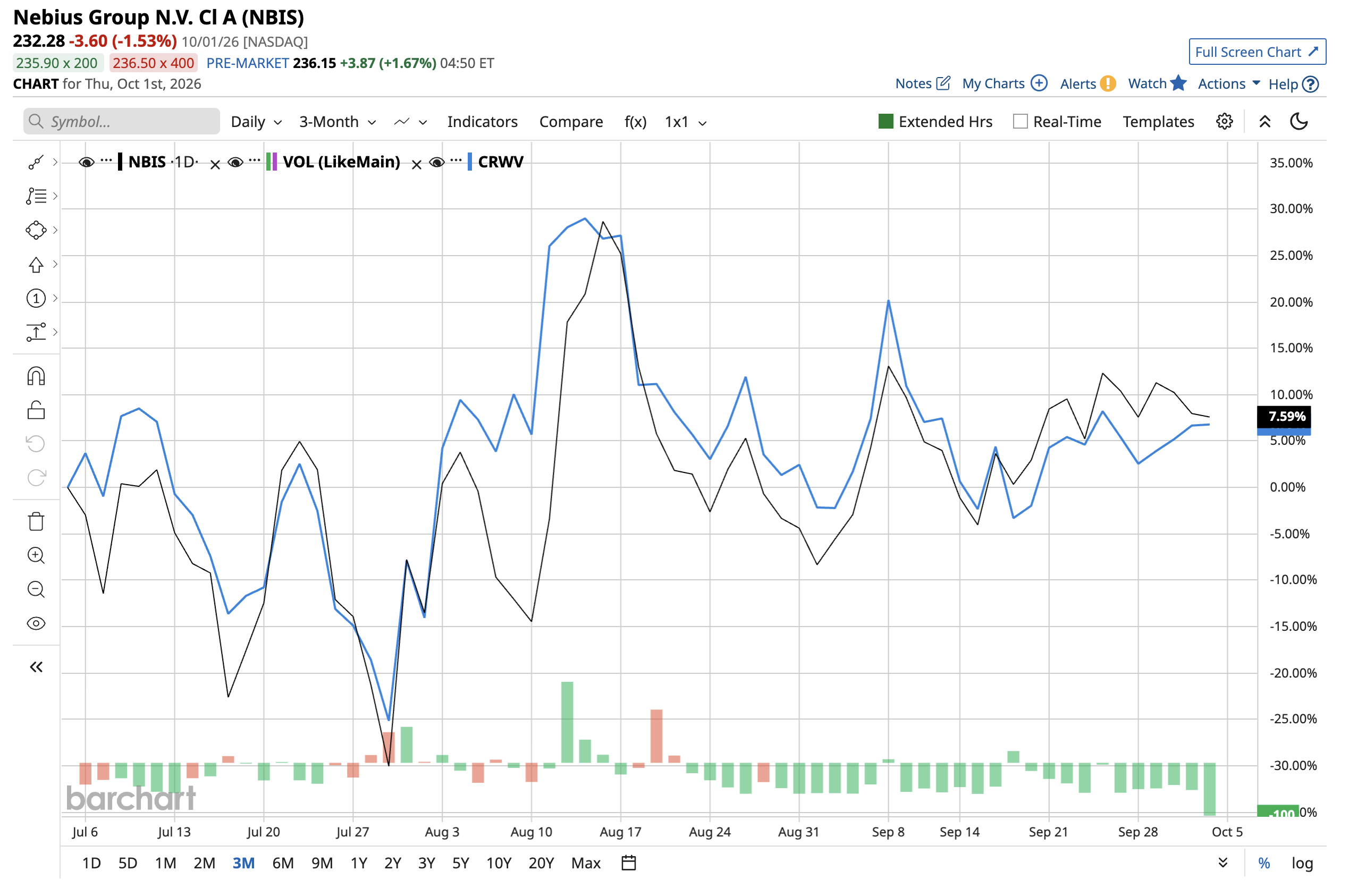
CoreWeave has declined almost 37% over the past year, underperforming Nebius’s gain of 101% during the same period. CoreWeave has been fairly volatile, ranging from $60.55 to $153.29 over the past 52 weeks and sits about 43% below its high. The decline appears tied to the cost of its growth rather than weak demand. CRWV’s second-quarter interest expense reached $640 million, up from $267 million a year earlier. However, Nebius’s gain was primarily driven by large contracts and strong quarterly results. The stock has gained momentum over the past 52 weeks, reaching a high of $283 on June 22. The trend has continued for NBIS this year as well, with the stock up 158% year-to-date.
What Do Analysts Think Of CoreWeave and Nebius Stocks?
Based on 36 Wall Street analysts covering the stock, CRWV holds a consensus “Moderate Buy” rating. Its mean price target of $136 reflects 54% upside from the current share price. Similarly, Nebius also carries a consensus “Moderate Buy” rating from 20 Wall Street analysts. The mean price target of $289 reflects 25% upside from current levels. Nebius has a high price target of $410, whereas CRWV has a high price target of $250.
CoreWeave offers a much healthier upside, but that is because it has fallen a lot owing to the issues it faces. I don’t think all the risks are priced in, and even though the upside looks much better, I am not willing to bet on that so long as its customer issues and debt problems don’t get resolved. Nebius’ 25% upside for me is still quite attractive.
On the date of publication, Jabran Kundi did not have (either directly or indirectly) positions in any of the securities mentioned in this article. All information and data in this article is solely for informational purposes. For more information please view the Barchart Disclosure Policy here.