


The 100 yuan oil price is not that easy to get rid of. The Zhitong Finance App learned that although crude oil flow in the Middle East region has almost returned to the level before the US attack on Iran, global oil prices are still hovering above $100 per barrel, about 40% higher than before the conflict broke out. Even when the Group of Seven (G7) and its partners announced on Friday that they would release up to 100 million barrels of emergency crude oil and diesel reserves, this did not push oil prices down. Instead, a series of problems have combined to keep oil prices high.
Traders are worried that the unresolved war could be rekindled at any time, especially as the US sends an additional aircraft carrier and more troops to the Persian Gulf. Even maintaining the current impasse is risky because Iran has already attacked some ships while trying to control the Strait of Hormuz.
Meanwhile, global crude oil inventories have been drastically depleted and are currently at their lowest level in five years. As a result of the ongoing war between Russia and Ukraine, many refineries that process crude oil into refined fuel are blocked from exporting, so refineries in other regions are willing to pay high prices to lock in the crude oil supply they need to maintain continuous operation.
Furthermore, it is extremely difficult to get crude oil out of the war zone via different shipping routes, which also adds additional costs. Haris Khurshid, chief investment officer at Karobaar Capital LP in Chicago, said: “We have lost supply, consumed inventory, and disrupted our ability to convert crude oil into finished products such as diesel. Getting oil back into circulation will not immediately solve any of these problems.”
Here are five major reasons why the price of crude oil remains above $100 per barrel.
Panic Factors
The market is still worried that the war may escalate. The US and Iran have huge differences over the terms of ending the war. Although the two sides have yet to relapse into full-scale hostilities like this spring, they will occasionally launch attacks against each other. Last month, a drone attack brought Saudi Arabia's East-West oil pipeline to a standstill, highlighting the ongoing risks.
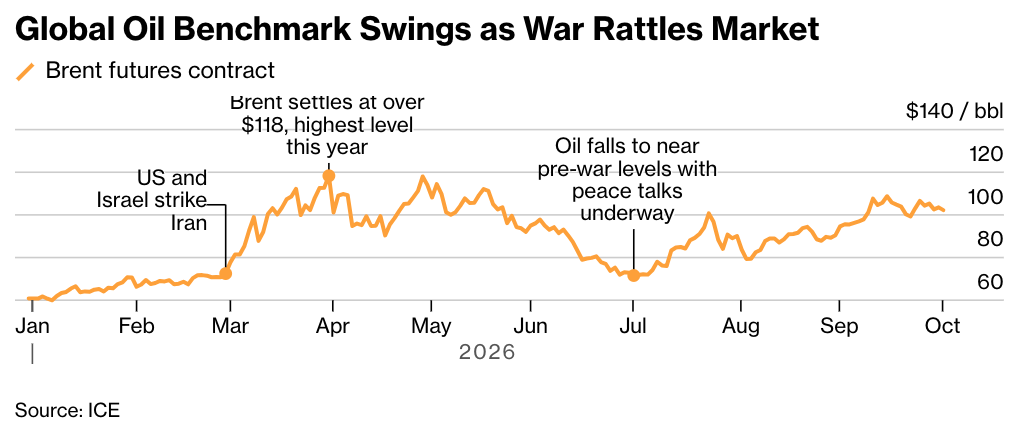
The war stirred up the market, and the global crude oil benchmark price fluctuated sharply
Both Iran and the US are trying to control the Strait of Hormuz as a strategic shipping channel. Before the war broke out, about 20% of the world's crude oil was transported through this strait. Furthermore, the Yemeni Houthis, supported by Iran, have announced a blockade on Saudi Arabian shipping through the Red Hemand Strait, threatening another crude oil transportation route.
According to the latest news, the situation in Yemen has once again escalated. On the 4th local time, Yemeni Houthi military spokesman Yahya Sareya issued a statement saying that the organization launched missile and drone attacks on Saudi Aramco's two facilities in the Riyadh and Khurais regions. The Houthis said earlier that Saudi Arabia launched a series of air raids on Yemen's Al Jawf province on the same day. The day before, the Houthis also claimed that they used ballistic missiles and drones to attack an oil facility in the Saudi capital Riyadh in response to recent Saudi attacks.
On the 4th, Chairman of the Yemeni Presidential Leadership Council and Supreme Commander of the Armed Forces, Rashad Mohammed Alimi, said in a televised address on Yemeni state television in the Saudi capital Riyadh that after several weeks of military mobilization, the Yemeni government officially launched large-scale military operations to recover areas recently controlled by the Houthis. He has ordered the armed forces, security services, and various military forces of the allied forces to begin implementing the combat plan.
Transportation costs
Although some ships are still sailing through these major channels, disruptions to normal shipping have driven up the cost of transporting crude oil to market. Transportation of crude oil out of the Strait of Hormuz is still highly dependent on cross-strait transportation, ship-to-ship transfers, and unconventional routes. Tanker freight rates to transport crude oil from the Persian Gulf to China have set a record — more than $1.2 million a day — further increasing the costs faced by consumers.
Senior crude oil analyst Xuyi Zhao said, “The core problem is that a recovery in supply does not mean that the entire supply system is fully restored to normal. Market pricing takes into account not only how much crude oil is being shipped, but also whether this crude oil can be delivered safely, reliably, and at a lower cost to the destination.”
Inventory has been hit hard
Although crude oil shipments from the Middle East are increasing, global stocks are still being severely depleted due to the war. According to data from consulting firm Energy Aspects, global crude oil inventories are currently around 4.3 billion barrels, and have been reduced by more than 400 million barrels since March — the first full month since the outbreak of the war.
Meanwhile, after experiencing the initial shock of high oil prices, global demand for crude oil has recovered. According to Energy Aspects data, the current total global demand for crude oil is about 104.8 million barrels per day, an increase of 6.5 million barrels per day from the low during the war in May.
fuel crisis
The restoration of crude oil flows will not solve the global shortage of refined fuel supplies, such as the shortage of diesel. Exports from the world's two major refining centers — the Middle East and Russia — are still restricted. As a result, refineries outside these two regions are making every effort to fill the supply gap, but this also means that their equipment has been overloaded for a long time, and if it fails, unplanned production may stop. To ensure a stable supply of crude oil, these refineries are willing to pay whatever price is necessary.
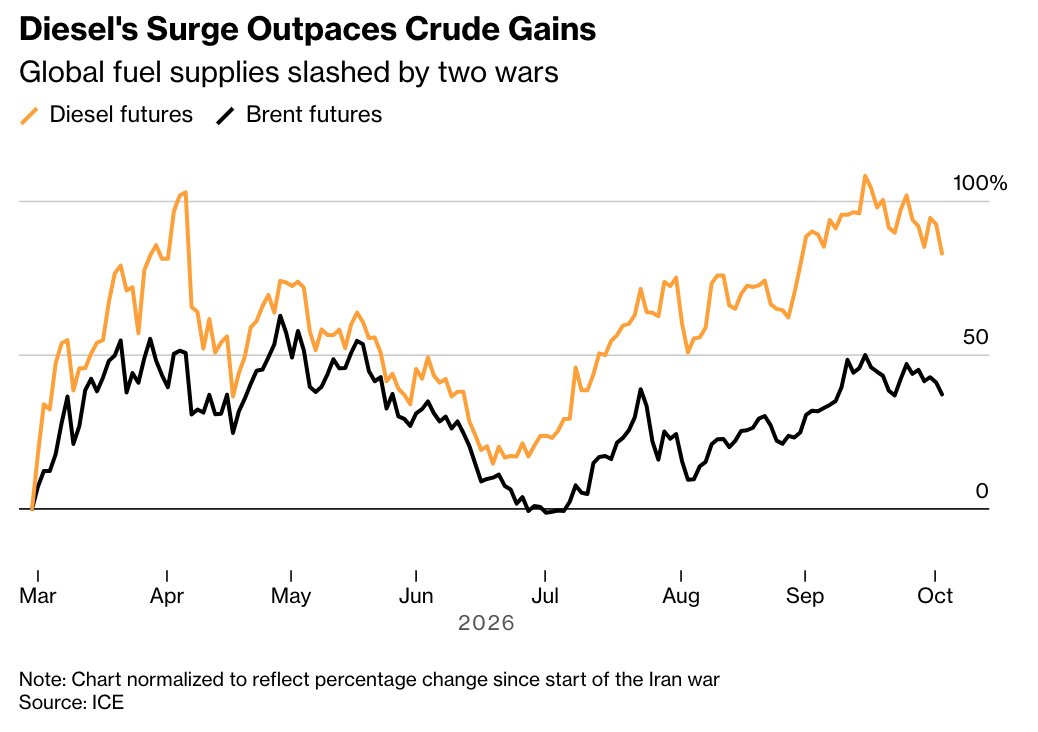
Diesel gains outpaced crude oil gains
Inflation hedging
Central bank officials around the world are discussing the effect of rising fuel prices on inflationary pressure, which may eventually lead to higher interest rates. Traders said that as bond yields continue to rise, in recent weeks, the crude oil market has once again become a hedge against inflation. Although this is not due to actual demand for crude oil, it may also drive up oil prices.