


- Planet Labs PBC reported the recent launch of 20 satellites on SpaceX’s Transporter-18 mission, including Google’s Project Suncatcher demo, the Tanager-2 hyperspectral satellite, and 18 SuperDoves, bringing its historical total to 718 spacecraft built and delivered on orbit.
- The missions extend Planet Labs PBC’s capabilities in on-orbit AI compute, methane and hyperspectral monitoring, and higher resolution Earth imaging, which directly support the company’s push toward higher value, solution-focused services rather than raw imagery alone.
- We will now look at how Planet Labs PBC's Google-backed in-orbit TPU test could influence the company’s broader investment narrative.
Planet Labs PBC Investment Narrative Recap
To own Planet Labs PBC, you need to believe that high cadence Earth data and on orbit compute can mature into repeat, solution driven contracts with large governments and enterprises. The latest launches and Google TPU test fit that story but do not change the near term reality that the business is still loss making and cash hungry.
The key short term swing factor is whether Planet Labs can convert its growing technical stack into more high value solution deals like JSAT while keeping capital spending and dilution in check. The biggest risk remains heavy investment in new fleets and AI experiments that may be slow to translate into monetizable products.
The Pelican 12 update in late September looks tightly linked to the current satellite news. It shows Planet Labs PBC trying to push higher resolution imagery, faster data relay and more on orbit AI through NVIDIA Jetson, while the Suncatcher mission explores TPUs. Together they point to a clear focus on edge compute and latency reduction.
For catalysts, Pelican 12 is operationally important because it targets practical customer needs, such as near real time insights and lower downlink costs, that can support the shift from raw imagery to packaged solutions. Execution risk sits in running many parallel testbeds while still moving towards larger contracts and eventual free cash flow breakeven.
What The Street Is Assuming About Planet Labs PBC
Analysts are effectively sketching a very ambitious arc for Planet Labs PBC. The consensus framework ties the on orbit compute push and higher value solutions to a long runway of top line expansion and a sharp turnaround in profitability over the next several years.
Planet Labs PBC's narrative projects US$791.4 million revenue and US$54.3 million earnings by 2029. This assumes 27.9% yearly revenue growth and an earnings increase of about US$414.2 million from earnings today of a US$359.9 million loss.
The forecasts imply a profit margin shift from a deep loss position toward the average margin level of the broader US professional services peer group. That kind of swing would mean the business not only covers its current cash burn but also generates a material earnings base on which investors would judge the on orbit AI and satellite expansion.
To line up with the current analyst framework, an investor would need to accept that by 2029 Planet Labs PBC is generating roughly US$791.4 million of revenue and US$54.3 million of earnings while the stock trades on a P/E of 347.3x those projected profits. That multiple compares with a much lower current P/E level for the wider US professional services industry. As a result, the story here is less about simple mean reversion and more about paying up for a specific geospatial and AI compute thesis.
There is also a capital structure angle that matters for anyone tracking per share outcomes. The consensus view embeds share count expansion of about 7% a year over the next three years, which would dilute existing holders if it comes through via new equity. On the other hand, the modelled earnings step up to US$54.3 million and earnings per share of US$0.12 by 2029 assumes the extra capital is put to work productively across the Pelican, SuperDove and on orbit compute programs.
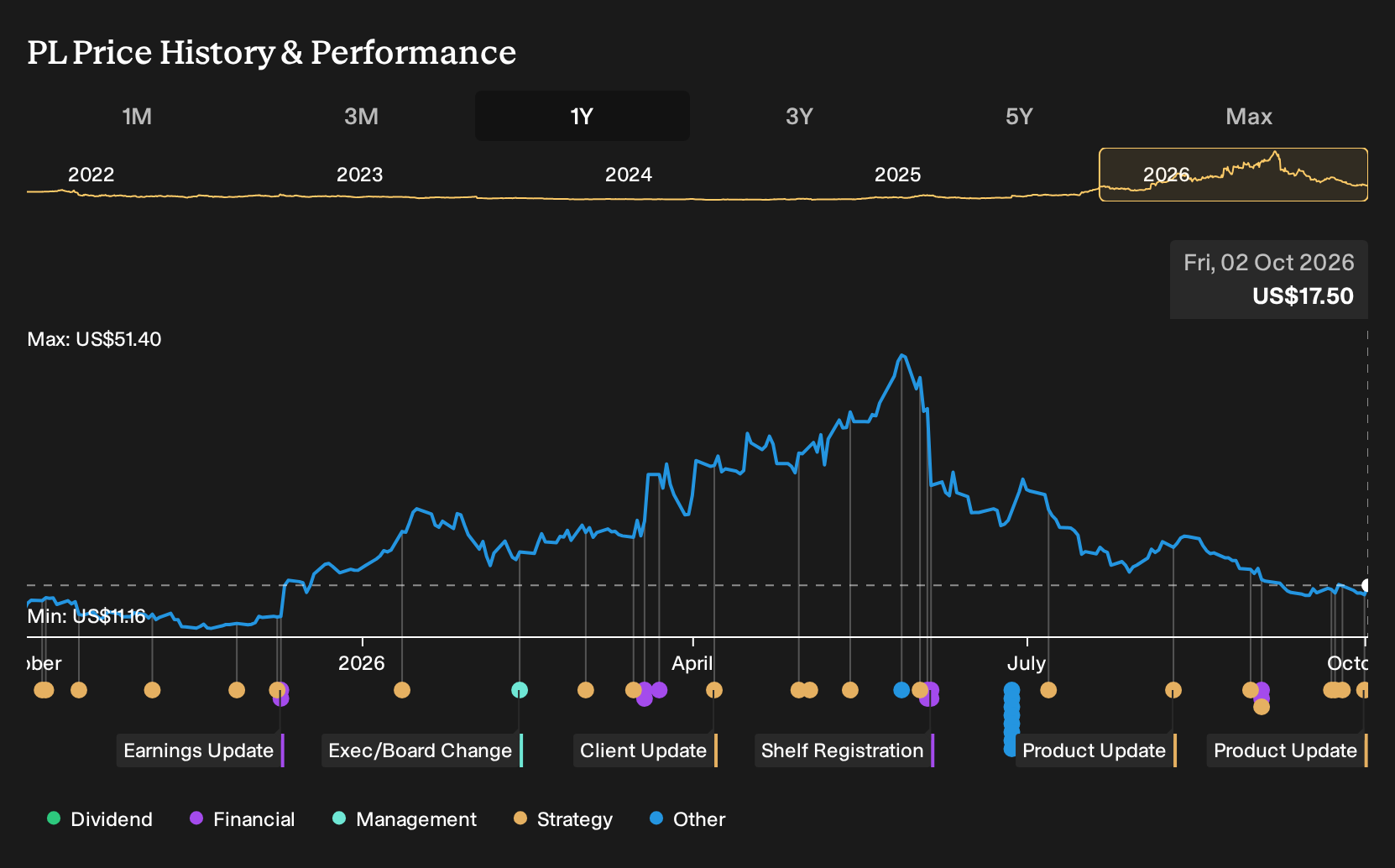
The current price targets try to put all of these moving parts into one number. Analyst views cluster around a US$34.0 handle, with the most optimistic at US$50.0 and the most cautious at US$22.0, compared with a recent share price of US$16.02. Instead of treating that spread as a signal in itself, it can be useful to reverse engineer your own version of the 2029 revenue, margin and satellite deployment path and then see where that would place Planet Labs PBC relative to the Street range.
Discover why Planet Labs PBC's fair value suggests a 94% potential upside to its current price, which could narrow quickly.
Exploring Other Perspectives
One bullish twist you might consider is the backlog story. The most optimistic analysts were already sketching revenue of US$929.8 million and earnings of US$63.0 million by 2029, with a very stretched 439.3x P/E. Those forecasts came before this TPU and hyperspectral launch, so your own view may shift as expectations reset.
Explore 8 other Planet Labs PBC fair value estimates, including one that suggests potential upside of up to 186% from the current price.
Decide For Yourself
Don't just follow the ticker. Dig into the data and build a conviction that's truly your own.
- A great starting point for your Planet Labs PBC research is our analysis highlighting 1 key reward and 3 important warning signs that could impact your investment decision.
- See our latest analysis for Planet Labs PBC. The report includes a comprehensive fundamental analysis summarized in a single visual, the Snowflake, making it easy to evaluate Planet Labs PBC's overall financial health at a glance.
Looking For More Investment Ideas Beyond Planet Labs PBC?
If Planet Labs PBC has sharpened your interest in space, data and AI, it can be useful to put that story next to other opportunities that might suit your risk tolerance and time horizon. The Simply Wall St Screener helps you scan the market using clear fundamentals so you can build a watchlist that matches your own criteria rather than relying only on a single stock.
- If capital preservation sits high on your list, start with companies that screen as more resilient using the 31 resilient stocks with low risk scores. This can help you see which businesses line up with your comfort level.
- For investors who care most about balance sheet strength and solid underlying fundamentals, the list of solid balance sheet and fundamentals (25 results) can surface candidates that keep financial robustness front and centre in your process.
- If you are hunting for less crowded opportunities backed by reasonable quality metrics, the 19 high quality undiscovered gems is a straightforward way to spot potential ideas before they become widely followed.
This article by Simply Wall St is general in nature. We provide commentary based on historical data and analyst forecasts only using an unbiased methodology and our articles are not intended to be financial advice. It does not constitute a recommendation to buy or sell any stock, and does not take account of your objectives, or your financial situation. We aim to bring you long-term focused analysis driven by fundamental data. Note that our analysis may not factor in the latest price-sensitive company announcements or qualitative material. Simply Wall St has no position in any stocks mentioned.
Have feedback on this article? Concerned about the content? Get in touch with us directly. Alternatively, email editorial-team@simplywallst.com