


Sept. 21 showed exactly where the weight-loss drug race stands. Eli Lilly (LLY) CEO Dave Ricks told CNBC that about 700,000 seniors have started weight-loss drugs since Medicare began covering them in July, and roughly 70% chose Lilly. On the same day, Novo Nordisk (NVO) held its investor day in London. CEO Mike Doustdar confirmed that Wegovy and Ozempic will lose their exclusive rights in the early 2030s, opening the door to cheaper copies. Novo’s U.S. shares fell nearly 8% in a single trading session.
Lilly Keeps Pulling Ahead
Lilly held about 61% of the U.S. market for these drugs in the second quarter, against Novo’s 39%. Its weight-loss pill, Foundayo, launched after Novo’s pill. It already wins about a third of new pill patients, and Ricks says that share is growing every week. To me, that sums up where the two companies stand, with Lilly winning even where Novo arrived first.
The risk for Lilly is price. Its U.S. drug prices fell 3% last quarter, and the Medicare program bringing in new seniors only runs through 2027. With the stock up 39% over the last 12 months, much of the good news is already priced in.
Novo Is Trying to Reinvent Itself
Novo is in rebuilding mode. It recently started calling itself simply “Novo” to be more recognizable to consumers. The company has also started exploring new areas like hair loss, addiction, and menopause. Doustdar even admitted that investors' confidence in the company is gone and will take time to win back. I think that honesty is refreshing. But the risk I see is that a new name and early ideas won’t win investors back on their own.
Novo has also asked a court to pull some of Lilly’s ads, claiming they compare the drugs unfairly, and a decision is still pending. Its stock is down 37% over the past 12 months, a sharp contrast to Lilly’s 39% gain.
Overall, Lilly has more to lose if its drug prices keep falling. Still, I’d rather back the company winning new patients today than one still searching for its next big market.
How Have NVO and LLY Stocks Performed?
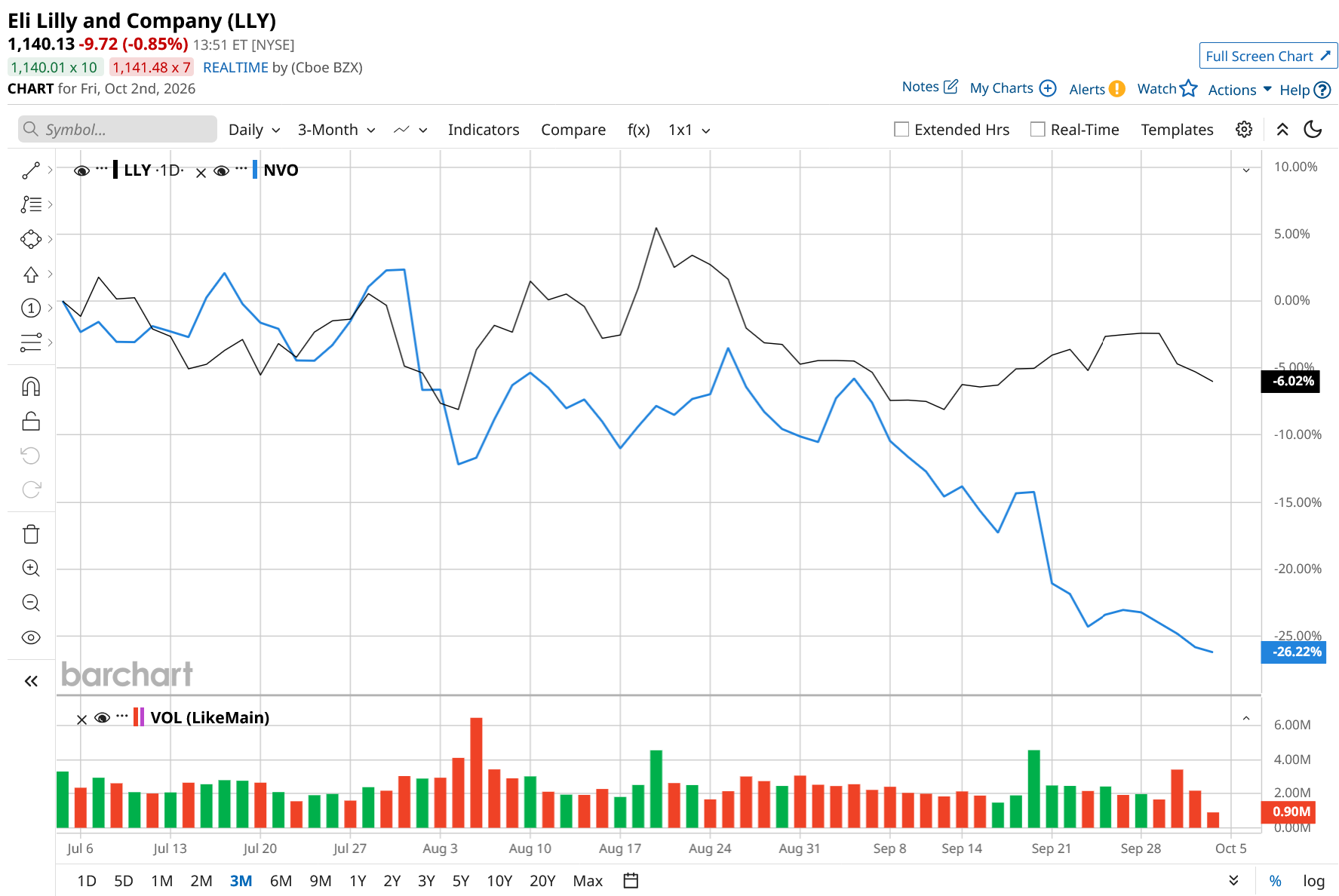
Over the past year, NVO shares have declined 37%, underperforming LLY, which surged 39% over the same period. That gap represents roughly 76 percentage points between two companies selling similar drug classes. Novo rallied into early 2026, then dropped sharply in February, partially recovered, and has slid again since July. The latest driver for NVO’s decline was the Sept. 21 Capital Markets Day. Shares fell about 7% to $40 after the plan failed to deliver the near-term clarity investors wanted, taking the stock to its lowest level since April.
In contrast, LLY’s trend has been choppy but upward. After an early climb from $800 to over $1,100, the stock slid back to a May low near $800. It then rallied to roughly $1,280 in August, backed by strong second-quarter results. Revenue was up 48% to $23 billion, and full-year revenue guidance was raised to $85-87 billion. This suggests that Lilly has been gaining ground in the obesity drug market, while Novo has been losing it.
What Do Analysts Think of NVO and LLY Stocks?
Based on 23 Wall Street analysts covering NVO stock, it holds a consensus “Hold” rating. Out of those, one has a “Strong Buy” rating, 19 have a “Hold” rating, and three have a “Strong Sell” rating. The stock has a mean price target of $46.38, which sits above its current share price. The high price target of $55.23 reflects 48% upside from current levels.
In contrast, LLY stock is being covered by 29 Wall Street analysts and carries a consensus “Strong Buy” rating. The analysts’ mean price target of $1,353.18 reflects a 19% upside from the current share price. LLY’s high price target of $1,600 implies an additional 40% upside from current levels.
Overall, analysts are cautious on Novo despite its upside on paper, and they remain confident in Lilly’s ability to keep growing.
On the date of publication, Jabran Kundi did not have (either directly or indirectly) positions in any of the securities mentioned in this article. All information and data in this article is solely for informational purposes. For more information please view the Barchart Disclosure Policy here.