


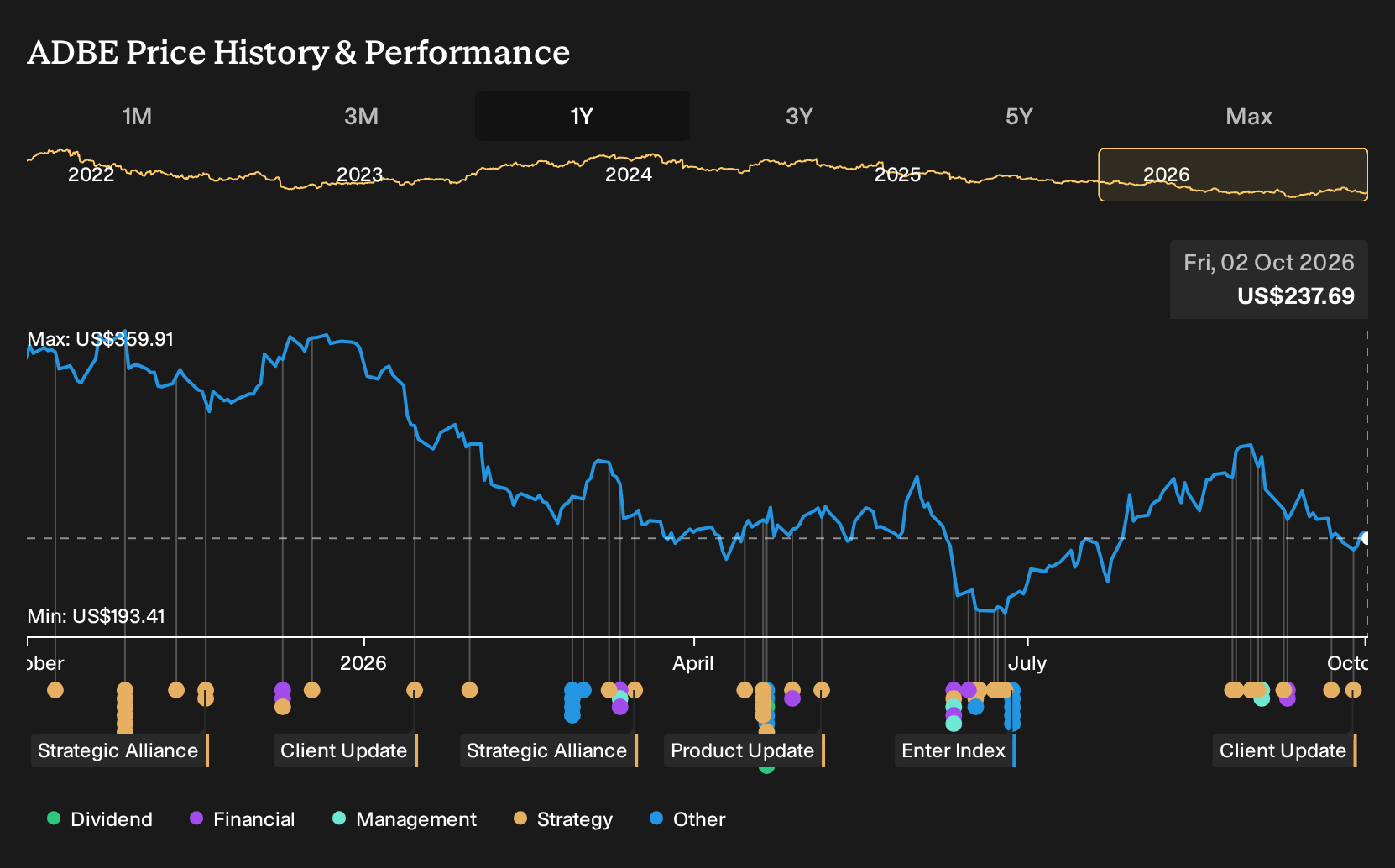
If you had backed Adobe in October 2025 on the promise that Firefly, GenStudio and broader AI tools would reshape marketing workflows and deepen engagement, the outcome over the next twelve months was painful. For Adobe shareholders, the loss over the past year was 32.1%, including dividends. Given that the original bullish case relied on 8.8% revenue growth, a 29.2% profit margin and a 25.1x future P/E, which parts of that thesis did not properly account for the way AI competition and execution risk might pressure those assumptions?
The move put Adobe in the middle of this trade. Scan 38 AI small caps for other companies exposed to it.
The Argument Adobe Investors Were Really Weighing
The shares cost US$351 at the start of the period, and buyers had to decide whether Adobe was an AI-led growth story or a maturing franchise facing pressure.
On the optimistic side, the Firefly and GenStudio pitch implied a Fair Value of US$456. This was essentially the price that 8.8% revenue growth, a 29.2% profit margin and a 25.1x future P/E were assumed to support over three years.
The cautious view set Fair Value at US$317 and treated Adobe as a strong but slowing business. In this scenario, 9.0% revenue growth, a 26.5% profit margin and a 20.0x future P/E assumption reflected worries about AI competition and margin compression over five years.
What The Evidence Did To The Adobe Argument
Adobe rolled out a broad freemium AI push across Firefly and Creative Cloud, plus new agentic tools in CX Enterprise and Acrobat, which supported the bullish idea that AI could deepen engagement. The harder test came from the numbers. Q3 2026 revenue and profit were higher than Q3 2025, yet net margin slipped from 29.6% to 27.0%. The evidence cut both ways.
The key lesson is simple. When an AI story leans on rich profitability, do not just track user counts or new tools. Watch whether net margin stays close to the original thesis and whether management shifts toward freemium models that might trade pricing for reach.
What Adobe's Drop Has Already Priced In
Adobe now trades at US$238, with this Narrative’s Fair Value described as sitting above that level rather than below it. The argument centers on creative pros caring less about raw image generation and more about tightly integrated, legally clean workflows across Adobe’s suite.
For the recent fall to look like an opening instead of a warning, a buyer today would need to believe that this integrated, commercially safe Firefly ecosystem can convert heavy professional use into durable subscription and credit spend over time.
"The prevailing narrative surrounding Adobe Inc. in the mid-2020s has been characterized by a profound sense of technological anxiety. Market participants, driven by the rapid proliferation of standalone generative artificial intelligence platforms, have largely adopted a reductionist view of the creative software industry."
The price and this Narrative do not agree. → Uncover what this Narrative says Adobe is actually worth
Looking One Step Beyond Adobe
Adobe chases creative workflows. Your next move might sit nearer the infrastructure behind AI itself.
Training and running large models needs immense, dependable computing capacity. That demand continues after the model ships into production.
Another business concentrates on cloud infrastructure tailored for demanding AI workloads. It provides clustered compute, storage and networking so customers can operate complex systems at scale.
Those customers also rely on its databases and software layers to keep private data usable and secure with current AI tools.
If that full-stack role expands as AI workloads spread, this quieter corner of the story could become far more important.
That argument has a Narrative and a number behind it. → See the company one Narrative values 174% above its price
This article by Simply Wall St is general in nature. We provide commentary based on historical data and analyst forecasts only using an unbiased methodology and our articles are not intended to be financial advice. It does not constitute a recommendation to buy or sell any stock, and does not take account of your objectives, or your financial situation. We aim to bring you long-term focused analysis driven by fundamental data. Note that our analysis may not factor in the latest price-sensitive company announcements or qualitative material. Simply Wall St has no position in any stocks mentioned.
Have feedback on this article? Concerned about the content? Get in touch with us directly. Alternatively, email editorial-team@simplywallst.com