


Qualcomm (QCOM) has been one of the notable technology stocks to lag the broader market in 2026. The company’s weaker performance largely stems from challenges in its handset business, which accounts for more than half of its overall revenue.
Weakness in Qualcomm’s handset business reflects broader difficulties in the Android smartphone market. Strong investment in artificial intelligence (AI) infrastructure and high-bandwidth memory (HBM) has shifted memory resources toward data center applications, driving up component costs for smartphone manufacturers.
Meanwhile, subdued consumer spending has continued to pressure smartphone demand and shipments. In response, several Android manufacturers, especially those operating in China, have scaled back production.
Qualcomm’s fiscal third-quarter 2026 results highlighted these difficulties. The company reported revenue of $9.9 billion, down 4% from the year-ago period. Its CDMA Technologies (QCT) segment also saw revenue decline by 5%, while handset-related revenue plunged 20% year-over-year (YoY).
Despite these near-term challenges, Qualcomm’s outlook is strengthening. Improving business conditions could provide the catalyst for a meaningful recovery in the company’s earnings and, consequently, its stock price.
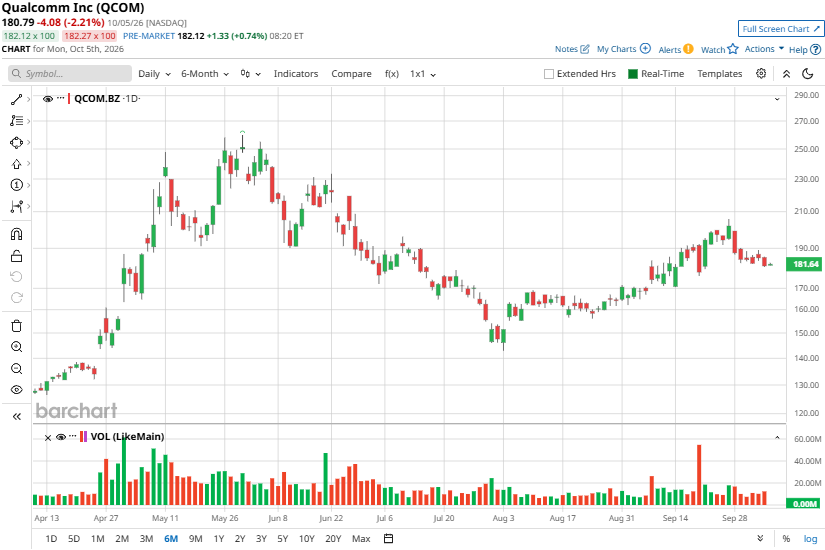
Qualcomm’s Growth Story Is Moving Beyond Smartphones
Qualcomm’s growth story is becoming less dependent on smartphones, which could be an important advantage over the coming years. The handset market remains challenging, but early signs of improvement are emerging. Management expects revenue from Chinese handset manufacturers to increase sequentially from the fourth quarter. At the same time, growing AI use in smartphones could encourage consumers to upgrade their devices, giving Qualcomm’s core handset business some support.
The bigger opportunity, however, lies outside smartphones. Qualcomm is investing heavily in automotive, IoT, data centers, and AI infrastructure, allowing the company to tap into markets with stronger long-term growth potential. It now expects non-handset QCT revenue to exceed $40 billion by fiscal 2029, significantly above its earlier $22 billion target. Automotive and IoT alone are expected to generate more than $24 billion, while data centers could contribute over $15 billion.
Data centers could become a key growth driver for Qualcomm’s future. The company plans to enter the market gradually, starting with connectivity products in fiscal 2026 and expanding into custom silicon and AI accelerators in 2027, followed by server CPUs in 2028.
Qualcomm has already moved two custom-silicon projects into wafer production, with revenue expected to start in the December quarter.
Further, its partnership with Amazon (AMZN) is another significant development. The two companies are working on customized silicon for AI data centers, as well as optical connectivity and technologies for future AI systems. The agreement could create up to $60 billion in revenue opportunities over the next decade. The move also provides a cushion against lower revenue from Apple (AAPL)-related business.
Overall, Qualcomm appears to be making a meaningful shift in its business model. By fiscal 2027, non-handset businesses are expected to account for more than half of QCT revenue, rising to roughly two-thirds by fiscal 2029.
As Qualcomm executes its revenue diversification strategy, it will be less exposed to smartphone cycles while gaining a stronger foothold in faster-growing technology markets.
Load Up on QCOM Stock
Qualcomm’s recent underperformance reflects near-term challenges, particularly in the handset market. However, its transformation into a more diversified semiconductor and technology platform, with significant exposure to automotive, IoT, data centers, and AI infrastructure, positions it well to deliver solid growth ahead.
Management’s significantly higher non-handset revenue targets, expanding automotive and IoT businesses, and planned entry into custom silicon, AI accelerators, and server CPUs could materially change Qualcomm’s earnings profile over the following years. The Amazon partnership further strengthens the company’s position in AI infrastructure and provides a potentially substantial new revenue opportunity.
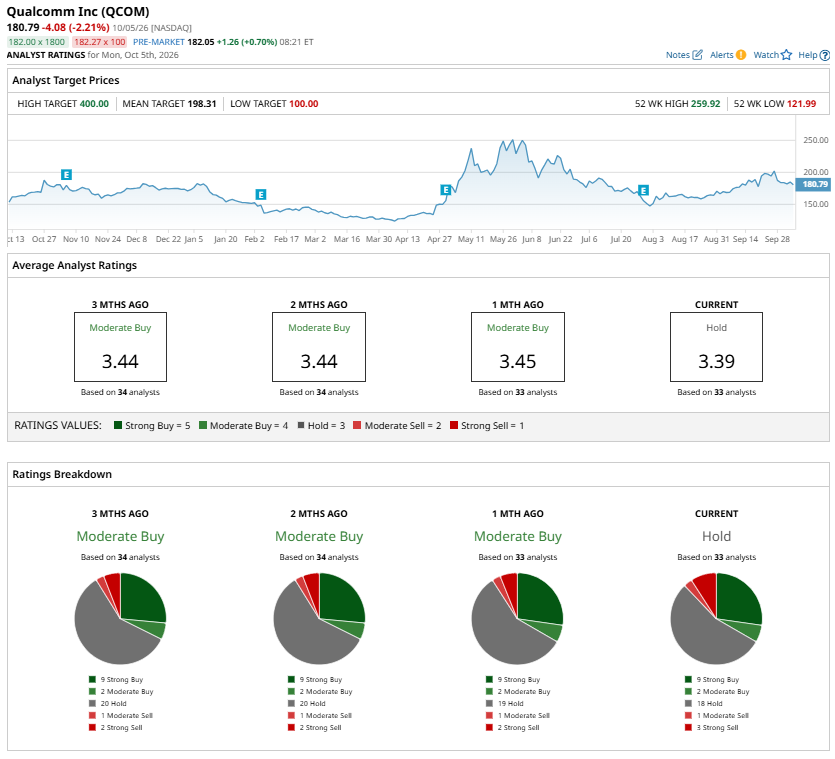
While analysts maintain a “Hold” consensus rating on QCOM stock amid near-term uncertainties, the company’s long-term growth prospects remain compelling. As Qualcomm expands into various high-growth markets, it is a buy ahead of a strong recovery.
On the date of publication, Amit Singh did not have (either directly or indirectly) positions in any of the securities mentioned in this article. All information and data in this article is solely for informational purposes. For more information please view the Barchart Disclosure Policy here.