


Key Points
Nvidia is worth $5.6 trillion, making it the most valuable company in the world.
The company is expanding its data center franchise beyond GPUs as the AI hyperscalers accelerate infrastructure spend.
If Nvidia stock continues to compound, a modest monthly investment could become a multibagger in a few years.
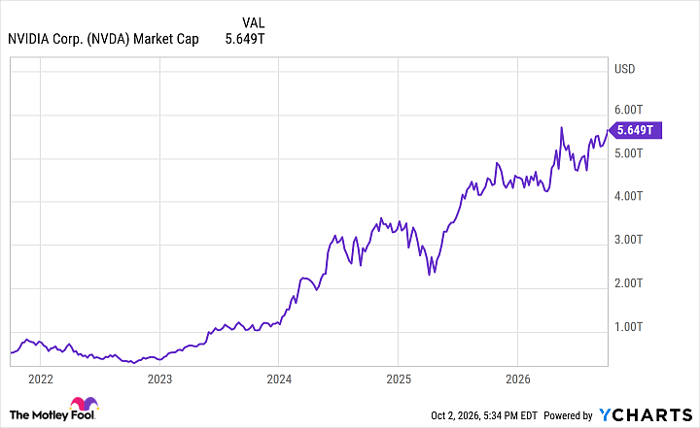
Artificial intelligence (AI) has created some enormous multibaggers for investors, but none are quite on the same level as Nvidia (NASDAQ: NVDA). When ChatGPT helped ignite the generative AI boom in late 2022, Nvidia was worth less than $400 billion. Today, the chipmaker's market capitalization has ballooned to roughly $5.6 trillion -- making it the most valuable company in the world.
Missed AI’s "Act 1"? Act 2 Could Be 15x Bigger. Most investors think they missed the AI boat because they didn't buy Nvidia in 2005. But according to our analysts, we’re only at the end of "Act 1"—the R&D phase. "Act 2" is the global rollout. Continue »
NVDA Market Cap data by YCharts
This parabolic ascent shows how Nvidia evolved from a generic semiconductor company known for gaming GPUs into the undisputed king of AI infrastructure. Let's assess what might happen if you invested $500 in Nvidia every month from now through the end of 2030. Spoiler alert: Big gains could be in store.
How big can Nvidia get?
Before crunching any numbers, I need to come up with a baseline of where Nvidia might be headed over the next several years. The company generated $96.2 billion in revenue during its most recent quarter, representing a staggering 106% increase from the prior year. Even more impressive, Nvidia's data center business generated $89 billion, growing 117% year over year.
The next chapter is already quietly unfolding. Nvidia's Vera Rubin architecture is moving into full production. The company says the platform can deliver 10x the agentic AI throughput of its previous generation Grace Blackwell architecture. This matters because AI spending is moving beyond simply training large language models (LLMs). Reasoning models, AI agents, robotics, and other inference workloads require enormous amounts of continuous computing power.
Meanwhile, infrastructure commitments from big tech are getting larger. The big five hyperscalers -- Amazon, Alphabet, Microsoft, Meta Platforms, and Oracle -- plan to spend approximately $800 billion in capital expenditures (capex) in 2026 alone and roughly $1.3 trillion in 2027. Meanwhile, Anthropic has reportedly committed at least $518 billion to AI infrastructure over the next decade.
Nvidia is also expanding how it can monetize data centers. The company isn't merely selling GPUs anymore. AI factories now combine GPUs with other solutions from Nvidia, including CPUs, NVLink, networking, BlueField data processing units, storage infrastructure, and software platforms like CUDA.
I think complementing the legacy GPU business with adjacent solutions should help Nvidia expand its market share in the data center realm. Against this backdrop, I think the company can rise from a $5.6 trillion market value today to $15 trillion by 2030.

Image source: Nvidia.
What investing $500 a month in Nvidia looks like
An investor putting $500 into Nvidia every month would invest $6,000 over the course of a full year. Assuming the strategy begins in October 2026 and continues through December 2030, the contributions would total $25,500.
Unfortunately, calculating the ending value isn't as simple as multiplying $25,500 by Nvidia's expected return. The reason is because you will be using a dollar-cost averaging strategy over the lifetime of the investment. This means the initial $500 invested in October 2026 has more than four years to appreciate, while a $500 investment made near the end of 2030 has almost no time to compound.
If I assume Nvidia's market capitalization rises gradually from $5.6 trillion to $15 trillion by the end of 2030, that works out to a 163% cumulative increase, or roughly 26% annualized or 1.9% per month when compounded. While this is a bit aggressive, I think it is also a reasonable upside scenario considering it's nowhere near the returns Nvidia generated during earlier stages of the AI boom.
If I run the calculated return across all 51 monthly investments, the $25,500 investment could finish 2030 worth approximately $43,400. That represents roughly $17,900 in investment gains, or 70% upside.
Remember to think long-term
Obviously, no one knows what Nvidia will be worth four years from now. If the company reaches a $10 trillion valuation by the end of 2030, the same $500 per month strategy would grow to roughly $34,400. If the AI infrastructure supercycle sends Nvidia all the way to $20 trillion, the investment could approach $51,600 -- nearly a 100% gain.
The first takeaway here is that Nvidia has enough structural tailwinds to support meaningful share price appreciation over the next several years. The second takeaway is to understand is that my estimates assume Nvidia's share price generally follows a smooth, compounded path toward the 2030 target.
In reality, the stock's movement will almost certainly be messier. This means the price could rise or fall significantly from month to month. That's actually the entire point of dollar-cost averaging: rather than trying to time the market and predict exactly when Nvidia's stock will rise or fall, investors consistently put the same amount of money to work. For someone investing consistently every month, patience will ultimately matter just as much as finding the right opportunities.
Adam Spatacco has positions in Alphabet, Amazon, Microsoft, and Nvidia. The Motley Fool has positions in and recommends Alphabet, Amazon, Meta Platforms, Microsoft, Nvidia, and Oracle. The Motley Fool has a disclosure policy.