


Microsoft’s (MSFT) cloud business is booming, but its PC business has ground to recover. In the quarter ended June 30, Azure and other cloud services revenue jumped 43%, helping push total revenue to $90 billion, up 18% from a year earlier. Windows OEM and Devices revenue, however, fell 7%. That contrast makes the next Windows and Surface announcements worth watching for signs of stronger customer demand.
Microsoft will share its latest Windows and Surface news tomorrow, Oct. 7, at 10 a.m. Pacific time. The event is expected to take place in San Francisco, with CEO Satya Nadella, Windows and Devices chief Pavan Davuluri, and Nvidia (NVDA) CEO Jensen Huang discussing local AI. This expected focus includes the RTX Spark platform, Surface hardware, and Windows experiences designed to run AI directly on devices.
Those features could give customers a reason to upgrade, making demand more important to shareholders than hardware specifications alone. Can Microsoft turn that interest into stronger Windows and Surface sales? Let’s find out.
Microsoft’s Premium Growth
Based in Redmond, Washington, Microsoft develops productivity software, operates Azure cloud services, and sells Windows licenses, Surface devices, and gaming products. Its market capitalization stands at approximately $3,843 billion. Beyond hardware, the company serves consumers and enterprises through subscriptions, infrastructure, and AI tools embedded across its expanding portfolio of digital services.
Microsoft shares finished trading on Oct. 5 at $525.18, delivering a year-to-date (YTD) advance of 8.59% and a more modest 1.51% gain over the prior 52 weeks.
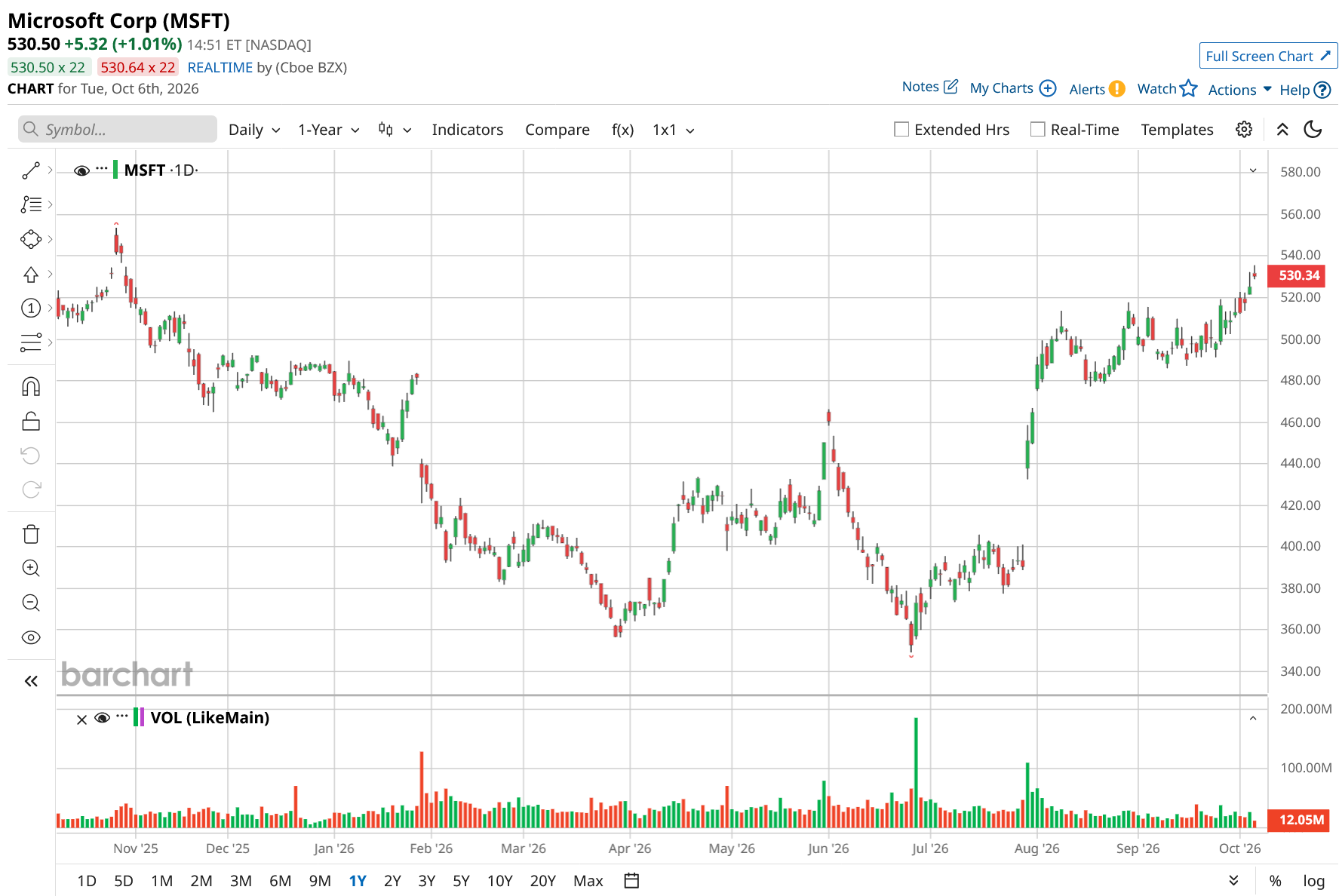
The stock trades at 11.47 times sales and 22.76 times cash flow, well above the sector medians of 3.72x and 18.94x. In addition, shareholders are entitled to a forward annual dividend of $3.64 per share, equating to a current yield of 0.71%.
Microsoft Corp. released its fiscal Q4 2026 results on July 29, covering the June quarter, also described as Q2 CY2026. Their revenue rose 17.7% year-over-year (YoY) to $90.01 billion, beating analysts’ $87.71 billion estimate by 2.6%.
This sales growth accompanied GAAP EPS of $4.81, exceeding the $4.22 consensus forecast by 14.1%. MSFT maintained a 45.1% operating margin, but its free cash flow margin declined to 21.8% from 33.4%, leaving less cash per revenue dollar after capital spending.
Microsoft generated 41.5% of total revenue through Intelligent Cloud, the segment containing Azure and its AI-related computing services. Their segment revenue increased 31.6% YoY, making cloud demand central to the earnings story.
This business delivered 17.9% annualized growth over five years, faster than Microsoft’s consolidated revenue growth. The preceding two years averaged 14.4% annualized growth, making the latest quarterly acceleration particularly notable.
Where Microsoft’s AI Growth Could Come From
Nokia (NOK) expanded its Microsoft partnership on Sept. 17 to develop an agentic, unified data foundation for telecommunications providers. The aim is to help operators automate network tasks and run AI-driven operations more reliably. This creates another enterprise use for Microsoft’s technology, though neither company disclosed the deal’s value or expected revenue.
While that partnership’s financial contribution remains unspecified, Copilot offers measurable evidence of customer demand. Its paid user base exceeded 30 million, and net seat additions more than doubled quarter over quarter. Those subscriptions provide a clearer measure of AI adoption than product demonstrations.
Taken together, these developments show where Microsoft can turn AI demand into revenue through enterprise services, paid subscriptions, and higher cloud prices. Windows and Surface offer another opportunity to connect useful AI features with products customers already use.
Wall Street Sees More Growth Ahead
Microsoft’s next earnings release is listed for Nov. 4, with its September-quarter EPS estimates averaging $4.70, versus $4.13 a year earlier, implying 13.80% growth.
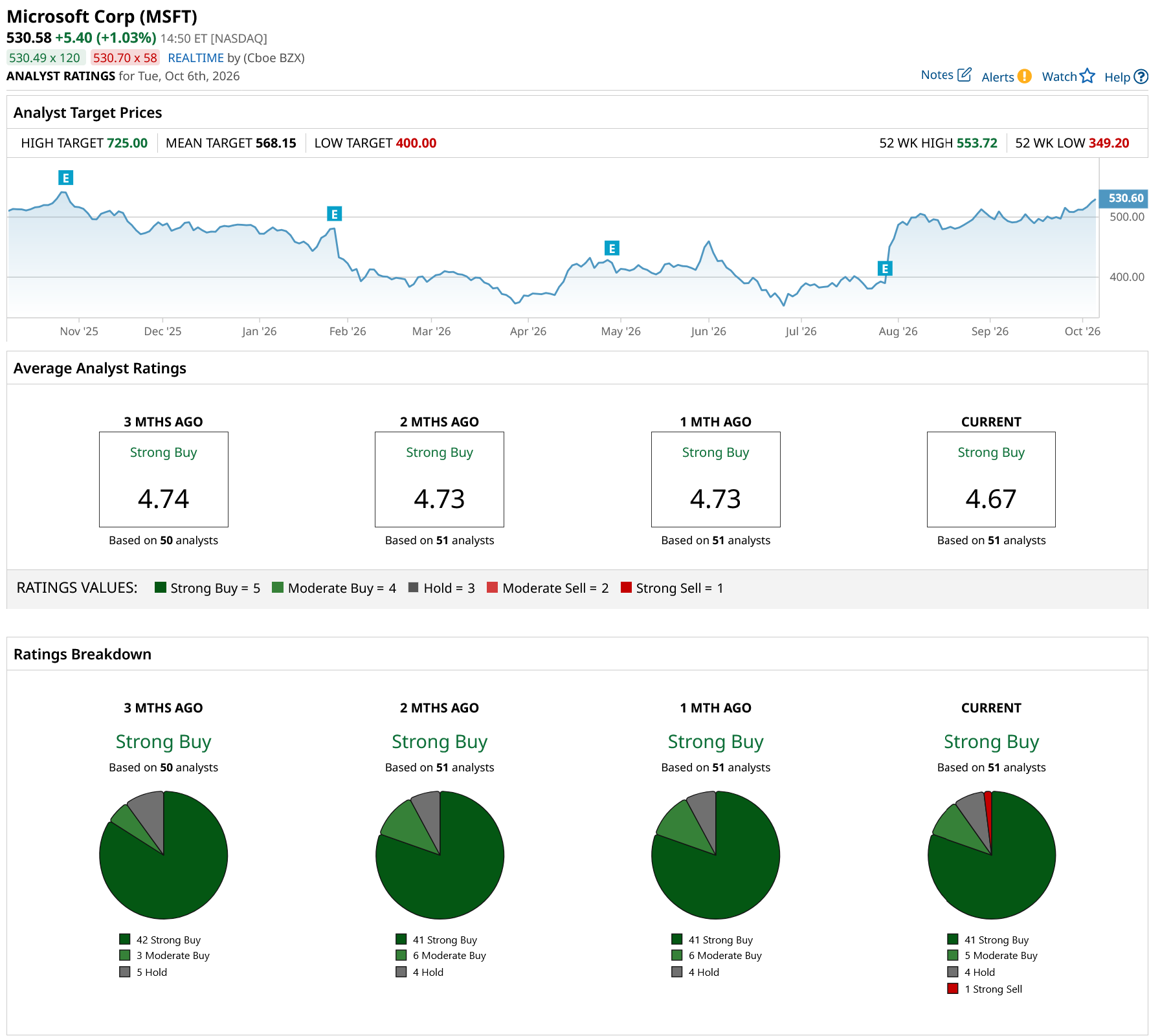
Wells Fargo added Microsoft to its Q4 tactical ideas list with an “Overweight” rating and a reported Street-high $725 target. Analyst Michael Turrin sees attractive valuations and several catalysts supporting his outlook. He expects the new reporting structure to clarify how AI investments translate into revenue.
That optimism extends to other firms. Stifel raised its target to $530 from $450 while maintaining “Hold” in one report. Separately, it upgraded MSFT from “Hold” to “Buy” on Sept. 22, arguing that the company had decisively turned a corner.
Overall, 51 surveyed analysts rate MSFT stock a “Strong Buy,” though that does not mean every analyst recommends buying. Their average $568.15 target implies 7.77% upside from MSFT’s Oct. 5 closing price.
Conclusion
Oct. 7 deserves a spot on Microsoft shareholders’ calendars, but expectations should stay grounded. The Windows and Surface event is more likely to strengthen the existing growth story than immediately change Microsoft’s earnings outlook. Useful AI features could encourage upgrades, though customer adoption will matter more than impressive demonstrations. With analysts already expecting earnings growth, the announcements need commercial substance to support further optimism.
On the date of publication, Ebube Jones did not have (either directly or indirectly) positions in any of the securities mentioned in this article. All information and data in this article is solely for informational purposes. For more information please view the Barchart Disclosure Policy here.