


I will readily and willingly admit that I’m obsessed with getting a 5% return on a portion of my portfolio. It’s becoming a lot easier to achieve without having to invest in U.S. Treasury bonds that go out decades. Check this out for starters:
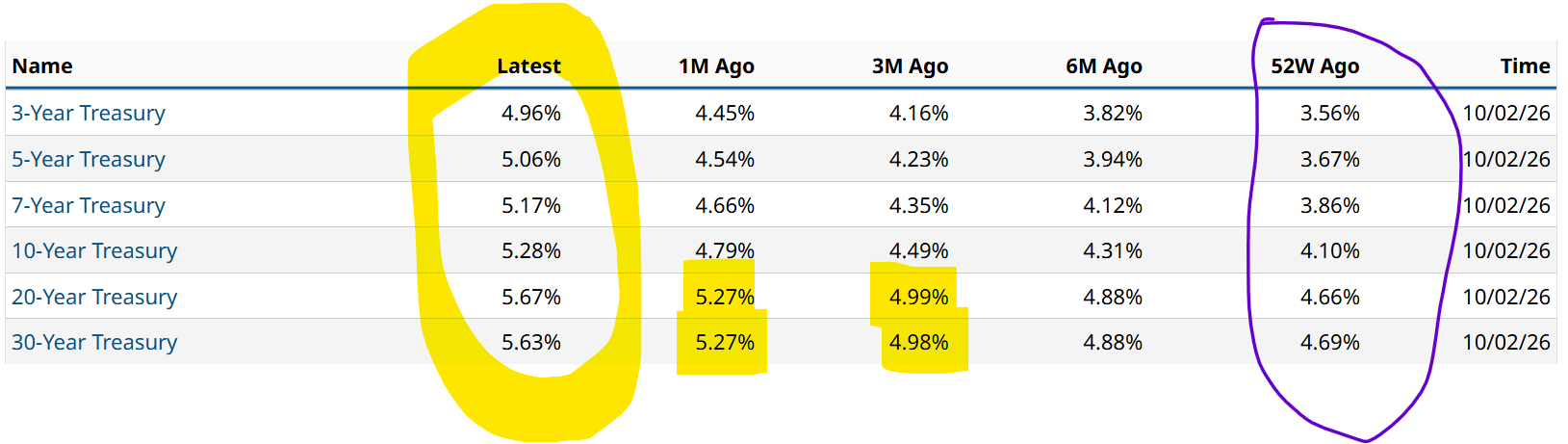
At this time last year, if I wanted 5%, I had to go to the “credit” markets. Corporate bonds, etc.
Now, I can invest with the only entity on the planet that excels at printing money. And while I know there’s a risk that rates can go higher, that 5% might even get closer to 6%. That’s a VERY competitive long-term return, and equity investors need to pay close attention.
Equity markets don’t care, but they should.
Equity markets continue to operate as if fixed income exists in an alternate universe. I’m talking about the headline S&P 500 Index ($SPX), as many stocks underneath are breaking, or at least bending.
But the S&P 500 is touching record valuations. And stock investors act as though rising interest rates and Treasury market volatility are harmless background noise. On the other side of the aisle, bond investors are fixated on federal debt issuance, yield curve twists, and persistent inflation.
The reality? These two markets are inextricably linked by the single most critical variable in capitalism: the price of money.
Ignoring the bond market while holding unhedged equities is dangerous. As I see it, failing to manage risk across both asset classes simultaneously is a recipe for portfolio disaster. And what we receive for sidestepping equity volatility is now 10x what it was earlier this decade.
What Stock Investors Are Ignoring About Fixed Income
For over a decade during the zero-interest-rate policy (ZIRP) era, stock investors didn’t have to care about bonds. When Treasuries yielded 1%, equities were “the only game in town” – or “there is no alternative” (TINA).
Now, that whole game is broken.
First, there’s the vanishing Equity Risk Premium. With 5-year Treasury yields holding above 5% and short-term T-bills paying 4.5%+, risk-free government paper offers a guaranteed income floor. Taking 100% equity risk for an S&P 500 earnings yield sitting near the same level provides zero compensation for downside volatility. But so much money is jammed into the S&P 500, it goes unnoticed. For now.
Then there’s the “Refinancing Wall.” Because corporate debt doesn’t exist in a vacuum. High-grade corporate bond yields over 5.7% and high-yield junk debt above 6.5% mean that companies maturing pandemic-era 3% debt must refinance at nearly double the interest cost. Double! That extra debt service expense comes directly out of earnings, share buybacks, and dividend growth.
Compounding the issue here is the S&P 500 Shiller CAPE ratio. This smooths earnings and adjusts for inflation. I have always considered it a prime market valuation indicator. However, it is slow-moving. Translation: it has been overvalued for a while. At some point, that corrects itself. And equities fall hard.
The CAPE currently sits near 40x. That’s a level seen only at historical market peaks like 1999 and 2021. High equity multiples have historically struggled to survive in an environment of sustained 5%+ interest rates.
What Bond Investors Are Ignoring About Stocks
While equity investors ignore rate risks, fixed-income investors often overlook how equity market concentration impacts credit markets. For the first time I can recall, we have multitrillion-dollar tech companies flooding the investment-grade market with hundreds of billions in debt to build out AI infrastructure.
That crowds out other borrowers, even the U.S. Treasury to some degree. For smaller borrowers, it is many times worse. If equity earnings slow down under these debt loads, the credit market faces rising default risks and widening spreads.
What I’m Doing
I am not settling for 5% with fixed income. I’m using it as a long-term bottom range of my total return. That’s a big difference.
To complement that, I’m taking and rotating small tactical positions in ETFs, and occasionally, some stocks. And the more rates continue to be volatile, the more that acts as another form of return to try to grab. Who says higher returns must come from stock investing? I see it totally differently. All because of what just happened in the bond market. And because of what it might do to stock and bond markets going forward.
Rob Isbitts is a semi-retired CIO, former fiduciary investment advisor, and Barchart columnist. Check out his other work at ETFYourself.com (featuring the Fresh Charts weekly trading post), and ROAR.PiTrade.com, helping investors to better-manage their own portfolios.
On the date of publication, Rob Isbitts did not have (either directly or indirectly) positions in any of the securities mentioned in this article. All information and data in this article is solely for informational purposes. For more information please view the Barchart Disclosure Policy here.