


What Wall Street professionals call a “convexity trade” can sound complex, but I prefer to teach trading in plain English rather than financial Greek. I spent decades as an “investor” but shunned trading, which I defined as owning something less than 6-12 months. Now, I laugh at that old fear of trading!
Because these days, if you wait too long without at least adjusting your position size downward, the gains can disappear or become “dead money” quickly.
Even the mighty SPDR S&P 500 ETF (SPY) has had some extended periods of nothingness. I can live with that in a bear market. But not with the peak long-term valuations and AI-focused hype trading that dominates today’s market.
Convexity: The Other Way to Say ‘Lottery Ticket’
In simple terms, a convexity trade is the investing equivalent of a lottery ticket, except the mathematical odds are closer to a favorite at the racetrack.
This is a trade where your maximum dollar risk is strictly pre-defined and tiny (at the trader’s discretion). However, your potential upside payout can be tremendous. “Take big shots with small amounts of money” is the motto my subscribers have come to know from me.
I do not place these trades because I am certain they will work. I place them when technical setups offer highly favorable risk-reward tradeoffs.
In a market where holding broad equities unhedged carries severe downside risk and my core capital is anchored in 5% Treasury yields, taking “asymmetric” shots with small capital is how you boost overall portfolio returns without risking your lifestyle.
Technical Setup: Trying to Profit From a Late-Cycle Surge
My latest target, just as was the case in this recent article, is the Invesco QQQ Trust (QQQ). While I remain skeptical of this narrow, top-heavy equity market, big-tech momentum remains the single pillar holding up headline indexes.
Here’s what I saw: a breakout in QQQ, after about a four-month trading range. Will it stick? I don’t know. But as I’ve written here many times, risk management comes in different forms. In this case, I’m “going for it” but with only enough money that I’d be OK losing 100% of what I traded.
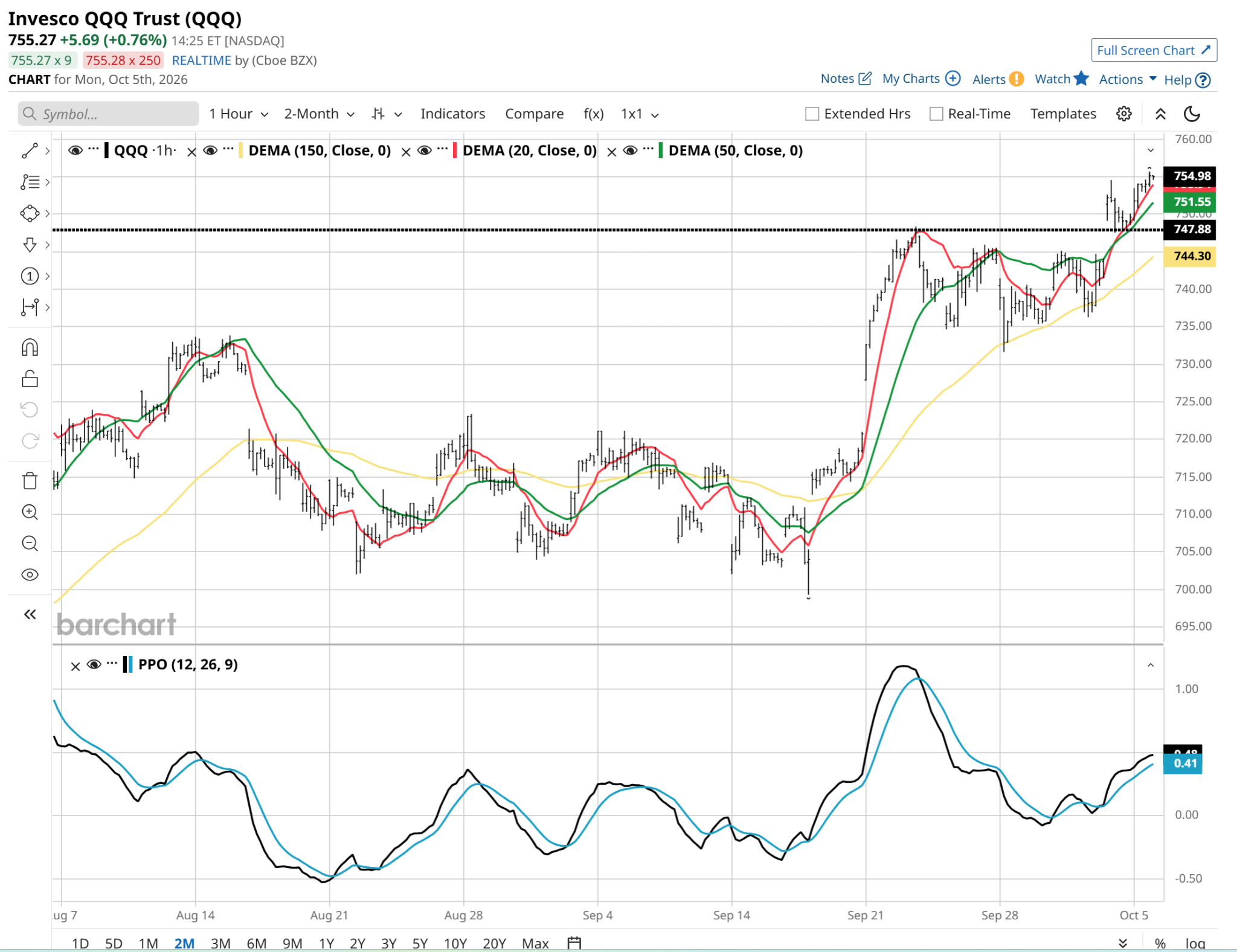
With QQQ trading near $753, I executed a defined-risk option position risking a total of $300:
Leg 1 ($780 Calls): Purchased 2 call option contracts expiring October 16, controlling 200 shares of QQQ at a $780 strike price.
Leg 2 ($790 Calls): Purchased 3 call option contracts expiring October 16, controlling 300 shares of QQQ at a $790 strike price.
The Maximum Loss
If QQQ trades flat or rolls over through expiration, the total capital lost is about $300. The total cost of the option premiums. On a $100,000 portfolio, risking $300 represents a 0.30% allocation. That is how much QQQ fluctuates multiple times in a single trading session. And probably during the time it took me to write this article!
A $7,000 payout on a $300 cash risk represents a 23.3x capital multiplier (a 2,233% net gain). That’s a longshot. But even doubling my money is a good trade. And for that to occur, I don’t need much of a move. A single 2% single-day jump in QQQ causes option implied volatility and delta sensitivity to expand rapidly. That allows us to take partial profits, bank core principal, and roll the remaining exposure forward risk-free.
You can read about all of those mathematical aspects on Barchart.com. I continue to approach this as more of an “options caveman” if you will. I just know this: if QQQ rallies from here, the fact that I essentially control 500 shares of QQQ, and it trades at $750 or so is a “notional” value of $375,000 right now.
These options are well out of the money, but my point is that’s a lot of potential value… for a $300 investment. Take that, over-leveraged hedge funds! To me, this is a form of leverage, but without the nasty side effects.
I don’t know if QQQ will surge or stall out. But by combining a 5% fixed-income return floor (which can also fly higher if rates sink eventually) with small convexity trades, you maintain total control over your downside while keeping the door open for explosive upside.
Rob Isbitts is a semi-retired CIO, former fiduciary investment advisor, and Barchart columnist. Check out his other work at ETFYourself.com (featuring the Fresh Charts weekly trading post), and ROAR.PiTrade.com, helping investors to better-manage their own portfolios.
On the date of publication, Rob Isbitts did not have (either directly or indirectly) positions in any of the securities mentioned in this article. All information and data in this article is solely for informational purposes. For more information please view the Barchart Disclosure Policy here.