


Trade relations between the U.S. and China just took a small but important step toward warmth, and coal exporters are suddenly part of the story again. A 30-for-30 tariff framework and China’s stated appetite for at least 10 million metric tons of U.S. coal in 2027 and 2028 create fresh questions about where future export flows might run. This article breaks down three U.S. listed coal related stocks exposed to that news, outlining where some investors may see opportunity and where caution could also be justified.
The three U.S. coal related stocks in this piece are a starting sample only, while the full screen surfaced 10 more listed businesses with equally detailed coal export narratives that are not covered below. To identify and analyze those additional tickers directly, head straight into the U.S. Coal Exporters to China screener.
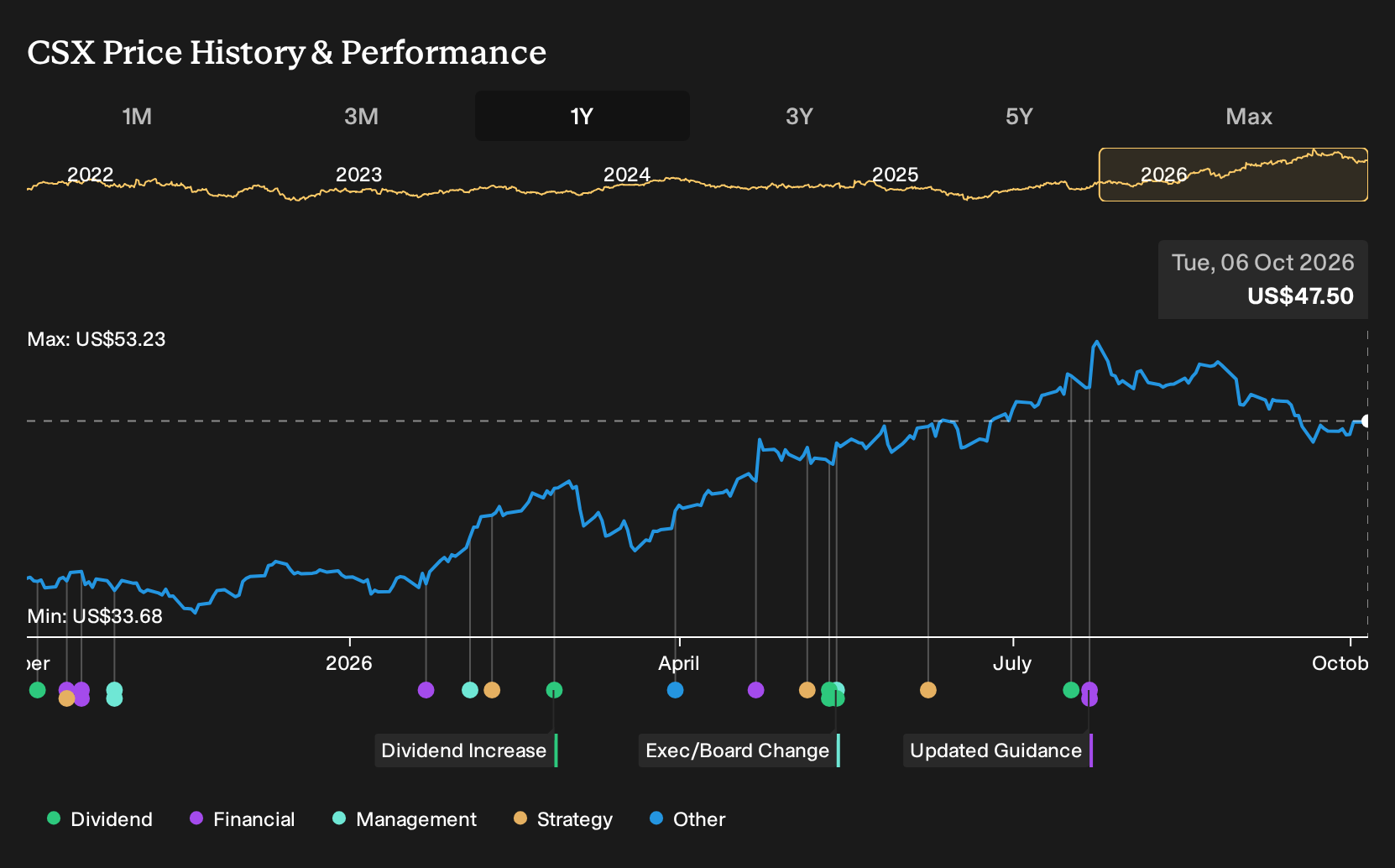
CSX (CSX)
Overview: CSX runs a large rail and intermodal network that hauls coal and other bulk freight to U.S. deep water export terminals.
Operations: CSX generates about US$13.7b from rail services and US$847 million from trucking, with a small intersegment elimination.
Market Cap: US$87.9b
CSX matters in this coal exporters theme because its tracks and terminals help move U.S. coal toward the seaborne trade routes that China is eyeing.
"Expansion of intermodal services and truck to rail conversions, supported by faster service and new corridors such as the SMX with CPKC and the Port of Virginia to Indianapolis route, should increase unit volume and fuel surcharge revenue, which can add to overall revenue and operating income."
What happens to CSX profit margins if a single key assumption about future bulk export flows and network capacity does not hold?
If that margin swing matters to you, read the full narrative for CSX to see how CSX’s coal corridors, pricing power and capital plans could be decoupling beneath the surface.
Peabody Energy (BTU)
Overview: Peabody Energy is a large U.S. and Australian coal miner supplying seaborne and domestic thermal and metallurgical coal to power and steel customers.
Operations: Peabody Energy generates about US$1.2b from Seaborne Metallurgical, US$1.1b from Powder River Basin, US$876 million from Seaborne Thermal, and US$731 million from Other U.S. Thermal segments.
Market Cap: US$3.1b
Peabody Energy matters for this coal exporters theme because its seaborne mines already feed the global trade routes that any extra Chinese demand would plug into. That exposure is where the pricing story really starts to get interesting.
"Sustained tightness in seaborne coal markets, with premium hard coking coal averaging US$238 per ton and Newcastle 6,000 kcal thermal coal averaging US$137 per ton in Q2 2026, continues to support pricing for Peabody Energy’s export volumes and can feed through to stronger net margins from the seaborne segments if similar conditions persist."
For investors watching Peabody Energy, the real swing factor now is how one unresolved production and cost pressure shapes those future margins.
That unresolved pressure is exactly where Peabody Energy’s story can start to accelerate once you read the full narrative for Peabody Energy and consider what might be masking beneath the surface.

Core Natural Resources (CNR)
Overview: Core Natural Resources produces, sells and exports metallurgical and thermal coal from U.S. mines to power and steel customers worldwide.
Operations: Core Natural Resources generates about US$2.2b from High CV Thermal, US$1.3b from Metallurgical and US$693 million from PRB, with roughly US$2.5b from export markets.
Market Cap: US$4.5b
Core Natural Resources matters for this U.S. Coal Exporters to China theme because it is one of the clearest pure plays on seaborne U.S. coal flows. It is backed by its own export terminal footprint and a mix of metallurgical and thermal volumes that can adjust toward whichever overseas buyers are paying higher prices.
"Core Natural Resources produces, sells and exports metallurgical and thermal coal to customers in the United States and international markets."
What happens to Core Natural Resources margins if a single export-driven pricing assumption on those contracted tons fails to hold?
That single assumption is the hinge. Read the full narrative for Core Natural Resources to see how Core Natural Resources export exposure could be quietly accelerating or masking bigger risks.

Curious About Smarter Alternatives?
Fresh ideas move first. Breakout stories gain momentum while they are still under the radar for now. Do not get caught watching prices fly. Act now.
- Chase reliable income streams by scanning dividend payers that aim to keep cash coming in with the 7 dividend fortresses.
- Spot early tech momentum and track profit potential before the crowd turns its attention to the 91 AI infrastructure stocks.
- Hunt for mispriced opportunity while these potential bargains still trade below the radar with the 26 high quality undervalued stocks.
This article by Simply Wall St is general in nature. We provide commentary based on historical data and analyst forecasts only using an unbiased methodology and our articles are not intended to be financial advice. It does not constitute a recommendation to buy or sell any stock, and does not take account of your objectives, or your financial situation. We aim to bring you long-term focused analysis driven by fundamental data. Note that our analysis may not factor in the latest price-sensitive company announcements or qualitative material. Simply Wall St has no position in any stocks mentioned.
Have feedback on this article? Concerned about the content? Get in touch with us directly. Alternatively, email editorial-team@simplywallst.com