


- Recent announcements show Nasdaq extending its Calypso AI framework across capital market and treasury workflows, while HSBC and Aapryl LLC each disclosed new uses of Nasdaq platforms and data in derivatives clearing and institutional manager analytics.
- The same Nasdaq infrastructure that powers trading and clearing is now being embedded deeper into client decision tools. This can influence adoption, stickiness, and the economics of its broader Financial Technology and data franchises.
- We will now explore how Nasdaq's new Calypso AI operating environment could shape the existing investment narrative around its technology growth ambitions.
Nasdaq Investment Narrative Recap
To own Nasdaq, you need to believe the company can keep turning its market infrastructure, data, and AI tooling into recurring software like revenue without letting costs run away. The near term swing factor is execution on high spend programs in Financial Technology, while expense guidance is already higher. Softer demand could compress margins quickly.
The main risk is that investors keep paying a premium P/E for Nasdaq even though forecast revenue and earnings growth sit below the broader US market. The latest AI and data partnerships may support the thesis around stickier technology usage, but on their own they do not materially change the risk and reward balance yet.
The Nasdaq Calypso AI operating environment looks most relevant. It plugs AI agents directly into trading, risk, and collateral data in a governed way, and recent wins like HSBC’s broader adoption and Aapryl’s eVestment integration show that the same plumbing is being reused across more workflows rather than built in silos.
For the stock, the catalyst is whether this AI and cloud infrastructure becomes a true second engine alongside listings and trading. Wider deployment can support the Financial Technology segment that already recorded 15% revenue growth and 16% ARR growth in Q2 2026. Any stumbles on delivery, security, or client adoption would feed back into the existing concerns around higher spend and margin pressure.
What The Current Nasdaq Forecasts Assume
Nasdaq's current analyst narrative anchors around forecasts that revenues reach US$7.1b and earnings land at US$2.5b by 2029. That path reflects 7.9% yearly revenue growth, with earnings expected to move from US$2.0b today to US$2.5b, a US$0.5b increase in aggregate profit.
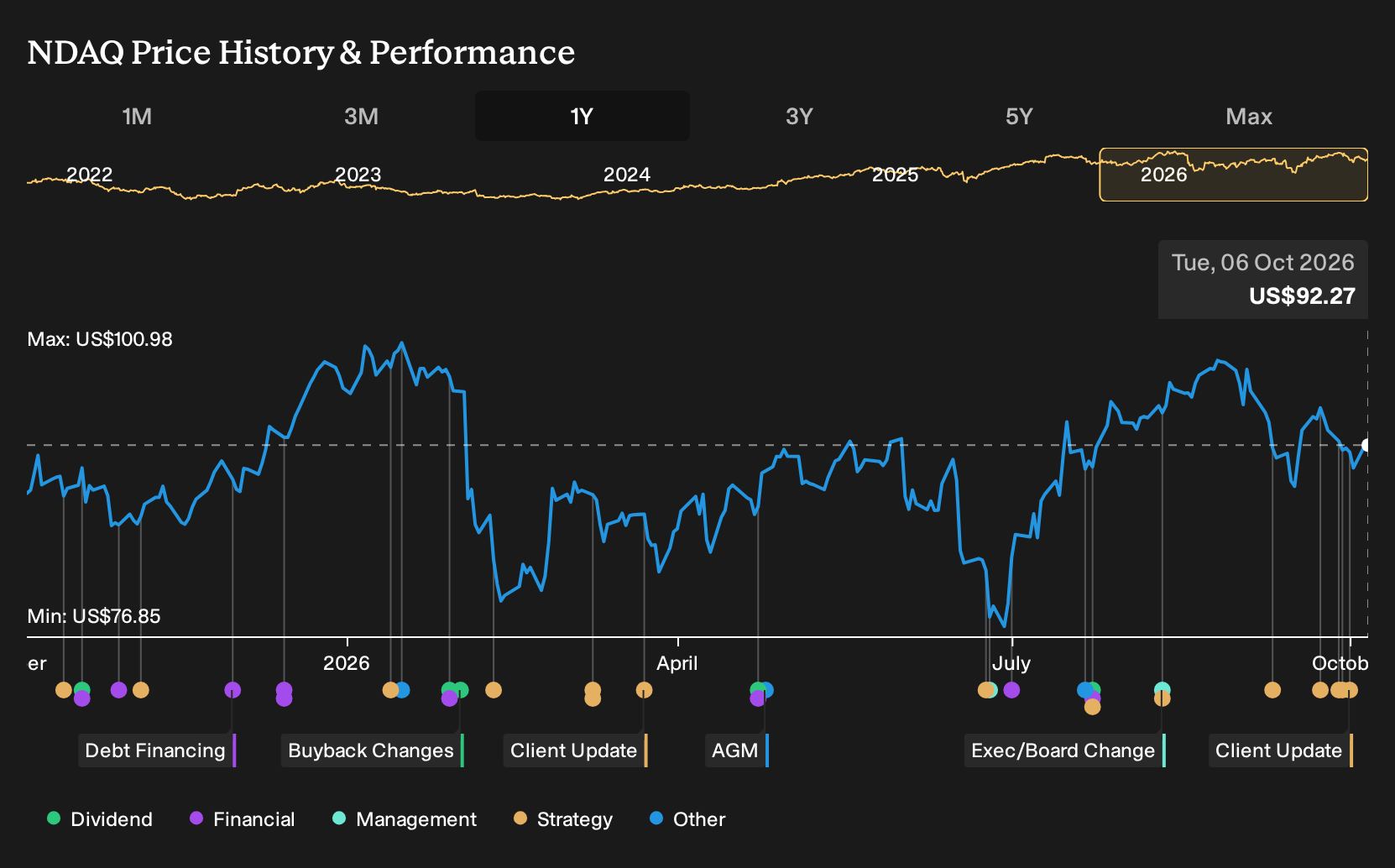
Uncover why Nasdaq's fair value indicates a 19% potential upside to its current price that could narrow quickly.
Exploring Other Perspectives
The Simply Wall St Community has posted four fair value views on Nasdaq, ranging from about US$87.10 to US$109.67 per share. That spread shows how far opinions can stretch. When you set those against rising spend on AI infrastructure and data partnerships, you can reach very different conclusions about future resilience. Use these contrasting angles to pressure test your own view.
Explore 3 other Nasdaq fair value estimates, including one that suggests as much as 6% downside from the current price.
The Verdict Is Yours
Don't just follow the ticker; dig into the data and build a conviction that's truly your own.
- A great starting point for your Nasdaq research is our analysis highlighting 3 key rewards and 2 important warning signs that could impact your investment decision.
- See our latest analysis for Nasdaq. The report includes a comprehensive fundamental analysis summarized in a single visual, the Snowflake, making it easy to evaluate Nasdaq's overall financial health at a glance.
Looking for more ideas beyond Nasdaq?
Once you have a handle on Nasdaq, it can help to widen the lens and compare it with other opportunities that match your preferred balance of quality, valuation, and risk.
- If you want to focus on companies that combine quality with what may be more modest valuations, scan through a curated 27 high quality undervalued stocks to see which ones deserve a closer look.
- For readers who care most about income resilience, filter for steady payers using a set of 8 dividend fortresses that might suit a more cash flow focused portfolio.
- If capital preservation comes first for you, concentrate on a 31 resilient stocks with low risk scores that score well on financial strength and business stability.
This article by Simply Wall St is general in nature. We provide commentary based on historical data and analyst forecasts only using an unbiased methodology and our articles are not intended to be financial advice. It does not constitute a recommendation to buy or sell any stock, and does not take account of your objectives, or your financial situation. We aim to bring you long-term focused analysis driven by fundamental data. Note that our analysis may not factor in the latest price-sensitive company announcements or qualitative material. Simply Wall St has no position in any stocks mentioned.
Have feedback on this article? Concerned about the content? Get in touch with us directly. Alternatively, email editorial-team@simplywallst.com