


When Nvidia (NVDA) reported its second-quarter fiscal 2027 results, the company commanded a gross margin of 75%. This, in itself, is the biggest validation of its moat. Nvidia's innovation edge coupled with strong demand has already translated into healthy margins and cash flows. From an investment perspective, the key question is whether Nvidia can maintain that edge and continue to be the biggest beneficiary of the artificial intelligence (AI) infrastructure buildout.
Given the addressable market of the AI revolution, there are bound to be challengers. For example, DeepSeek recently released an AI chip software developed with Huawei. This collaboration aims at technology that can replace Nvidia's own solutions. The new toolkit is open-source and includes TileLang, which some consider to be China's response to Nvidia's CUDA.
However, this development is unlikely to have much of a negative near-term impact on Nvidia. After all, the company’s exports to China have already been restricted and NVDA stock has discounted that factor. Only small shipments of Nvidia’s H200 chips currently reach China.
At the same time, the capital expenditures of hyperscalers continue to be the biggest driver behind Nvidia’s growth story. For Q2 fiscal 2027, hyperscale contributed $48.7 billion of revenue. That kind of business will be difficult to disrupt, and even if Nvidia's CUDA moat takes a hit, the impact will take awhile to manifest. Therefore, Nvidia stock remains attractive amid these developments.
About Nvidia Stock
Headquartered in Santa Clara, California, Nvidia is a world leader in AI and accelerated computing. The company commands a market capitalization of $5.75 trillion and has been at the center of the AI infrastructure boom. Nvidia operates two business segments — Compute & Networking and Graphics — with its data-center business being the key growth driver of its compute segment.
Nvidia has been on a robust growth trajectory. For the first half of fiscal 2027, the company reported top-line growth of 96% year-over-year (YOY) to $177.8 billion. Further, with healthy margins, Nvidia reported operating cash flow of $74.4 billion for the same period.
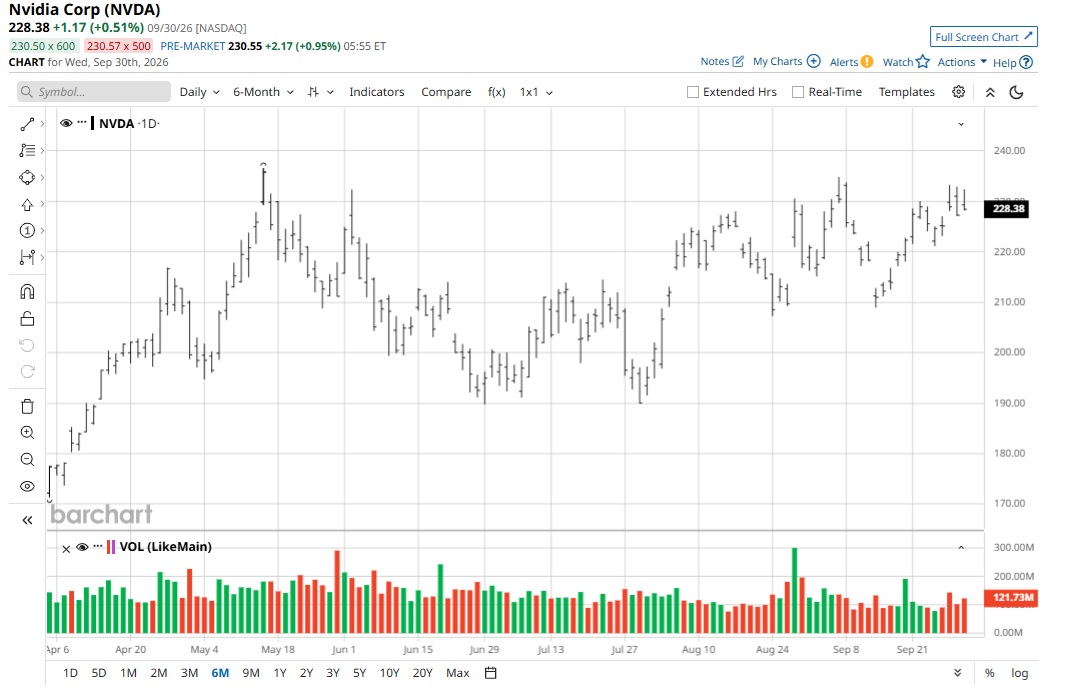
According to JPMorgan, cumulative AI infrastructure spending is likely to reach between $5 trillion and $7 trillion by the end of the decade. Given the structural industry tailwinds, Nvidia is well-positioned to benefit. Accordingly, with strong growth and a positive industry outlook, NVDA stock has trended higher by 35% in the last six months.
Nvidia Has Clear Growth Momentum
Nvidia’s current price action is a function of stellar growth, cash flow upside, and structural industry tailwinds. It’s worth noting that Nvidia has already commenced production of Vera Rubin. That will likely be the biggest catalyst for the company in the coming quarters.
While growth in fiscal 2027 has been robust, Nvidia has indicated that revenue is likely to grow by 70% in fiscal 2028 — and that is also a supply-constrained outlook. Therefore, Nvidia stock should remain in an uptrend as cash flows continue to swell and shareholder returns accelerate through both dividends and buybacks. With its strong balance sheet and cash flows, the company also has ample flexibility to invest in innovation-driven growth.
Notably, NVDA stock trades at a forward price-to-earnings (P/E) ratio of 25.3 times. Considering the potential growth trajectory, its valuation is not stretched.
What Do Analysts Say About Nvidia Stock?
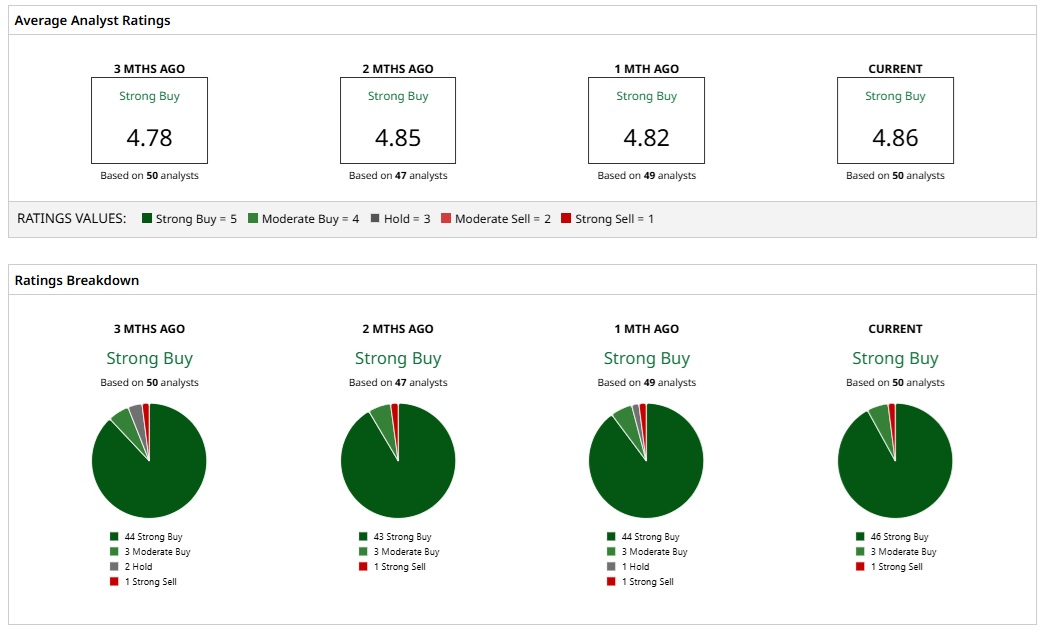
Based on 50 analysts with coverage, NVDA stock has a consensus “Strong Buy” rating on Wall Street. While 46 analysts have a “Strong Buy” rating for the stock, three have a “Moderate Buy” rating, and one analyst has a “Strong Sell” rating.
The mean price target of $327.15 represents potential upside of 37% from current levels. Further, the most bullish price target of $515 suggests that NVDA stock could climb as much as 115% from here.
On the date of publication, Faisal Humayun Khan did not have (either directly or indirectly) positions in any of the securities mentioned in this article. All information and data in this article is solely for informational purposes. For more information please view the Barchart Disclosure Policy here.