


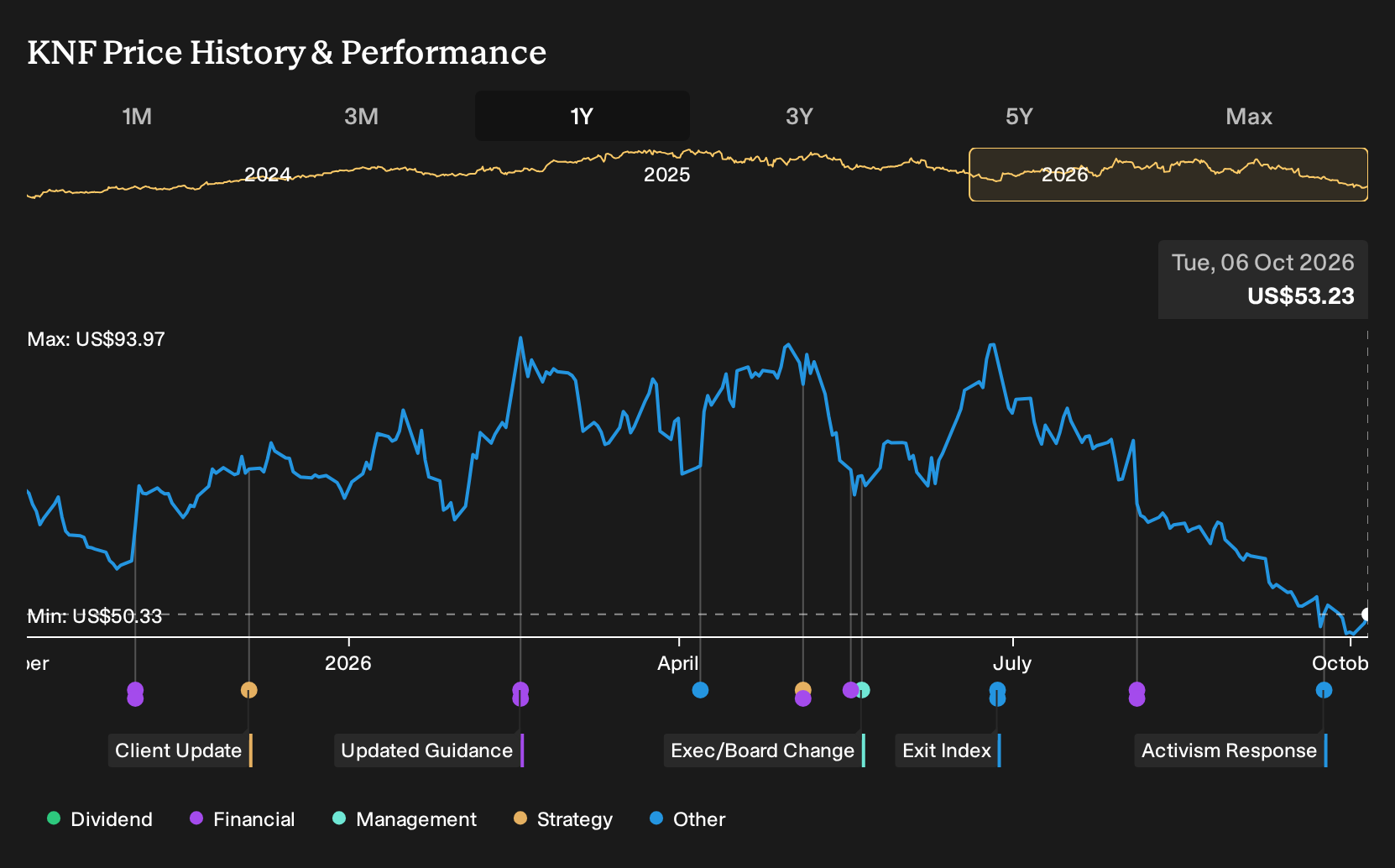
- Knife River responded to Starboard Value's disclosed investment and prior letter, saying the board and leadership welcome shareholder input and intend to engage with the activist while continuing to pursue its EDGE initiatives around pricing, efficiency, and margin improvement.
- The company framed Starboard's arrival as compatible with its aggregates-led, vertically integrated model that combines materials and contracting services, which management argues is key to long term value creation through disciplined capital allocation and operational discipline.
- We will look at how Knife River's investment narrative interacts with Starboard's activist involvement and management's emphasis on shareholder engagement.
Knife River Investment Narrative Recap
To own Knife River, you need to believe its aggregates-led, vertically integrated model can turn a large public infrastructure backlog into steadier earnings, even with weather issues and regional funding friction. The near term focus still sits on execution of pricing, cost work and mix shift, not on the Starboard letter itself.
The short term catalyst many holders watch is margin recovery, given net margin sits around 4.2% and was higher last year. The biggest risk remains execution pressure from weather, public funding exposure and acquisition integration. The new activism headline does not immediately change those operational swing factors.
The September 24 statement responding to Starboard ties directly into these execution themes. Management leaned on its EDGE program, which targets pricing discipline, efficiency gains and margin improvement across aggregates, ready mix, asphalt and contracting. That is the operational playbook investors already track.
For you as a shareholder, the practical question is whether this engagement helps sharpen Knife River’s focus on backlog quality, capital allocation and return on equity, which is currently described as low and forecast to remain modest. Any shift in priorities that slows pricing work or integration of past deals could matter more than the activist presence itself.
Knife River Analyst Scenario At A Glance
Analysts sketch a fairly specific picture for Knife River. Their base case ties together moderate top line expansion, a lift in profit margins, and a higher valuation multiple by the end of the decade.
On the revenue side, consensus assumes Knife River grows sales by 5.6% each year over the next three years. That pace sits at the center of the current story because it underpins both the record public infrastructure backlog and the ability to absorb fixed costs more effectively.
Profitability expectations build on that. Forecasts reference net margin moving from about 4.2% today to 5.2% in three years, helped by pricing work, a mix shift toward aggregates, and the EDGE efficiency playbook that management keeps highlighting, including in its response to Starboard.
Earnings estimates line up with that margin path. Current earnings are described at roughly US$139.9 million. Consensus points to earnings of US$201.2 million by 2029, with a more cautious camp modeling US$178.0 million, which gives a clear sense of the range of outcomes being debated.
On those US$201.2 million forecast profits, the analyst framework implies Knife River trading at a P/E of 31.4x in 2029. That compares with a P/E of 21.7x today and an industry marker around 18.7x, so the story does not just rely on fundamentals. It also leans on investors being willing to pay a higher multiple for the stock than they do today.
Valuation work in the same report pulls everything together into a revenue line of US$3.9b and earnings of US$201.2 million in 2029. The current consensus target price of US$85.38 is 37.5% above the recent share price of US$53.37, with individual targets spread between US$62.00 and US$118.00.
Knife River's narrative projects US$3.9b revenue and US$201.2 million earnings by 2029. This assumes 5.6% yearly revenue growth and about US$61.3 million earnings increase from US$139.9 million today.
Uncover why Knife River's fair value indicates a 60% potential upside to its current price before that valuation gap starts to close.
Exploring Other Perspectives
For Knife River, the biggest swing factor in the alternate story is slower earnings progress if EDGE gains get eaten up by higher labor and equipment costs. The most cautious analysts were penciling in only 2.9% annual revenue growth to about US$3.6b and earnings of US$165.6 million by 2029 before this Starboard news. Some of those views may evolve as the engagement unfolds, so weigh them carefully against your own assumptions.
Explore another Knife River fair value estimate, including one that suggests there could be as much as 30% downside from the current price.
Form Your Own Verdict
Don't just follow the ticker. Dig into the data and build a conviction that's truly your own.
- A great starting point for your Knife River research is our analysis highlighting 1 key reward and 1 important warning sign that could impact your investment decision.
- See our latest analysis for Knife River. The report includes a comprehensive fundamental analysis summarized in a single visual, the Snowflake, making it easy to evaluate Knife River's overall financial health at a glance.
Looking for more investment ideas beyond Knife River?
Once you understand where Knife River fits in your portfolio, it can help to line it up against other opportunities using the Simply Wall St Screener so you see the trade offs clearly.
- If you want a wider margin of safety, scan a 27 high quality undervalued stocks that match your quality and valuation filters.
- For investors who care most about balance sheet strength, compare Knife River with a list of solid balance sheet and fundamentals (25 results) that can better withstand tough cycles.
- Income focused portfolios can pick through a 8 dividend fortresses that aim to combine higher yields with resilience.
This article by Simply Wall St is general in nature. We provide commentary based on historical data and analyst forecasts only using an unbiased methodology and our articles are not intended to be financial advice. It does not constitute a recommendation to buy or sell any stock, and does not take account of your objectives, or your financial situation. We aim to bring you long-term focused analysis driven by fundamental data. Note that our analysis may not factor in the latest price-sensitive company announcements or qualitative material. Simply Wall St has no position in any stocks mentioned.
Have feedback on this article? Concerned about the content? Get in touch with us directly. Alternatively, email editorial-team@simplywallst.com