


Microsoft (MSFT) has been in focus after Wood Mackenzie plugged its energy and natural resources intelligence directly into Microsoft Copilot, allowing professionals to query sector research and data through natural-language prompts inside existing workflows.
For shareholders watching Microsoft, that Wood Mackenzie Copilot plug-in arrives after a strong price run, with the shares delivering a 37.7% 90-day share price return and lifting the latest share price to $529.30, while the 1-year total shareholder return sits at 1.7%. This points to short-term momentum that contrasts with a far more modest recent long-run payoff.
Spot 91 AI infrastructure stocks that, like Microsoft, are plugged directly into the AI workflow buildout behind tools such as Copilot and enterprise data platforms.After a 37.7% 90‑day surge that leaves Microsoft at $529.30, analyst targets cluster higher at $587.63 while one intrinsic value gauge sits lower. So where does a reasonable fair value anchor for this move lie?
Most Popular Narrative: 26% Overvalued
Against the latest $529.30 close, the most followed narrative on Microsoft pegs fair value at $419.91, which implies the recent rally has pushed the share price ahead of that anchor according to CubanEros.
Microsoft rarely goes on sale, so it's worth paying attention when the multiple compresses. At around $380, the stock trades at roughly 22 to 23x trailing earnings and ~14x EV/EBITDA, well below its own seven year historical range. This is the cheapest Microsoft has been in years, and the de-rating looks more like a capex cycle worry than a deterioration in the business.
Returns on equity sit around 33% and returns on invested capital around 21%, the balance sheet is effectively net cash, and the enterprise/cloud moat, Azure, the Office and Windows franchise, and AI-platform optionality through Copilot and the OpenAI stake, remains as good as anything in large-cap tech. Operating income has been remarkably steady even as headline GAAP earnings bounce around on non-operating swings tied to the OpenAI investment.
See why 257 investors see Microsoft as 26% overvalued.
Result: Fair Value of $419.91 (OVERVALUED)
Still, the Microsoft thesis faces pressure if AI data center capex fails to earn solid returns, or if Copilot style tools see slower enterprise adoption than expected.
Find out about the key risks to this Microsoft narrative.
Another View On Microsoft’s Valuation
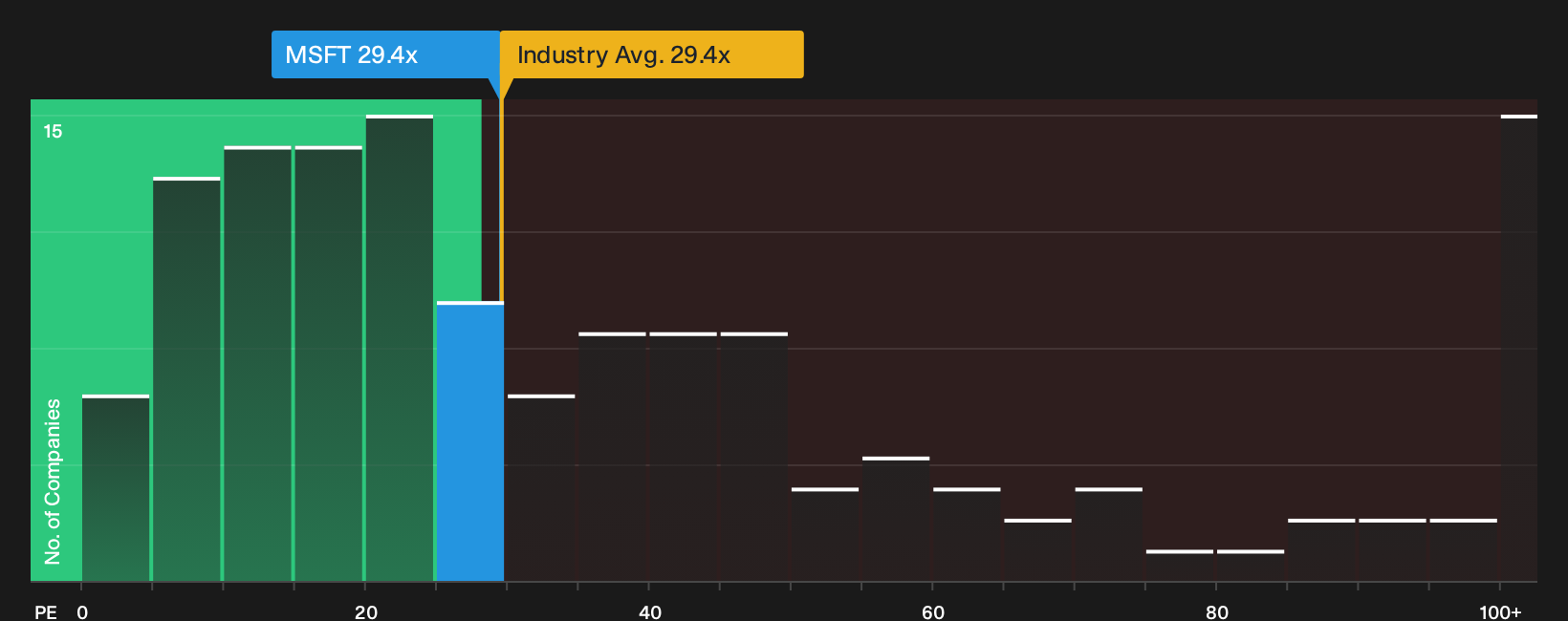
A different lens puts Microsoft on a leaner footing. The current P/E of 29.4x matches the US Software average of 29.4x but sits below a fair ratio of 49.9x, and above a peer average of 26.6x. That mix points to balanced valuation risk rather than a clear premium or discount. So which anchor would you trust when volatility returns?
See what the numbers say about this price — find out in our valuation breakdown.
Next Steps
If this mix of enthusiasm and caution around Microsoft feels familiar, you may want to test the numbers yourself and decide where you land. To see the balance of potential upside and the issues holders are watching, review the 2 key rewards and 1 important warning sign.
Looking for more Microsoft-style investment ideas?
Do not stop your research with Microsoft alone. Use the Simply Wall Street Screener to surface other opportunities that fit your style before the next move passes you by.
- Target potential mispricing by scanning a curated set of 27 high quality undervalued stocks that combine solid fundamentals with room for market sentiment to catch up.
- Prioritise resilience by focusing on 31 resilient stocks with low risk scores that score well on financial strength and business stability when conditions get choppy.
- Hunt for future leaders early by reviewing 19 high quality undiscovered gems that have strong underlying metrics but limited market attention so far.
This article by Simply Wall St is general in nature. We provide commentary based on historical data and analyst forecasts only using an unbiased methodology and our articles are not intended to be financial advice. It does not constitute a recommendation to buy or sell any stock, and does not take account of your objectives, or your financial situation. We aim to bring you long-term focused analysis driven by fundamental data. Note that our analysis may not factor in the latest price-sensitive company announcements or qualitative material. Simply Wall St has no position in any stocks mentioned.
Have feedback on this article? Concerned about the content? Get in touch with us directly. Alternatively, email editorial-team@simplywallst.com