


- Qualys reported a strong Q2, with revenue up 11% year over year and profitability remaining solid as its cloud platform gained traction with customers managing IT assets and cyber risk.
- The earnings release highlighted how Qualys' unified cloud-based security platform is capturing demand from organisations seeking consolidated tools to manage vulnerabilities across hybrid and multi cloud environments.
- We will now examine how Qualys' investment narrative could shift in light of this Q2 revenue strength and solid profitability.
See how Qualys' Q2 performance compares to other security focused stocks by reviewing our hand picked 31 resilient stocks with low risk scores that pair resilient balance sheets with disciplined execution.
Qualys Investment Narrative Recap
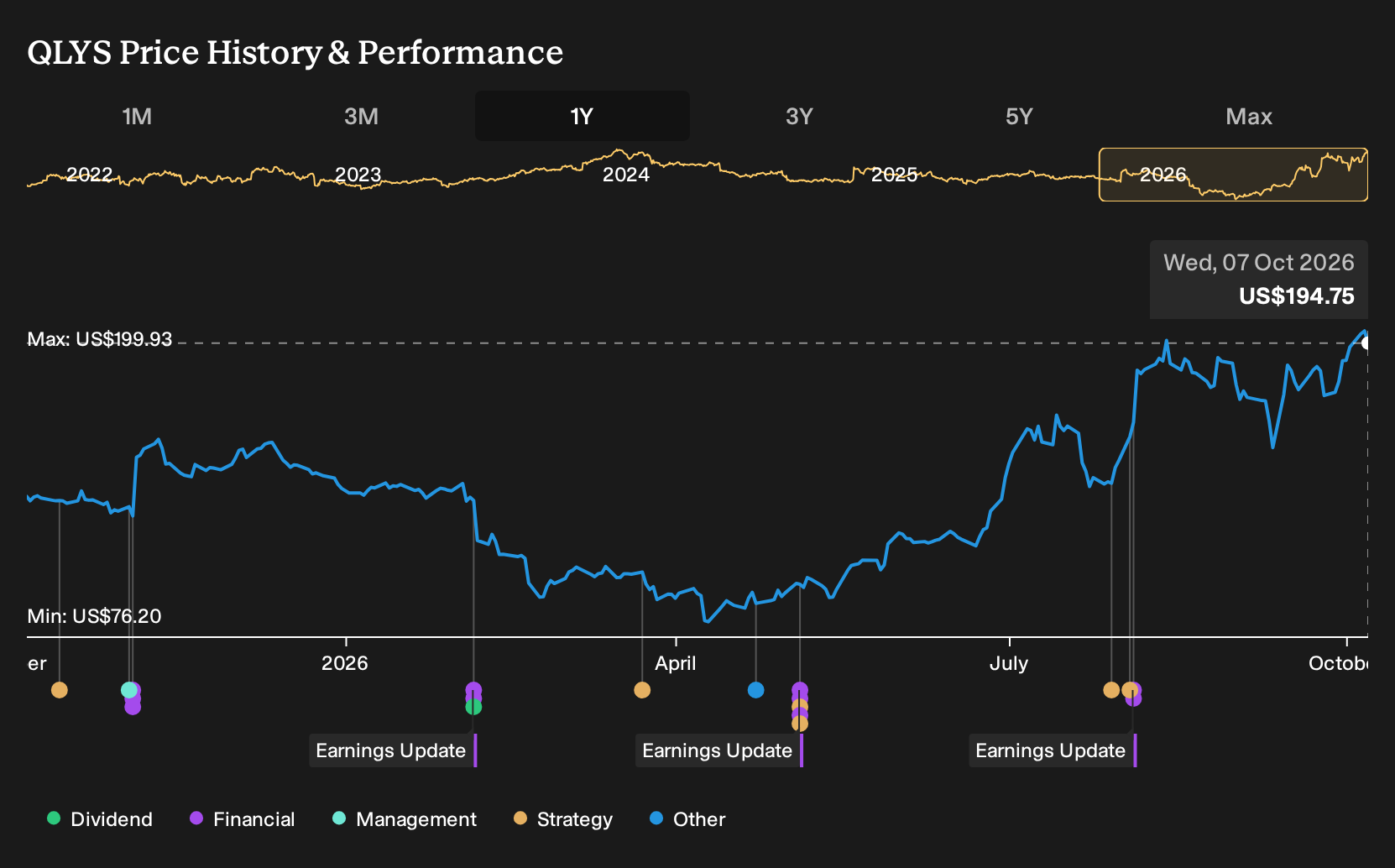
To be comfortable owning Qualys, you need to believe its cloud security platform can keep attracting workloads as organisations centralise risk management across on premises, cloud, and hybrid setups. The Q2 print, with 11% revenue growth and a more than 20% move in the share price, suggests the TruRisk platform and broader suite are resonating with customers right now.
For the near term, the key swing factor is whether that demand turns into sustained bookings as Flex pricing, AI agents, and partner channels scale. The biggest risk is that AI security moves faster than Qualys can ship useful features or that vendor consolidation pushes larger clients toward broader suites, which could pressure both growth and margins.
There were no major new product or pricing announcements tied directly to this Q2 release, so the most relevant reference point is the ongoing rollout of the Flex and QLU model. That framework now sits behind the business you see reporting 11% revenue growth, which makes it central to how you think about the next phase.
If customers keep using Flex to add modules and expand TruRisk usage, it can help lift average revenue per user and keep Qualys embedded in security programs. If, instead, enterprises optimise usage aggressively or bundle more with hyperscaler security tools, that same model could limit potential upside and make revenue trends more sensitive to churn and seat rationalisation.
Analysts currently model Qualys reaching US$872.0 million in revenue and US$225.7 million in earnings by 2029, which implies 7.4% yearly top line growth and an earnings increase of about US$19.2 million from US$206.5 million today.
Uncover why Qualys' fair value indicates an 8% potential downside to its current price, which leaves little room for error.
Exploring Other Perspectives
One alternate view on Qualys leans hard into consolidation risk. The most cautious analysts had been pencilling in only US$875.7 million of revenue and US$203.2 million of earnings by 2029 before this Q2 surprise, which paints a much tougher path than consensus. Use that spread to test your own assumptions and explore several competing narratives.
Explore 2 other Qualys fair value estimates, including one that suggests there may be as much as 8% downside from the current price.
The Verdict Is Yours
Disagree with existing narratives? Extraordinary investment returns rarely come from following the herd, so trust your own research and judgment.
- A great starting point for your Qualys research is our analysis highlighting 3 key rewards that could impact your investment decision.
- See our latest analysis for Qualys. The report includes a comprehensive fundamental analysis summarized in a single visual, the Snowflake, making it easy to evaluate Qualys' overall financial health at a glance.
Looking For More Investment Ideas Beyond Qualys?
If tracking Qualys has sharpened your thinking on risk, cash generation, and pricing power, use that same lens to scan a broader watchlist. The Simply Wall St Screener helps you quickly filter for businesses that fit your own comfort level on quality, balance sheet strength, and income.
- For investors who care most about valuation support and business quality, start with a curated pool of 27 high quality undervalued stocks that combine stronger fundamentals with appealing pricing.
- If resilience and financial durability matter most to you, narrow the field using a list of solid balance sheet and fundamentals (25 results) that can handle tougher conditions without stretching the balance sheet.
- Income focused readers can build a shortlist of potential yield ideas by scanning a targeted universe of 8 dividend fortresses that aim to pair higher payouts with balance sheet discipline.
This article by Simply Wall St is general in nature. We provide commentary based on historical data and analyst forecasts only using an unbiased methodology and our articles are not intended to be financial advice. It does not constitute a recommendation to buy or sell any stock, and does not take account of your objectives, or your financial situation. We aim to bring you long-term focused analysis driven by fundamental data. Note that our analysis may not factor in the latest price-sensitive company announcements or qualitative material. Simply Wall St has no position in any stocks mentioned.
Have feedback on this article? Concerned about the content? Get in touch with us directly. Alternatively, email editorial-team@simplywallst.com