


Santos (ASX:STO) sits in focus after fresh sector data on hydrocarbon producers put renewed attention on how its mix of Australian and Papua New Guinea assets might influence valuation for patient investors.
Despite a slightly softer 1-day share price return and some recent consolidation, Santos has generated an 11.63% 90-day share price return and a 38.86% year to date share price return, while its 1-year total shareholder return of 34.55% points to momentum that has been building rather than fading.
Scan Santos alongside other hydrocarbon producers by reviewing the hand picked 44 power grid technology and infrastructure stocks.
Santos has already rewarded holders who were in before the recent run, while short term momentum has cooled. The next step is working out whether the current A$8.54 price already reflects fair value or still leaves a margin of safety.
Most Popular Narrative: 9.4% Undervalued
Santos is priced at A$8.54 against a widely followed narrative fair value of A$9.43, which puts a modest valuation gap in front of investors who care about both current operations and future project contributions.
At A$9.427 per share, Santos (ASX: STO) appears reasonably valued when considering its existing operations and the expected contribution from the Barossa and Pikka projects. Santos reported 2025 revenue of US$4.9 billion, underlying profit of US$898 million and free cash flow of US$1.8 billion. Using a consevative exchange rate per Australian dollar gives an estimated P/E ratio of approximately 24 times, meaning the assessed price relies partly on future production growth rather than current earnings alone.
See why 6 investors see Santos as 9% undervalued.
Result: Fair Value of A$9.43 (UNDERVALUED)
Still, the Santos narrative could be knocked off course if Barossa or Pikka face operational setbacks, or if commissioning costs stay higher for longer than expected.
Find out about the key risks to this Santos narrative.
Another View On Santos Using Market Comparisons
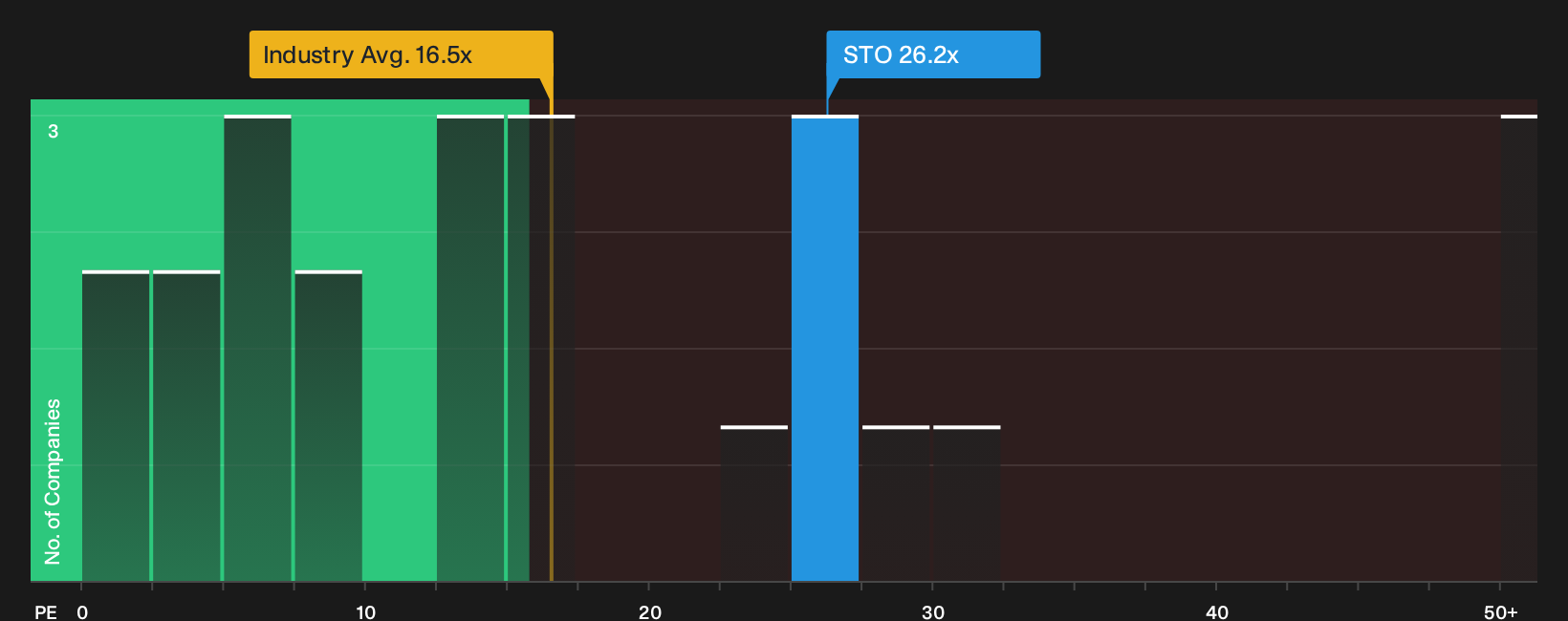
The SWS DCF model and the community narrative both point to Santos looking undervalued around A$8.54, yet the market is pricing the shares on a P/E of 26.2x. That is richer than the Australian Oil and Gas industry at 16.5x, the peer average at 13.7x, and even above a fair ratio of 25x.
This higher multiple suggests investors are already paying up for Santos relative to sector peers. This raises the risk that any slip in execution, commodity prices or project timing could have an outsized effect on the share price. Does that premium feel like a margin of safety or a margin for error to you?
For a closer look at how this pricing gap lines up against earnings, peers and the fair ratio, See what the numbers say about this price — find out in our valuation breakdown.
Next Steps
Mixed messages on Santos valuation and risk tend to split opinions. Move quickly, review the data yourself and weigh both sides using the 2 key rewards and 1 important warning sign.
Looking for more ideas beyond Santos?
If Santos has sharpened your thinking, do not stop here. Broader context across other opportunities can help you judge whether this hydrocarbon producer still earns a place in your portfolio.
- Target income resilience by scanning a curated group of companies offering stronger yields and robust profiles using the 3 dividend fortresses.
- Hunt for potential mispricing by reviewing a focused set of quality stocks that screen as undervalued through the 5 high quality undervalued stocks.
- Prioritise resilience first by checking a hand picked 7 resilient stocks with low risk scores that may help you avoid fragile balance sheets before the crowd catches on.
This article by Simply Wall St is general in nature. We provide commentary based on historical data and analyst forecasts only using an unbiased methodology and our articles are not intended to be financial advice. It does not constitute a recommendation to buy or sell any stock, and does not take account of your objectives, or your financial situation. We aim to bring you long-term focused analysis driven by fundamental data. Note that our analysis may not factor in the latest price-sensitive company announcements or qualitative material. Simply Wall St has no position in any stocks mentioned.
Have feedback on this article? Concerned about the content? Get in touch with us directly. Alternatively, email editorial-team@simplywallst.com