


Western Union has seen its share price fall a long way in recent years, which naturally puts the spotlight on whether the current valuation still lines up with what its earnings can support. With the stock trading around US$6.11, the key issue is how that market price stacks up against the profits the business is generating today.
- Over the past 5 years the share price has fallen 53.9%, which raises the question of whether the market has simply marked the business down or is reassessing the earnings power of the company.
- The group relies heavily on turning transaction volumes into consistent profit margins, so any change in how efficiently it converts revenue into net income can shift what investors are willing to pay for each dollar of earnings.
- Your read on Western Union is one view; the desks covering it have another. See what analysts think Western Union's shares could be worth.
The stock's next move may depend on whether Western Union's current earnings are strong and durable enough to justify the price investors are paying today.
If Western Union's earnings profile has you rethinking your watchlist, a focused screen of 29 high quality undervalued stocks can give you a broader starting point for further research.
Is Western Union a Bargain on Earnings?
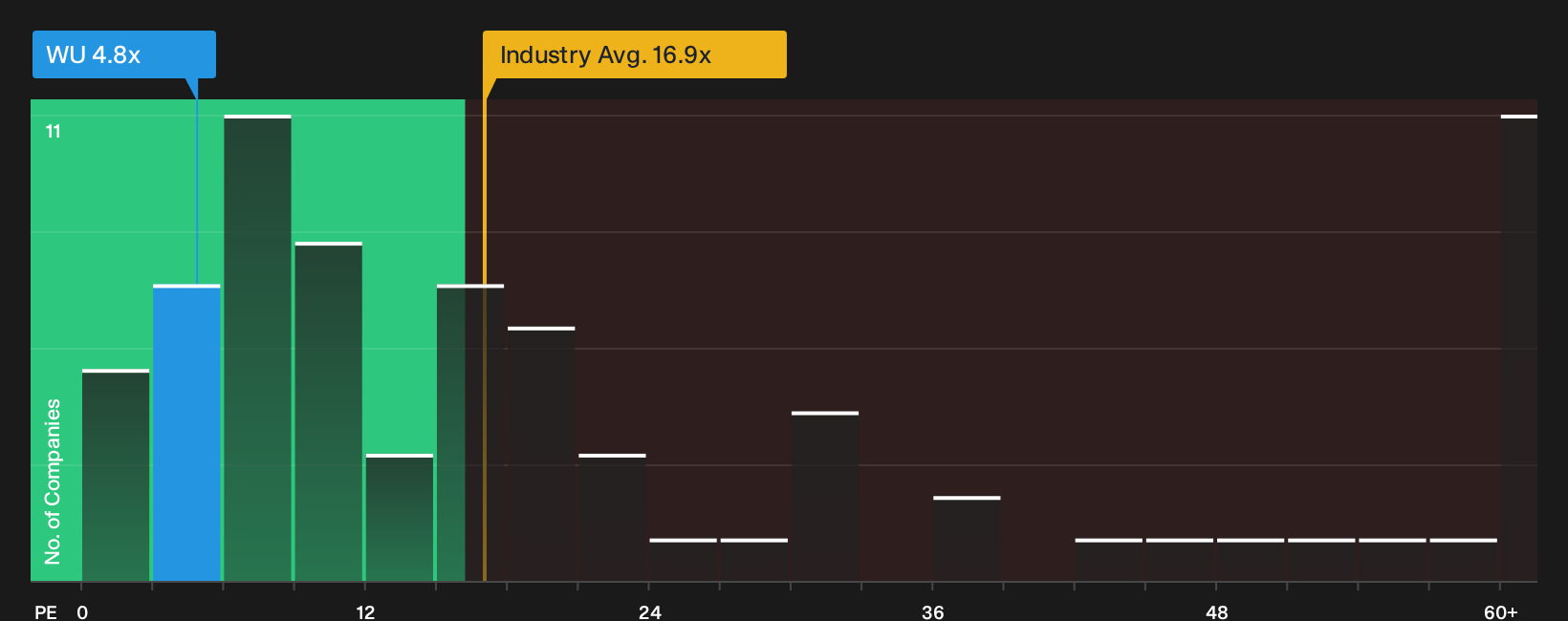
The P/E ratio fits Western Union because earnings remain the key lens investors use for mature financial firms that generate steady profit rather than rapid expansion. On this measure, Western Union trades on roughly 4.8x earnings, which is far below the diversified financial industry average of about 16.9x and also well under the peer group’s much higher 50.2x level.
The fair multiple implied by the valuation model sits above the current 4.8x figure. This suggests the shares screen as undervalued on this earnings yardstick. That gap points to a market that is assigning a heavy discount to Western Union relative to what its own profitability profile might justify, so readers need to weigh whether the risks they see in the business are large enough to explain that difference before deciding if the current pricing looks appealing enough to research further. Explore the numbers behind Western Union's P/E valuation.
The Western Union Narrative: What Would Justify Today's Price?
Narratives for Western Union pick up where the P/E puzzle leaves off, by spelling out which paths for revenue, margins and earnings would need to play out for the share price to look materially higher or lower than today. Instead of a single output from a ratio or model, they lay out the future conditions that number quietly relies on so you can return to those assumptions over time and see whether the story still fits.
Community views on Western Union are split between a potential cost and digital execution upside and concern that mix shift and regulation may keep earnings under strain.
Bull case: 11% undervalued
"The accelerated Beyond Efficiency program, targeting US$50 million of run rate cost reductions by the end of 2026 and US$200 million by the end of 2027 through measures such as legacy product shutdowns, AI enabled productivity gains and regionalized operations, is aimed at offsetting pressure from the mix shift to lower margin digital…"
Discover why this Narrative puts Western Union at 11% undervalued.
Bear case: 22% overvalued
"Despite efforts to shift toward digital payout-to-account and branded digital channels, Q2 2026 data shows consumer money transfer transactions up 3% but adjusted EPS falling from US$0.42 to US$0.31 as low revenue per transaction partnerships and payout-to-account transactions that grew roughly 50% dilute revenue per transaction…"
Explore why this Narrative puts Western Union at 22% overvalued.
One more Western Union check that belongs beside the P/E
Price comparisons only tell you what the market thinks today, while professional models sketch out where they expect Western Union’s earnings power to be a few years from now. Explore where analysts expect Western Union to be in a few years.
This article by Simply Wall St is general in nature. We provide commentary based on historical data and analyst forecasts only using an unbiased methodology and our articles are not intended to be financial advice. It does not constitute a recommendation to buy or sell any stock, and does not take account of your objectives, or your financial situation. We aim to bring you long-term focused analysis driven by fundamental data. Note that our analysis may not factor in the latest price-sensitive company announcements or qualitative material. Simply Wall St has no position in any stocks mentioned.
Have feedback on this article? Concerned about the content? Get in touch with us directly. Alternatively, email editorial-team@simplywallst.com