


- Blue Owl Capital has been in talks to sell Stack Infrastructure’s Asia-Pacific data centre portfolio and is now prioritising expanding the amount of insurance capital it manages as a source of long-term funding for new investments.
- The decision to build an insurance capital platform without buying an insurer points to a lighter balance sheet model that still seeks durable funding and potentially reshapes how Blue Owl structures future private market deals.
- This article examines how Blue Owl's push into managing insurance capital could reshape its investment narrative and future earnings mix.
Blue Owl Capital Investment Narrative Recap
To own Blue Owl Capital, you need to believe in its permanent capital model, its role in private credit and real assets, and its ability to keep raising funds despite market cycles. The potential sale of Stack’s Asia-Pacific data centers would test how management recycles capital from mature digital infrastructure assets into higher fee opportunities without disrupting fee streams.
The key near term swing factor is still fundraising and deployment across private credit, real estate and infrastructure, given earnings remain closely tied to new capital inflows. The biggest operational risk is execution as the platform expands into more complex areas like insurance capital, combined with already high leverage and a dividend that is not well covered by earnings or free cash flow.
The most relevant announcement alongside the Stack news is Blue Owl’s push to grow third party insurance capital without buying an insurer. That shift matters because it speaks directly to funding of long life data center and AI related assets, and whether the group can secure longer duration capital without loading up its own balance sheet.
If Blue Owl can scale an insurance capital platform, the main catalysts stay tied to consistent AUM growth, more permanent vehicles and a higher share of recurring management fees. The risk side is clear. Complex insurance partnerships can raise regulatory, structuring and integration challenges at the same time that investors are already watching leverage, dividend coverage and competition from giants such as BlackRock in similar asset classes.
Blue Owl Capital's analyst narrative points to revenues of US$3.5b and earnings of US$868.7m by 2029, based on a 5.8% yearly revenue growth assumption and an earnings increase of about US$787.8m from current earnings of US$80.9m.
Uncover how Blue Owl Capital's fair value indicates a 40% potential upside to its current price before that discount begins to close.
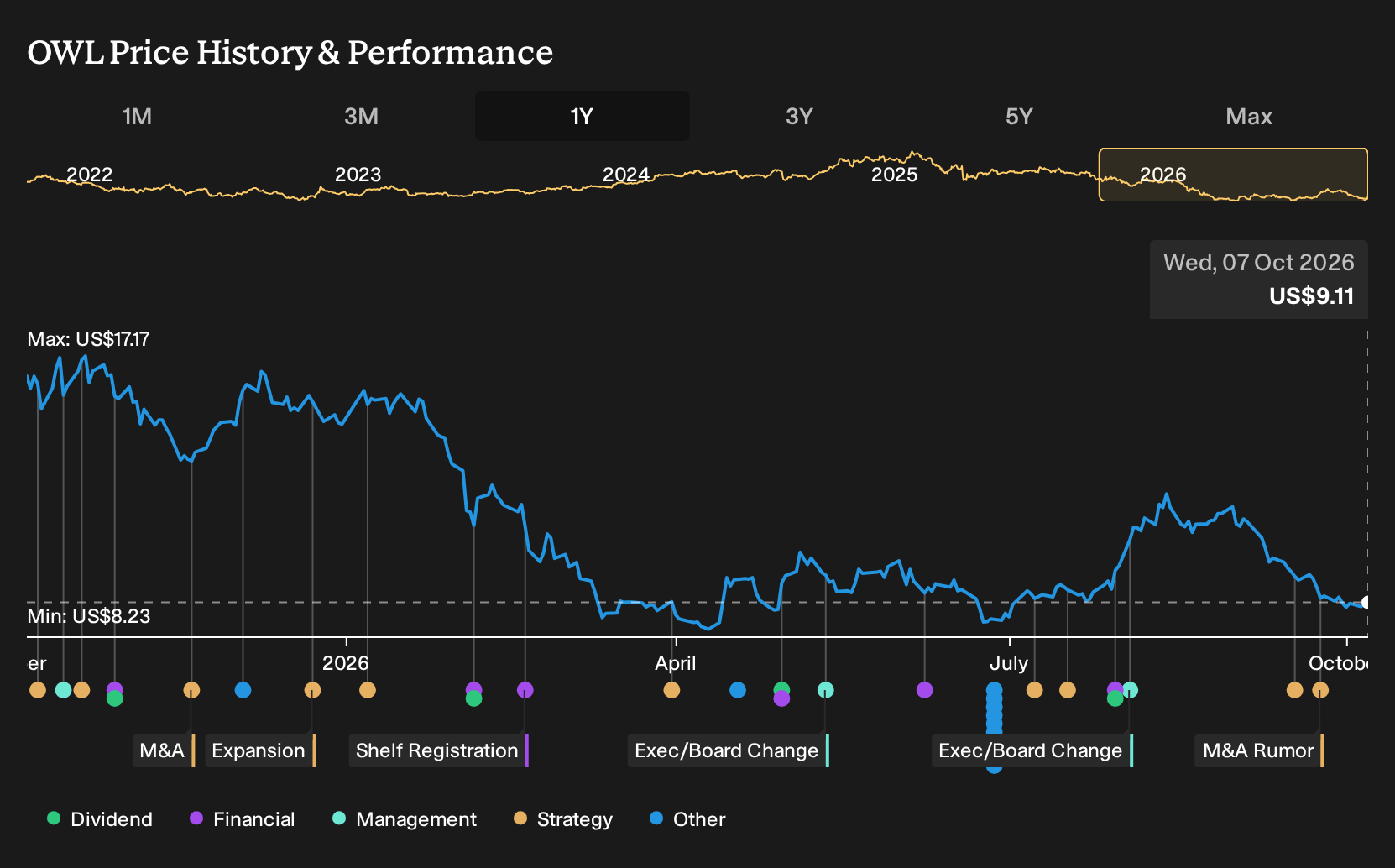
Exploring Other Perspectives
One big swing factor the lowest analysts focus on is fundraising pressure. They worry that if investors keep favouring cheaper index products, Blue Owl Capital might struggle to hit even their trimmed 4.7% revenue growth path and US$3.4b revenue plus US$974.7m earnings by 2029. Those views predate this data centre sale talk, so you may see forecasts shift as opinions adjust.
Explore 7 other Blue Owl Capital fair value estimates, including one that suggests as much as 88% downside from the current price.
Decide For Yourself
Disagree with existing narratives? Extraordinary investment returns rarely come from following the herd, so go with your instincts.
- A great starting point for your Blue Owl Capital research is our analysis highlighting 2 key rewards and 3 important warning signs that could impact your investment decision.
- See our latest analysis for Blue Owl Capital. The report includes a comprehensive fundamental analysis summarized in a single visual, the Snowflake, making it easy to evaluate Blue Owl Capital's overall financial health at a glance.
Looking for more investment ideas beyond Blue Owl Capital?
If you want to pressure test your thesis on Blue Owl Capital or simply compare it with other opportunities, the Simply Wall St Screener can surface companies that better match your risk appetite and income goals.
- If capital protection comes first for you, scan for 31 resilient stocks with low risk scores that may better align with a more cautious approach.
- If you want income potential on top of price appreciation, review a curated set of 7 dividend fortresses that could suit a yield focused portfolio.
- If you prefer to get in before the crowd, comb through 20 high quality undiscovered gems that match stronger fundamentals with lower market attention.
This article by Simply Wall St is general in nature. We provide commentary based on historical data and analyst forecasts only using an unbiased methodology and our articles are not intended to be financial advice. It does not constitute a recommendation to buy or sell any stock, and does not take account of your objectives, or your financial situation. We aim to bring you long-term focused analysis driven by fundamental data. Note that our analysis may not factor in the latest price-sensitive company announcements or qualitative material. Simply Wall St has no position in any stocks mentioned.
Have feedback on this article? Concerned about the content? Get in touch with us directly. Alternatively, email editorial-team@simplywallst.com