


Markets are pulling back from record highs, bond yields are pressing higher, and big index and ETF sponsors are right in the crosshairs of those swings. That mix can punish some stocks and open the door for others as investors reassess where to park cash. This article walks through three asset management groups from our screener that appear well placed based on recent fundamentals and their exposure to these shocks.
The stocks covered below are only a starter pack for this idea. The full screen surfaced 17 additional large listed ETF and index fund providers with equally compelling stories that are not covered in this article.
If you want to identify which of these asset managers best fits your own playbook, head straight into the Global Multi-Asset ETF and Index Fund Providers screener to filter the list, analyze each business, and focus on the setups that matter most to you.
Pershing Square (PS)
Overview: Pershing Square is an alternative asset manager running concentrated, permanent capital vehicles that give investors exposure to large public companies and market-wide fee economics.
Operations: Pershing Square generates about US$769 million from asset management, entirely sourced from the United States, tying revenues closely to US markets.
Market Cap: US$23.9b
Pershing Square fits this screen as a large listed asset manager whose fee income is closely tied to how investors reposition portfolios when volatility in rates and indices increases.
"The planned use of modest investment grade leverage at both Pershing Square Inc. and Pershing Square U.S. at 15% to 20% of assets is intended to scale exposure to underlying holdings in a measured way."
The key variable is how one less visible pressure on future earnings power influences the eventual shape of those expanding fee margins.
That hidden pressure point is exactly where the story gets interesting, and the full narrative for Pershing Square shows how Pershing Square’s fee engine could accelerate or stall from here.

HMC Capital (ASX:HMC)
Overview: HMC Capital is an Australian asset manager that runs real estate, digital infrastructure and private credit funds linked to long term megatrend themes.
Operations: HMC Capital generates about A$88.6 million from real estate, A$51.2 million from digital, and A$40.6 million from private credit funds.
Market Cap: A$1.2b
HMC Capital matters for this screener because it channels big institutional money into real assets, so shifting rates and flows can quickly reshape how its fee engine converts global megatrend themes into shareholder outcomes.
"Although HMC Capital reports solid fee-generating AUM and recurring funds management revenue, the recent net loss of A$49.1 million, driven by A$133.3 million of fair value losses, shows that valuation swings in underlying assets can still overwhelm operating performance. This could restrain future reported earnings even if headline AUM and fee income continue to build."
What happens to HMC Capital’s earnings profile now largely hinges on how one unresolved capital recycling and asset valuation tension ultimately plays out.
That capital recycling question is exactly where the full narrative for HMC Capital joins the dots on what might be masking HMC Capital’s earnings power and where future fee momentum could accelerate.

Perpetual (ASX:PPT)
Overview: Perpetual is a Sydney based investment manager that runs diversified multi asset funds and related trustee, custody, advice and administration services.
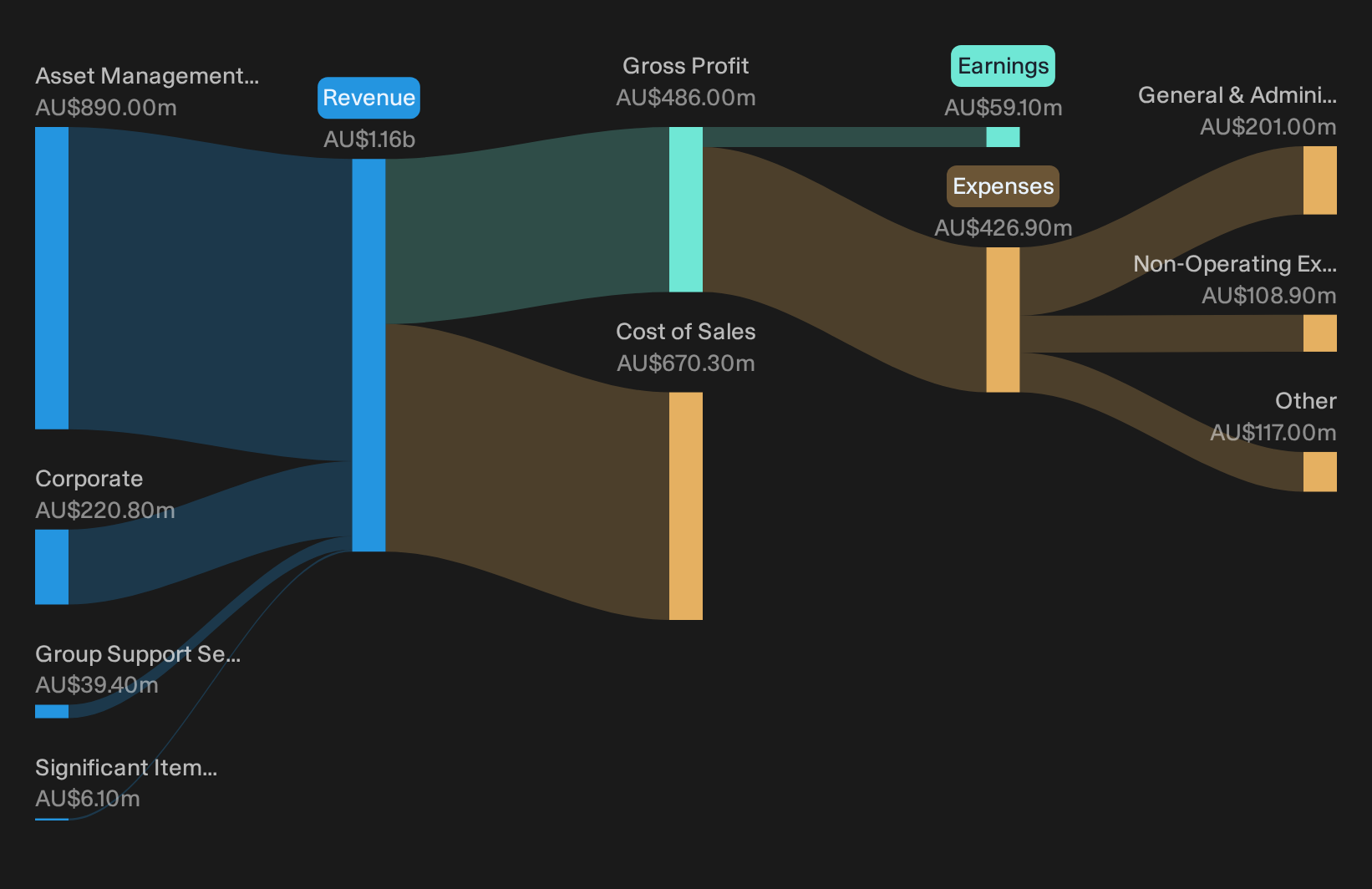
Operations: Perpetual generates about A$890 million from Asset Management, A$220.8 million from Corporate activities, and A$39.4 million from Group Support Service.
Market Cap: A$1.9b
Perpetual matters in this screen because its broad mix of equity, bond and cash products puts it directly in the path of investors rebalancing portfolios as yields move and multi asset flows shift across regions.
"Perpetual has agreed to sell its Wealth Management business to Bain Capital for an upfront payment of A$500 million, with the possibility of up to A$50 million of additional consideration at completion and a further earn-out of up to A$50 million."
What happens to future fund growth and fee margins now largely depends on how that incoming capital is deployed and costs are reset.
How that capital is put to work next is the real hinge, and the full narrative for Perpetual shows whether Perpetual’s reset could accelerate earnings power or leave value masked.
Seeking Fresh Alternatives Before They Fly
Fresh setups rarely stay quiet for long. Breakout stories build momentum, weak ideas keep dropping, and under the radar for now opportunities vanish before the crowd reacts. Get in early.
- Target income first and filter for resilient cash generators inside the 7 dividend fortresses before yields reset and the strongest payouts get fully priced.
- Track where real-world demand meets scarcity through the 17 top copper producer stocks while the market is still sorting which producers control the most valuable volumes.
- Position around the buildout of tomorrow’s energy backbone by scanning the 43 power grid technology and infrastructure stocks before capital chases the most critical infrastructure suppliers.
This article by Simply Wall St is general in nature. We provide commentary based on historical data and analyst forecasts only using an unbiased methodology and our articles are not intended to be financial advice. It does not constitute a recommendation to buy or sell any stock, and does not take account of your objectives, or your financial situation. We aim to bring you long-term focused analysis driven by fundamental data. Note that our analysis may not factor in the latest price-sensitive company announcements or qualitative material. Simply Wall St has no position in any stocks mentioned.
Have feedback on this article? Concerned about the content? Get in touch with us directly. Alternatively, email editorial-team@simplywallst.com