


The Zhitong Finance App learned that the third quarter earnings season for US stocks began this week. As financial reports are released one after another, the scene the market has been waiting for is expected to come true: S&P 500 profits will explode again.
US stocks closed at record highs on Tuesday, and investors are betting that AI capital spending will not be derailed by rising bond yields. AI capital expenditure has become an important driver of the US market and economy. If key companies give optimistic guidance, compounded by stabilizing the bond market, it is expected to push US stocks to a strong end at the end of the year.
The AI engine is running at full speed, and the profit growth rate of the S&P 500 is driving 30%
On an exponential level, profit growth is expected to be very strong. According to consensus estimates compiled by FactSet, analysts expect the third-quarter earnings of the S&P 500 index constituent stocks to increase by nearly 30% year-on-year. This forecast is higher than 26.7% on June 30.
The technology sector remains critical. This sector accounts for 40% of the S&P 500 index's weight. If profit expectations declined, this would have raised concerns, but the reality is quite the opposite. FactSet pointed out that the expected earnings per share (EPS) growth rate for the technology sector has risen from 57% on June 30 to the current 65%, partly due to the revised earnings expectations of Nvidia (NVDA.US) and Micron Technology (MU.US).
Analysts raise earnings growth forecasts
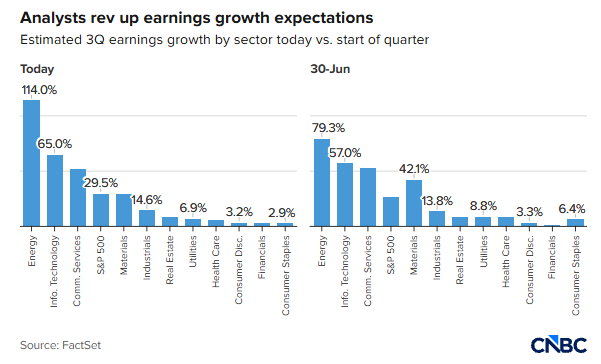
Strong performance from AI chip makers and other big tech companies has allayed market concerns about the peak of the cycle. Micron handed over a strong financial report, which gave a positive signal to the broader demand for AI chips. On the consumer side, Meta Platforms launched the Muse smart device, igniting an arms race where AI empowers consumer e-commerce.
More importantly, profit growth is spreading outward from the “Big Seven.” According to Russell Investments, these giants are expected to grow an average of 20%, while the remaining 493 stocks in the S&P 500 index are expected to grow 27% year over year.
In addition to large stocks, the profit growth of small and medium-sized stocks also showed a healthy trend. Economist Ed Yardney, head of research at Adney, pointed out that the operating profit of the S&P 400 mid-cap index is expected to increase by 19% in 2026. He added that analysts expect S&P 600 small cap earnings to grow 21% this year and 16% in 2027.
“The stock market is still responding to corporate profits,” Barclays strategists said in a report this week. They wrote that S&P 500 profits are expected to increase 30% this year, adding: “2025-27 may be the fastest three-year profit growth period in decades (not including the rebound after the recession).”
UBS is equally optimistic. Ulrik Hoffman-Burchadi, the American CIO of UBS's Chief Investment Office and head of global equities, said in a report on Wednesday: “Investors should continue to position the market. We expect the S&P 500 index to rise to 8,400 points by June next year.”
Fractures under prosperity: Market breadth worsens, high pressure on the bond market disrupts the situation
However, stocks other than the “Big Seven” and major chip makers still need a profit boost. The breadth of the market is deteriorating. According to Morgan Stanley data, as of the end of September, only about 20% of stock trading prices were above the 50-day moving average, down from 70% in midsummer.
In addition to large stocks, a large number of stocks are mired in bear markets. Of the 504 constituent stocks in the S&P 500 index, nearly 38% fell 20% or more from their 52-week high. Companies that dropped at least 50% include Costa (CSGP.US), AppLovin (APP.US), Boston Scientific (BSX.US), Oracle (ORCL.US), and Coinbase (COIN.US).
From an industry perspective, the future is not all bright. Although all industry sectors of the S&P 500 index are expected to grow, FactSet data shows that since June 30, bottom-up EPS estimates for eight sectors have been lowered, with sectors such as materials (-10.2%), essential consumption (-4%), and healthcare (-3.3%) leading the decline.
Even with strong index profits, rising bond yields could disrupt the market. The 10-year US Treasury yield just broke through 5.36%, a 24-year high, up from 4.75% in August. Part of the increase in yield reflects strong economic growth, but it also reflects continuing inflationary pressure. The Federal Reserve's preferred core PCE inflation indicator was 3% in August. If the economy does not fall into recession, interest rates may need to be raised a few more times to bring inflation closer to the 2% target.
Higher interest rates are putting pressure on high-dividend sectors such as utilities, essential consumption, and real estate. Banks may also be pressured by fixed-income portfolios, accumulating losses on their balance sheets.
Currently, rising interest rates are not enough to weaken AI trading and other profitable growth drivers. Barclays strategists believe that even if interest rates rise by one percentage point, the market may not be affected. They pointed out, “If profits increase by 30% and real interest rates rise by 100 basis points, profit growth (if not yet priced) will still prevail. The stock market understands this — that's why stock prices have always been strong and unwilling to fall.”
Bank financial reports and valuation test: US stocks need to cross “three hurdles” to rise at the end of the year
Investors should pay close attention to the financial reports released by major banks next week to understand how higher interest rates will affect loans, mergers and acquisitions activities, and IPO plans. J.P. Morgan Chase, Goldman Sachs, Citigroup, and Wells Fargo will release financial reports on October 13.
Profits will also test high market valuations. Although the S&P 500 forward price-earnings ratio has dropped to about 19 times, Bank of America said that out of 20 valuation indicators, 17 showed the index to be “expensive,” which means an annualized return of -3% over the next ten years.
In terms of short-term allocation, Bank of America says its momentum and value model favors the energy, technology, and communications services sectors. Jefferies favors sectors with improved profits and “macroeconomic support,” and indicated that finance, healthcare, technology, and materials would benefit.
For US stocks to continue to strengthen until the end of the year, several conditions need to be met at the same time: the performance of large technology companies, banks, and other key companies must exceed Wall Street expectations; bond yields need to stabilize; and oil prices need to fall, preferably far below $100 per barrel, supported by the Iran peace agreement.
If all of these conditions are fulfilled, US stocks are expected to end strongly at the end of the year.