


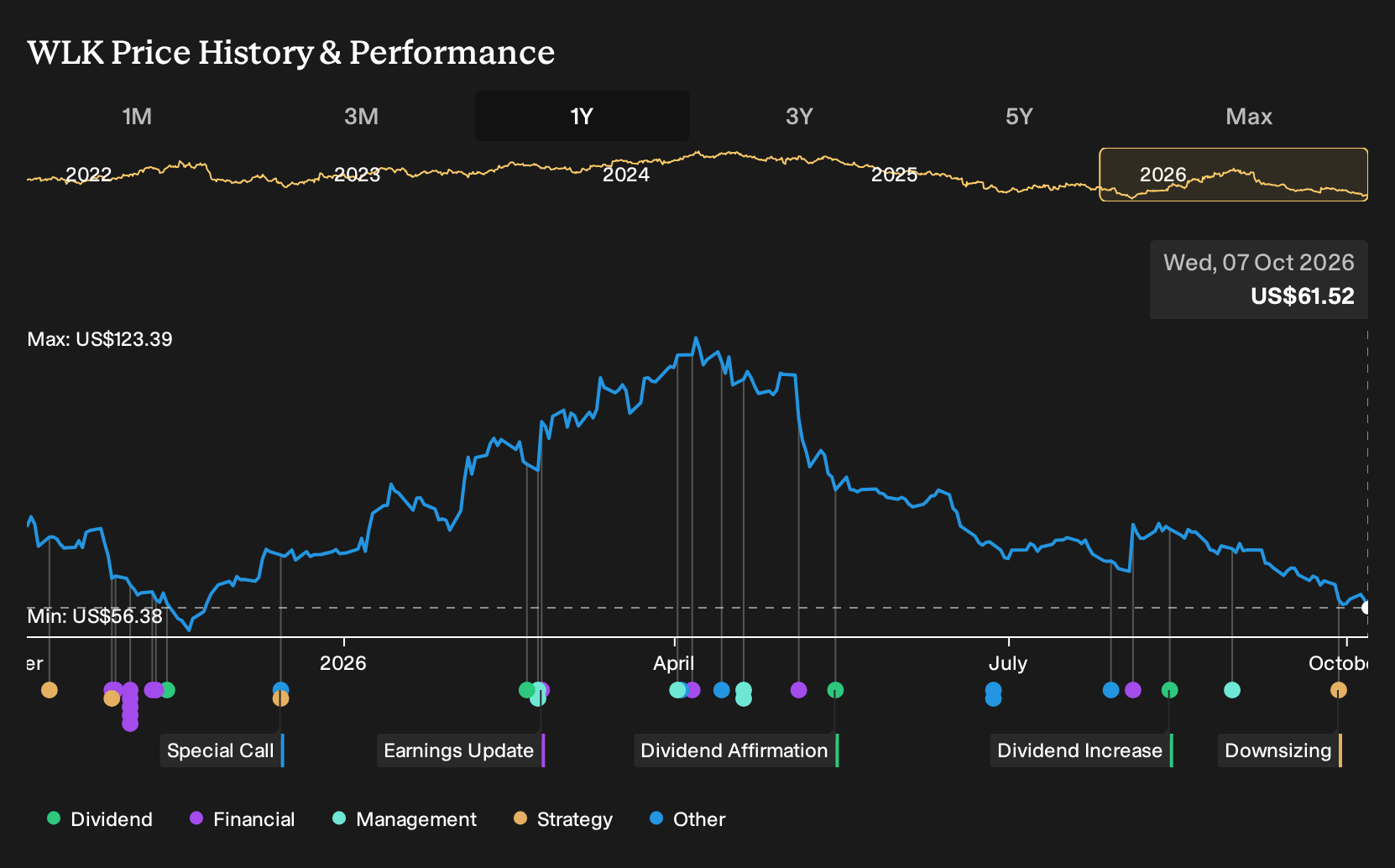
- Westlake Corporation has decided to shut its higher cost PVC facility in Cologne, Germany, after facing weak regional demand, elevated energy costs and increasing import pressure, and plans to redirect customers to its remaining German sites including the Wilhelmshaven plant.
- The closure carries about US$205 million in pre tax charges spread across 2026 and 2027, yet removes 165,000 metric tons of higher cost PVC capacity from Westlake's European footprint and tightens the focus on larger, lower cost chlorovinyl assets.
- This move could reshape Westlake's investment narrative as it exits the higher cost Cologne PVC plant in Europe.
Scan beyond Westlake and review hand picked chlorovinyl and basic materials peers facing similar cost pressures with the list of solid balance sheet and fundamentals (25 results) for potential resilience under tough operating conditions.
Westlake Investment Narrative Recap
For a shareholder in Westlake, the core belief is that a mostly North American feedstock base, an integrated chlorovinyl chain and the Housing and Infrastructure Products arm can collectively turn pricing and volume into healthier margins over time. The Cologne shutdown sits inside that story. It is a clean up action that hits near term earnings through US$205 million of charges but is aimed at taking out structurally higher cost tonnage.
The key short term swing factor still sits in global supply and demand for core chemicals and how that flows into pricing in Performance and Essential Materials. The closure does not remove that risk. Oversupply from Asia, energy volatility and softer housing and infrastructure activity remain the main operational headwinds that can keep Westlake’s profitability under pressure.
The most relevant prior update for this move is Westlake’s plan to reshape its European chlorovinyl footprint around lower cost assets, including the 380,000 metric ton Wilhelmshaven PVC and VCM plant. Cologne had smaller scale and higher logistics costs, so exiting that facility lines up with the profitability improvement program that targets US$600 million of EBITDA benefit in 2026.
That same framework highlights the main execution test. Management still needs to integrate Wilhelmshaven effectively, deliver the remaining cost savings and handle any further pricing pressure from Asian imports without eroding returns. For anyone tracking Westlake closely, the Cologne closure is best viewed as a step inside a broader cost and footprint reset rather than a new catalyst on its own.
What The Current Analyst Framework Implies For Westlake
Westlake's narrative projects US$12.8b revenue and US$708.9m earnings by 2029. This lines up with analysts assuming 4.1% yearly revenue growth and an earnings swing of about US$1.9b from a loss of US$1.2b today to that 2029 consensus level.
Uncover why Westlake's fair value indicates a 50% potential upside to its current price, which could narrow quickly.
Exploring Other Perspectives
One alternate view focuses on capped earnings power. The lowest analysts were only penciling in about US$12.0b of revenue and roughly US$230.2m of earnings by 2029, compared with the higher consensus of US$12.8b and US$708.9m. That more cautious storyline might shift again once this Cologne closure fully filters into updated forecasts, so explore a few different perspectives before deciding how you see Westlake.
Explore 2 other Westlake fair value estimates, including one that suggests up to 19% downside from the current price.
Reach Your Own Conclusion
Disagree with existing narratives? Extraordinary investment returns rarely come from following the herd, so go with your instincts.
- A great starting point for your Westlake research is our analysis highlighting 3 key rewards and 1 important warning sign that could impact your investment decision.
- See our latest analysis for Westlake. The report includes a comprehensive fundamental analysis summarized in a single visual, the Snowflake, making it easy to evaluate Westlake's overall financial health at a glance.
Looking For More Investment Ideas Beyond Westlake?
If you want to stress test your view on Westlake against what else is on the market, a quick pass through the Simply Wall St Screener can help you compare risks, balance sheets and income potential across other listed businesses.
- For investors who care most about resilience, scan a curated 31 resilient stocks with low risk scores that may better hold up when conditions turn tougher.
- If you want income to do more of the work, review a focused set of 8 dividend fortresses that combine yield with underlying business strength.
- When you are hunting for underfollowed opportunities, check out a pool of 20 high quality undiscovered gems that pair solid fundamentals with lower market attention.
This article by Simply Wall St is general in nature. We provide commentary based on historical data and analyst forecasts only using an unbiased methodology and our articles are not intended to be financial advice. It does not constitute a recommendation to buy or sell any stock, and does not take account of your objectives, or your financial situation. We aim to bring you long-term focused analysis driven by fundamental data. Note that our analysis may not factor in the latest price-sensitive company announcements or qualitative material. Simply Wall St has no position in any stocks mentioned.
Have feedback on this article? Concerned about the content? Get in touch with us directly. Alternatively, email editorial-team@simplywallst.com