


The Zhitong Finance App learned that the analytical agency Eudaemon Research has re-examined the NAND business prospects of Micron Technology (MU.US) in a recent report. The agency previously determined that in the Micron business structure, DRAM is more resilient than NAND, and NAND prices and demand will return to normal more quickly.
However, Micron's latest Q4 fiscal quarter data corrected this view: NAND is no longer a homogenized market, and the supply, demand, and pricing logic for consumer-grade NAND and enterprise-grade data center SSDs is clearly divided.
Data center SSDs reshape NAND revenue structure
Micron's Q4 fiscal quarter showed that its SSD division's data center revenue was about $10 billion, 10 times the same period last year, and accounted for about two-thirds of NAND's total revenue. In the same period, Micron NAND's total revenue was US$14.1 billion, up 42% month-on-month, and prices rose about 30% month-on-month. According to subsequent standards, the share of data center SSDs in NAND revenue has further increased to about 70%.
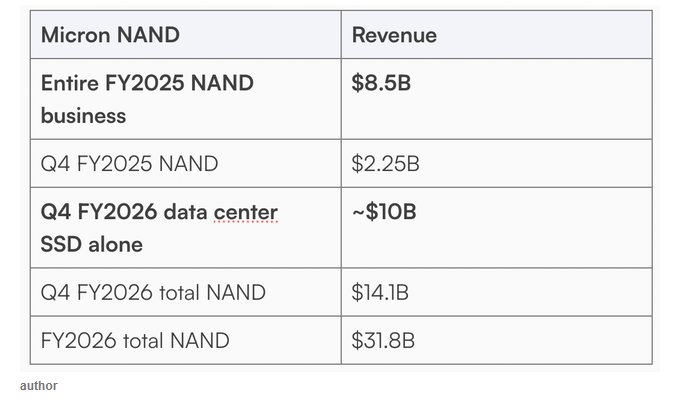
Data center SSD revenue in just one quarter has already surpassed Micron's NAND business revenue for the full year of the previous year.
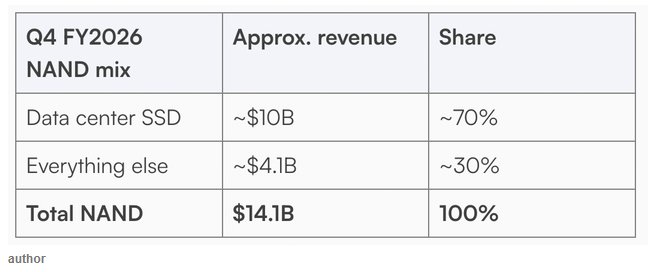
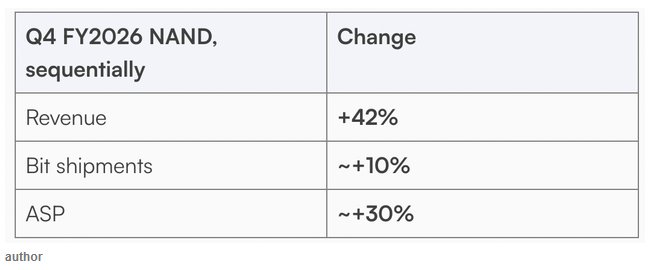
The report emphasizes that this change is not simply an increase in shipments, but rather that the Micron NAND product structure is skewed towards high-value data center SSDs.
As the focus of business shifts from the consumer market to the enterprise market, Micron's dependence on consumer NAND cycle fluctuations declines, and the pricing and demand for data center SSDs is becoming a more critical profit variable.
The trend differentiation between enterprise-grade SSDs and consumer-grade NAND
TrendForce's latest forecast shows that the NAND shortage is expected to ease in the second half of 2027, when additional production capacity will be released. However, smartphones and notebooks are not the main absorbers of the new production capacity. Consumer electronics still account for about 40% of the NAND market, and weak demand is still putting pressure on them.
However, demand for enterprise-grade SSDs is expected to increase by more than 80% this year. Cloud vendors continue to expand AI reasoning, and most new supplies have been locked in advance, and enterprise-grade SSDs are expected to see significant price increases in Q4.
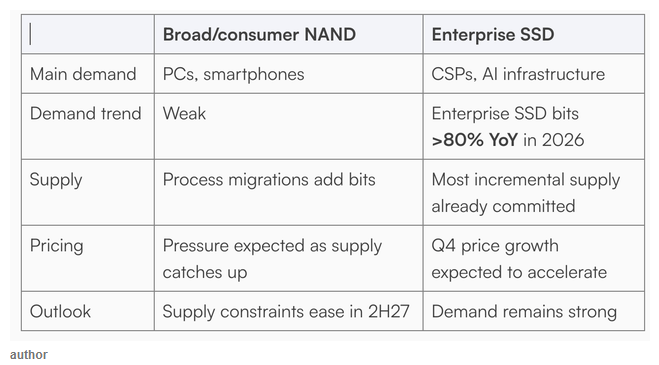
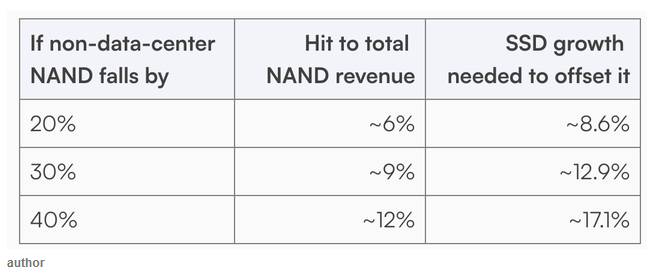
This means that if about 70% of Micron's NAND revenue comes from a market where prices are expected to rise, the adjustment in consumer-grade NAND can be offset by the growth of enterprise-grade SSDs. According to the report's estimates, even if non-data center NAND business revenue falls by 30%, Micron's total revenue will only drop by about 9%; as long as SSD revenue increases by 13%, this impact can be offset. Considering that analysts expect demand for enterprise-grade SSDs to grow by more than 80%, the associated downside risks are no longer prominent.
KV cache offload and mechanical hard disk replacement components driven by demand
Micron attributed the need for enterprise-grade SSDs to two major drivers: KV cache offload and mechanical hard disk replacement. HBM and DRAM are expensive when storing large amounts of data, but their speed advantages are irreplaceable. As the scale of AI context expands and inference continues to run, large amounts of data, especially KV caches, can be transferred to SSDs.
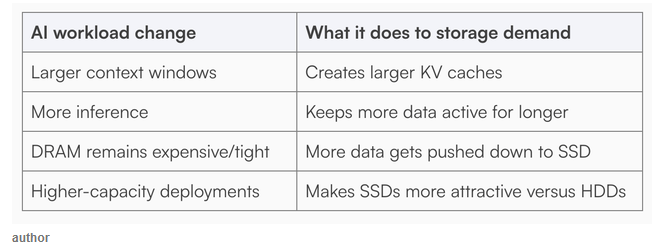
J.P. Morgan analyst Harlan Sur said during the Micron Q4 conference call that Micron is participating in the Nvidia (NVDA.US) SCADA program, which aims to enable GPUs to directly access storage; he also pointed out that more and more KV cache work is shifting to storage. Micron CEO Sanjay Mehrotra generally agreed with this, adding that the growing context is driving the expansion of the storage hierarchy from HBM to DRAM to SSD.
According to the report, this is directly related to Micron's $10 billion data center SSD revenue. Micron has received design orders for the world's largest data center deployments. Although it is difficult to prove that all orders are related to KV cache offloading or SCADA, the relevant requirements are reflected in actual deployment, and Micron's SSD business is growing rapidly.
Micron's share of enterprise-grade SSDs is higher than its NAND supply position
This raises the key question: Can Micron seize sufficient share in this market to enjoy excess profits?
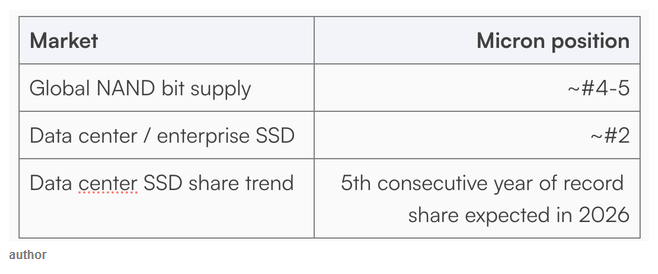
In fact, Micron doesn't need to be the largest NAND producer to win in the enterprise SSD market. Harlan Sur pointed out during the conference call that Micron's actual share in the enterprise-grade SSD sector is much higher than its share of the original NAND supply, which allows it to obtain a higher value per bit.
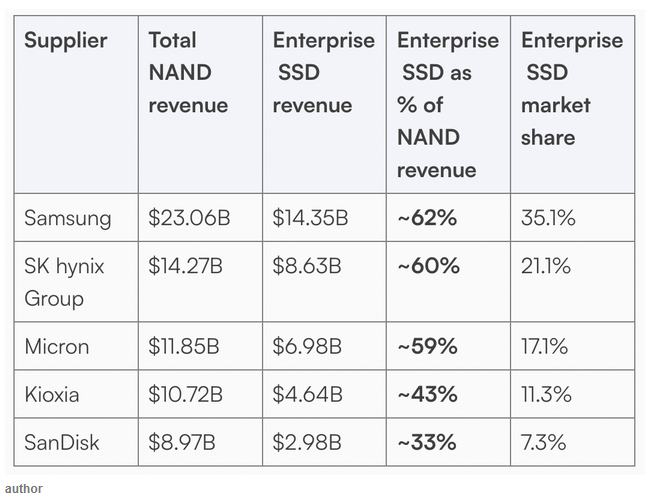
TrendForce's revenue structure estimates for the second quarter of 2026 show that Micron is not the only company with a high share of the enterprise level. Samsung (SSNLF.US) and SK Hynix (SKHY.US) both account for a higher share of the enterprise class. With 176-layer QLC, PCIe 5.0 products, and the ability to simultaneously supply DRAM and NAND to the same server customer, Samsung is clearly in a leading position. SK Hynix has the Solidigm high-capacity QLC product line and superimposes its own TLC products.
Micron's advantage is probably the speed of transformation: its Q2 enterprise-grade SSD revenue grew 126.3% month-on-month, the fastest among the top five vendors; the share of 59% is out of date, and now it is over 70%.
There are obvious signs of improvement on the profit side, and the valuation logic has been fine-tuned
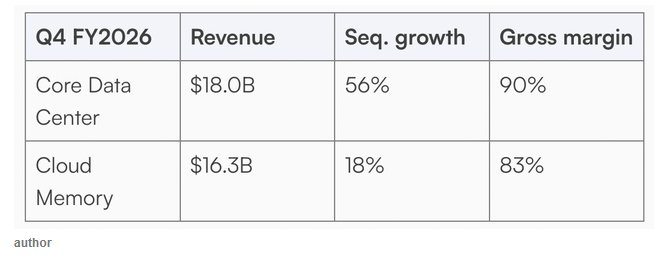
Micron did not separately disclose the gross profit margin of data center SSDs, so it is impossible to accurately determine the profit level corresponding to the above 10 billion US dollars of revenue. However, according to Eudaemon Research, qualitative judgments can still be obtained from other indicators: Micron's core data center business revenue increased sharply month-on-month, with a gross margin of 90%; the performance of the cloud memory business was relatively unremarkable, because the price increase was offset by a higher share of the HBM product portfolio. Since the core data center business also includes DRAM, it is not directly compatible with SSDs, but the agency believes that as Micron tilts towards data center SSDs, its business indicators are improving at a very high level, and this trend is already quite clear.
At the valuation level, the agency used Micron FY2028's earnings per share of 215 US dollars and a price-earnings ratio of 7 times the price-earnings ratio to give a fair value of about 1,500 US dollars. At the time, it was assumed that NAND would be normalized before DRAM. Today, the agency's grasp on this assumption is declining. NAND shipments may still normalize in the future, but as long as Micron can use more NAND for enterprise-grade SSDs, the revenue impact brought about by the normalization of NAND supply and demand can be offset.
Eudaemon Research has yet to adjust its earnings forecast of $215 per share because Micron did not provide sufficient data center SSD margin details to accurately raise $10 to $20. However, the agency said that $215 is no longer as aggressive as thought two months ago. It maintains a fair value of $1,500 and continues to give Micron a “buy” rating. Unlike before, the agency now has more confidence in the profit side of Micron's NAND business.