


The Zhitong Finance App learned that recently, as long-term US bond yields of 10 years or more repeatedly hit new highs since 2002, and the yield on long-term treasury bonds in the UK, Japan and other countries reached the highest level in more than 20 years, and the market is increasingly worried that the surge in US bond yields will cause long-term financing cost pressure to heat up, and AI revenue generation by hyperscale cloud computing companies cannot cover the continuously rising AI computing capital expenses. In addition, the core force of the AI computing power theme, the memory chip sector, has fallen back into a bubble due to expectations of Toshiba's HDD capacity expansion. “About AI The pessimistic bear market theory of “about to break up” The adjustments can be described as being rampant.
The battle between global institutions and retail investors over whether the “AI bubble” is about to burst is shifting from high or low valuations of AI computing power industry chain leaders such as Nvidia and AMD to a more lethal substantive issue: as long-term capital acquisition costs and long-term financing costs become more and more expensive, whether industries related to artificial intelligence applications, including NeoCloud (NeoCloud), large model development companies, and traditional cloud computing giants, can use real and continuous cash returns to support AI computing power investments that are still expanding at an accelerated pace.
According to information, Joachim Klement, a senior market strategy director from Panmure Liberum, a well-known financial institution in London, set the target for the S&P 500 index at the end of 2027 at the end of 2027 at the end of 2027, corresponding to a sharp drop of about 36% — meaning that the veteran strategist predicts that US stocks will fall into a deep bear market, and he predicts that the AI trading boom may collapse in 2027 or 2028 at the latest. Klement even advises clients to start developing contingency plans and timing tools to prepare for a market crash and fully defend when the S&P 500 falls below the 200-day moving average.
The veteran strategist's concerns focus on the rising cost of debt financing against the backdrop of large-scale cloud companies' AI capital spending continuing to eat up free cash flow and surging yields on long-term US bonds of 10 years or more. This strategist's opinion echoes the cautious AI computing power infrastructure investment view of research firm Bloomberg Intelligence, which is expected to reach US$713 billion in 2026, an increase of more than double that of the previous year — that is, the scale of AI investment is still expanding at an accelerated pace, but financing is becoming more and more expensive, and whether cash returns can keep up has yet to be verified, and there is a potential contradiction between expansion needs and financial affordability; this also means that at a time when AI data center capital development supports continued expansion, enterprises are facing the double of rising financing costs and the implementation of return on investment The tests, especially the former, are getting more and more stressful.
A strategist is starting to prepare for a bear market! Shifting from 8,300 points to 5,000 points: the AI bubble burst or triggered the worst collapse of the S&P 500 since 2008
The head of market strategy at a major investment bank headquartered in London issued a stern warning to investors: the AI investment boom could soon come to an end and could trigger the worst market crash in the global stock market since the 2008 global financial crisis.
This year, global stock markets rose strongly and repeatedly reached new highs, driven by the AI superbull market around the theme of AI computing power. Part of the impetus came from investors' continued optimistic expectations of a surge in AI computing power infrastructure spending. However, Joachim Klement from Panmure Liberum said that his benchmark judgment is that this AI trading boom will collapse and collapse as early as 2027, leading to a sharp decline in the stock market.
“My core judgment is that the AI bubble will burst in 2027 or 2028, sometime in the next two years.” Klement said in an interview with the media. He said that the free cash flow of hyperscale cloud computing companies has basically been exhausted, and debt financing costs are rising rapidly along with 10-year US bond yields, and are becoming unbearably high for these companies.
Klement's target for the S&P 500 index at the end of 2027 is 5,000 points, which means there is 36% room for decline compared to the current level. Compared to the other seven strategists tracked by Bloomberg Intelligence, his forecast was clearly the most pessimistic; other strategists on average expect the index to still have room to rise by 14%. He also predicted that the European Stoxx 600 index would drop to 430 points, which is more than 30% lower than the current level.
This strategist began his career as a fund manager at UBS Group more than 20 years ago, and now he is one of the senior strategists who first predicted the end of this stock market bull market. Just in mid-September, his main judgment was that the S&P 500 index would reach 8,300 points by the end of next year.
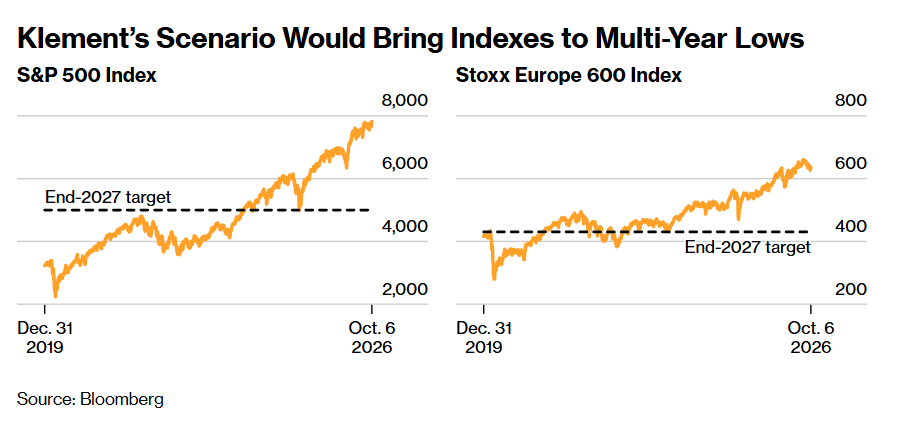
As shown in the above chart, strategist Klement's forecast scenario will cause the US stock market's benchmark stock index to fall to a multi-year low.
The reason he completely changed his opinion in the short term is because he is concerned that stubborn inflation will push the Federal Reserve to start a new cycle of interest rate hikes and that investment and financing costs that continue to soar with inflation expectations may derail the investment boom in AI-related infrastructure.
This sentiment echoes Temasek International Chief Investment Officer Rohit Sipahimalani's warning this week that the complete reversal of the AI trading boom is a key risk facing the global market.
According to the latest estimates by Bloomberg Intelligence researchers, hyperscale cloud computing companies' data center capital expenses in 2026 may reach 713 billion US dollars, more than double that of last year. This figure is expected to increase further next year, albeit at a slower pace. This round of spending expansion has become an important support for many US technology companies' profit forecasts.
“The current situation is that people are only concerned about one thing, and that is profit, especially the profit trajectory of technology companies linked to AI computing power.” In an interview with the media, Klement emphasized, “No matter what macro, credit, or other adverse factors you suggest, they will use this narrative to explain the past.”
Citigroup strategists said this week that despite high interest rates and ongoing geopolitical risks, the extremely steady profit growth trajectory based on the 2027 AI computing infrastructure frenzy can still support a further rise in global stock markets.
Klement admits that his bearish judgement may have come too early. Regarding the performance of the European Stoxx 600 Index up to the end of 2026, he is still the most optimistic of the strategists tracked by Bloomberg Intelligence. It is expected that the regional benchmark index, which has already entered a bullish trajectory, will still have room for growth of about 10%.
“I'm starting to alert people right now because I think something might happen in six to nine months.” He said in an interview.
Instead of advising clients to sell stocks now, the strategist advises them to develop emergency plans and establish timing tools to help identify the beginning of a sharp decline.
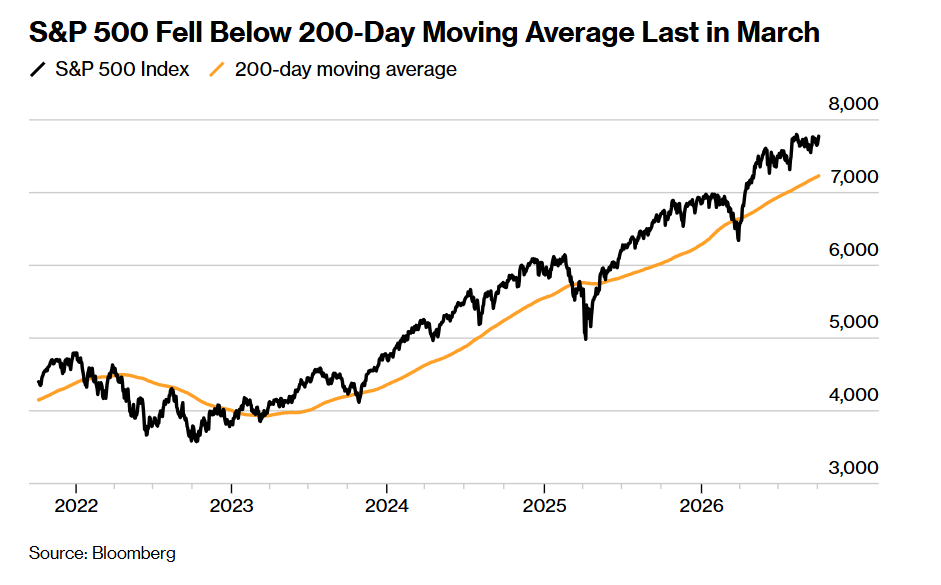
As shown in the above chart, the last time the S&P 500 index fell below the 200-day moving average was in March.
His first recommendation is to “fully shift to a defensive investment strategy” once the S&P 500 falls below its 200-day moving average. This technical indicator helps identify long-term trends in the market by averaging the index's closing price. In this context, he advocates allocating sectors that have been extremely defensive for a long time, including healthcare, food, tobacco, and pharmaceuticals stocks.
“What I tell people is that now is the time to start preparing.” Klement said, “Emergency plans should now be formulated for the deep bear market after the market enters the AI bubble bursts.”
Long-term debt sounded the alarm: the AI super bull market is undergoing a “capital cost stress test”
The higher the corporate expenditure associated with the AI computing power infrastructure construction process that is currently in full swing, the better the current performance of core chip vendors related to AI computing power; however, if the commercial returns related to AI revenue generation of terminals continue to fail, companies that invest in building computing power may also bear more and more pressure on cash flow.
However, it should be emphasized that the pessimistic score of 5,000 points in the S&P 500 index mentioned above is Klement's personal benchmark judgment, not a Wall Street consensus; he is even optimistic about the performance of the European stock market for the rest of 2026, and advocates early preparation rather than immediate liquidation.
As of October 8, 2026, Beijing time, the latest full trading day reflects the expansion of long-term yields in the treasury bond market, high stock market shocks, and internal repricing within the global AI-related industry chain. On October 7, the Dow fell by about 0.66%, and the S&P 500 and Nasdaq Composite Index both fell by about 0.22%. The latter two had just hit new closing highs on the previous trading day; the Philadelphia Semiconductor Index fell 1.15%. Individual stock performance was clearly divided: Nvidia fell by about 0.7%, SpaceX fell by about 2.5%, but Micron's stock price bucked the trend and rebounded about 4.1% after experiencing a short-term decline caused by the news of Toshiba's HDD expansion.
In the global treasury bond market, the yield on US 10-year treasury bonds, which have the title of “the anchor of global asset pricing,” once soared to about 5.36% in the intraday market, and hit the highest point since 2002. The yield on US 30-year treasury bonds once rose to about 5.73% in the intraday market, and continued to be in the highest region since 2002. The yield on British 30-year treasury bonds hit the highest point since January 1998, hovering around 6.05%.
As of October 8, during the concentrated trading period in the Asian market, the market's implied probability of the US Federal Reserve's interest rate hike in October was about 19%, but the probability of interest rate hikes in December is still about 80%, and the probability of continuing interest rate hikes in early 2027 is also growing; the recent increase in expectations of suspending action at the meeting does not mean that expectations of tightening during the year have disappeared. The yield on long-term treasury bonds can be understood as “the average expectation of future short-term interest rates+term premium,” which compensates investors to bear the uncertainty of long-term interest rates, inflation, and holding periods. Therefore, even if the probability of the Federal Reserve's interest rate hike surrounding the October monetary policy falls, the ongoing impact of rising energy inflation in the context of intensifying geopolitical conflicts, huge demand for government financing, and competition for long-term capital pools in the private debt sector dominated by AI technology issuance themes such as Microsoft, Google, Oracle, and SoftBank may continue to drive up long-term capital pools.
The combined pressure of the US, Britain, and Japan comes from inflation and bond supply, and each has different amplifiers: the US faces simultaneous expansion of fiscal financing and AI financing; British investors are wary of government borrowing and budget arrangements; and Japan is compounding the Bank of Japan's interest rate hikes, reduction in debt purchases, and fiscal expansion expectations. The rise in domestic Japanese bond yields may also raise the opportunity cost of capital holding long-term overseas bonds, but it cannot be directly assumed that Japanese institutions have already sold off large-scale US bonds on this basis. What needs to be paid more close attention now is the rise in the return on long-term treasury bonds required by the global long-term capital pool, not just whether the next central bank meeting will raise interest rates.
Energy and geopolitics are extending this stress test. After the US and Israel launched an attack on Iran on February 28, the April 8 cease-fire did not completely end hostilities; recent diplomacy is still constrained by the sequential order of nuclear negotiations, lifting the blockade, and sanctions arrangements. At the same time, Iran is preparing a stronger response to a possible large-scale US military attack. Entering October, the risk of attacks on ships in the Gulf and Strait of Hormuz increased again. On October 7, an oil tanker near Qatar was attacked and there were casualties, and transportation safety and insurance costs continued to be impacted.
As far as the AI trading boom is concerned, the most important transmission path for oil prices to continue to rise around $100 is that energy shocks increase inflationary stickiness, reduce the central bank's room for easing, and then maintain high actual financing costs and risk compensation requirements.
As of 12:27 Beijing time on October 8, the international crude oil price benchmark — Brent crude oil futures trading price was about 102.28 US dollars/barrel, and WTI was about 89.94 US dollars/barrel; based on the last trading day before the war — February 27 — settlement prices of 72.48 US dollars and 67.02 US dollars, respectively, the cumulative increase was about 41.1% and 34.2%. These are a before and after comparison of contract quotes in recent months. On October 7, the International Energy Agency supported speeding up the implementation of the reserve release plan already announced in March, and gave priority to the release of diesel stocks, which helped lower oil prices; however, the release of reserves only buffered supply pressure and could not completely eliminate the oil and gas supply crisis and energy inflation situation under the risk of shipping attacks and escalating conflicts.
The real “AI transaction killer line”: when computing power continues to expand faster than the ability to return cash
The core differences in this market debate over “when will the AI bubble burst”, as shown by Joachim Klement, a senior strategist from London's Panmure Liberum, the key is whether the real technological revolution can support current investment scales, financing structures, and asset prices. Needless to say, the super bull market, which is dominated and driven by AI computing power, is entering a phase of significant differentiation where “profit cashing and financing capacity together determine victory or loss”.
Galaxy Digital founder Mike Novogratz believes that the bubble has not yet reached its final frenzy; Ray Dalio (Ray Dalio), founder of Bridgewater Fund, focuses on rising interest rates, US bond yields, and liquidity pressure when investors turn their book wealth into cash; Nassim Taleb, author of “Black Swan,” points risk to the ability of the bond market to bear and reminds investors that changing the world through technology does not guarantee the ideal early returns for shareholders of leading companies.
According to top strategists at Wall Street financial giants such as Goldman Sachs, the strong profits of computing power vendors such as Nvidia and Micron reflect strong demand for AI infrastructure, but whether downstream cloud vendors and data center operators can turn huge computing power investments into continuous cash returns sufficient to cover capital costs is still the key to judging the sustainability of this investment boom.
In the AI infrastructure stock sample quoted by Goldman Sachs senior trader Tony Pasquariello, the median forward price-earnings ratio fell from about 32 times to 22 times in April, reflecting that profit growth has absorbed part of the valuation; the profit contributions of companies such as Nvidia and Micron also support that this round of market has a real fundamental basis. However, for GPU buyers, cloud vendors, and data center operators, capital expenditure immediately forms an expense on the cash flow statement, but is usually reflected gradually through depreciation over the next few years on the income statement, so profit growth and free cash flow pressure go hand in hand. Pasquariello further pointed out that when one company borrows money to purchase chips, it can immediately support another company's revenue, yet it has not been proven that the entire AI ecosystem has generated sufficient terminal payment revenue to repay these debts. Therefore, to assess the sustainability of the global AI industry's prosperity, it is necessary to penetrate the procurement and financing cycle between companies and observe cash repayments from customers outside the ecosystem.
Another important reminder is the capital expenditure cycle study by Bobby Molavi, another strategist from Goldman Sachs: stock pricing is about future changes in return on investment, and capital expenditure often reflects construction promises already made in the past. As a result, equipment delivery, computer room construction, and capital expenses may continue to rise for several quarters after the stock price peaks. There have been similar lags of 6 to 24 months in history, but this is not a time formula that can be mechanically used to predict the top of 2027. At the same time, Molavi's calculation data shows that AI-related stock stocks account for about 42% of the S&P 500 market value under a specific classification scale, revealing that the index is highly dependent on a small number of profit engines; it can not only amplify the rise brought about by rising profits, but also amplify the impact of capital expenditure deceleration or valuation reduction.
The latest $40 billion financing plan for space exploration and AI leader SpaceX founded by Musk can be described as an important window to observe the shift in AI investment from equity narratives to credit market constraints under the “bursting of the AI bubble.” According to media reports, the company plans to buy Nvidia chips with a bank loan of about $10 billion and an investment-grade debt of 30 billion US dollars, and the deal is still in the fundraising stage; at the same time, its 5-year CDS spread rose from about 110 basis points to 193 basis points in June, and the spread on bonds maturing 2056 compared to US bonds widened to about 236 basis points. What they focus on is that investors demand higher risk compensation, which is not equivalent to the probability of default of 194 basis points. When the benchmark yield on US bonds rises at the same time as corporate credit spreads, the cost of new debt will be doubly squeezed; interest rates on existing fixed-rate debt will not change immediately, but new project financing, floating rate loans, and maturing refinancing will be put under pressure. Shortening the bond issuance period can temporarily reduce some financing costs, but it may also increase the frequency of future refinancing; borrowing from different currency markets also requires considering exchange rate hedging costs.
Another Wall Street financial giant, the “structural misalignment” recently revealed by Deutsche Bank, focuses on the five lines of sovereign debt, corporate credit, central bank policy, energy curve, and stock valuation. Deutsche Bank said that interest spreads on 10-year treasury bonds between France and Germany widened by 32 basis points in a single week, indicating a rapid rise in sovereign risk compensation; however, adjustments in stock and corporate credit spreads were relatively limited during the same period, which meant that investors had not fully taken into account the consequences of the transmission of financing pressure to the real economy.
At the same time, the Deutsche Bank strategist team said that the market is betting that the central bank is shifting to easing due to financial turmoil, yet it may underestimate the policy constraints of high inflation; the forward curve of oil prices still reflects pricing that will ease supply pressure, and spot supply risks have been slow to recede. The Deutsche Bank strategist team said that what is really worth being wary of is that stocks still rely on strong profits to absorb macroeconomic shocks, yet bonds already require higher risk compensation. By October 7, European bank stocks had declined markedly. Deutsche Bank said it was enough to show that this pressure was gradually being transferred to the stock market, and “complete indifference in the stock market” was not enough to describe the latest state of affairs.
From the perspective of data center and big model engineering economics, what really needs to be examined is how much distributable cash each unit of effective computing power can generate during the economic life of the equipment. The GPU purchase price is only the starting point. The computer room's power-up time, cluster utilization, HBM and data center optical interconnection constraints, inference scheduling efficiency, power costs, and customer payments will all determine the actual return on investment. The increase in token usage is also not an equal increase in revenue and profit: cache reuse, model compression, batch processing, and competitive price reductions can all reduce unit token revenue; if the cost savings brought about by increased efficiency can be fully translated into new payment requirements, the return on investment will continue to improve. Especially in the US market, when electricity is delayed, equipment iterations are accelerated, or customer concentration is high, financing interest has already begun to accumulate, but stable cash income may not necessarily arrive at the same time. Once the risk-adjusted expected return of the project continues to fall below the cost of full-caliber capital, continued expansion may shift from value creation to consumption value.
Long-term yield surges may be an important catalyst to break the AI asset bubble, but there is no unifying switch for “10-year US bonds reach a certain point and AI will inevitably collapse.” Long-term real interest rates remain high, credit spreads for AI companies continue to widen, and terminal commercialization or profit expectations have begun to be drastically lowered. At that time, continuing to increase capital expenditure will pressure buyers' cash flow, and cutting capital expenditure will also affect chip and equipment supplier orders, creating a situation where both ends of the industrial chain are under pressure at the same time. Conversely, if the financing market remains smooth, energy shocks are mitigated, and corporate payment and inference revenues continue to be realized, profit growth may still offset higher discount rates, and the AI-driven global AI superbull market may also continue through sector rotation and valuation digestion.