


The Zhitong Finance App learned that the heads of Japan's two major securities groups — Nomura Holdings and Daiwa Securities Group — rarely spoke in agreement on the same day: the strong rise in the Japanese stock market is expected to continue until 2027 and beyond, but a potential reversal in artificial intelligence (AI) investment sentiment poses the primary threat facing the current market.
“The current market, stock prices, and corporate profits are all strongly driven by AI-related investments,” said Kentaro Okuda, CEO of Nomura Holdings at an event held in Tokyo on Thursday. “Once the market's sentiment towards AI shifts and this trend is reversed, it will present significant risks.”
Smaller competitor Daiwa Securities Group CEO Akihiko Ogino expressed similar views during the same discussion.
The two heads of Japanese brokerage firms also specifically pointed out that recent waves of public opposition to AI and data centers in the US and other countries may lead to a decline in investment in this field. In many regions of Europe and the US, large-scale construction of data centers has sparked widespread controversy over electricity consumption, water use, and community impact, and some local governments have begun imposing stricter approval conditions on data center projects. This boycott at the level of public opinion may substantially restrict the capital expenditure plans of tech giants through policy transmission mechanisms.
“The most important thing to be wary of is the reaction of market participants,” said Akihiko Ogino. “Market sentiment may reverse drastically in a very short period of time, causing sharp fluctuations in asset prices. This type of market fluctuation will amplify risk, and its impact will far exceed changes in the real economy itself. I think this is the biggest challenge.”
This warning is highly consistent with the judgment of other large institutional investors around the world. Rohit Sipahimalani, chief investment officer of Singaporean state-owned investment giant Temasek, said this week that the reversal of AI transactions is the biggest risk facing the market. “We don't think this is an imminent thing, but will there be any bumps in 2027? Yes, it's possible.”
He pointed out that despite the sharp rise in US Treasury yields, AI is still the key force supporting US stocks to maintain near record highs, but strength at the index level masks apparent weakness — about half of the constituent stocks in the Russell 3000 Index fell at least 20% from their June high, highlighting the extent to which market resilience depends on a small number of winners.
The multiple drivers of a four-year bull market
Despite this, before AI sentiment was reversed, the two executives predicted that the Nikkei 225 Index would eventually hit the 80,000 mark, but there were significant differences in judging the path to reach it. Akihiko Ogino expects the target to be achieved this year, and further predicts that the Nikkei Index will climb to 88,000 points around the end of 2027. Kentaro Okuda is relatively cautious, and the index is expected to be around 75,000 points by the end of the year and surpass 80,000 points by the end of 2027.
The Nikkei 225 index closed at 69,042.11 points on Thursday, meaning that even with Kentaro Okuda's conservative forecast, there is still room for growth of more than 8%, while Akihiko Ogino's target implied an upward potential of about 16%.
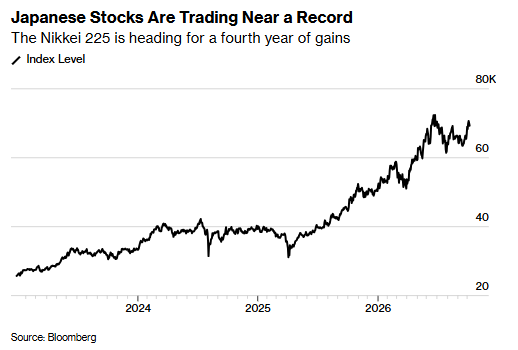
The two executives are strongly optimistic about Japanese stocks, based on a historic bull market that has continued for nearly four years. Currently, the Japanese stock market is approaching an all-time high, and its rise is strongly driven by three forces: the wave of AI investment, corporate governance reforms, and the increase in investment attractiveness brought about by the return of inflation.
The continued inflow of foreign capital has become the most important financial support for this round of the market. According to data from Japan's Ministry of Finance, the net purchase amount of Japanese spot stocks by overseas investors in the first half of 2026 exceeded 10 trillion yen, five times that of the same period last year, and reached a record high on a half-year basis.
The corporate governance reform provided institutional support for the revaluation of Japanese stocks. In July 2026, the Financial Services Agency of Japan and the Tokyo Stock Exchange jointly issued a revised version of the “Corporate Governance Guidelines” after a lapse of five years, requiring the board of directors to more actively manage and disclose the use of cash reserves and capital efficiency. This reform continues the “broken net stock” governance campaign promoted by the Tokyo Stock Exchange since 2023, and continues to guide Japanese companies to raise the level of shareholder returns.
Meanwhile, Japan's economy is experiencing its strongest wage growth cycle in decades. The average increase in “Chundou” salary negotiations in 2026 reached 5.01%, exceeding the target of 5% for the third year in a row, setting a record for the first “three consecutive wins” since 1989 to 1991. Continued wage increases provided a fundamental basis for the Bank of Japan to withdraw from ultra-loose monetary policy, and also injected impetus into consumption-driven economic growth.
However, the background of AI investment reversal risks warned by Kentaro Okuda and Akihiko Ogino is an unprecedented wave of capital expenditure around the world. Goldman Sachs predicts that between 2026 and 2031, global AI capital expenditure around computing, data centers, and electricity will reach about $7.6 trillion, and annual investment will rise from $765 billion in 2026 to $1.64 trillion in 2031. Five hyperscale cloud vendors, Microsoft (MSFT.US), Alphabet (GOOGL.US), Amazon (AMZN.US), Meta (META.US), and Oracle (ORCL.US) alone, are expected to reach about $795 billion in capital expenditure in 2026, and will approach $1.08 trillion in 2027.
This round of capital market boom has also directly translated into an explosion in the performance of these two major brokerage firms, with both making records in the previous fiscal year.
The trend of the yen
In judging the Japanese yen exchange rate, the predictions of the two executives were also divided. Akihiko Ogino expects the USD/JPY exchange rate to trade around 160 within the entire forecast range up to the end of 2027. Okuda Kentaro predicted that the USD/JPY exchange rate would be around 156 by the end of the year, then gradually strengthened as geopolitical concerns abated.
Akihiko Ogino attributed the yen's recent recovery from excessive weakness to joint intervention, US Treasury Secretary Beisent's appeal to the Bank of Japan to raise interest rates, and the central bank to raise interest rates in September. He also described the rate hike as a “positive sign” reflecting economic growth.
Okuda Kentaro said that overseas investors still maintain strong interest in Japan, and the negative impact of interest rate hikes has not been significant so far. He added that the conflict between the Middle East and Russia and Ukraine could prolong, or push up energy prices and disrupt supply chains.