


Japanese interest rates are back in the spotlight as Prime Minister Sanae Takaichi talks more about fiscal discipline and bond markets start to test that story. When borrowing costs matter more, investors often pay closer attention to leaders with their own legacy on the line rather than hired managers on a short contract. This article walks through three founder driven Japanese stocks from the screener that fit that mindset.
The three founder led stocks that follow are only a sample from the broader idea, with the full screen surfacing around 100 more businesses with similarly strong founder stories that are not covered below.
If you want to identify and analyze the highest conviction founder opportunities in one place, go straight to the Founder-Led Companies screener.
Sega Sammy Holdings (TSE:6460)
Overview: Sega Sammy Holdings runs Sega’s global gaming and entertainment business, spanning console and mobile titles, amusement machines, animation, toys, pachislot/pachinko and casino resorts.
Operations: Sega Sammy generates about ¥328b from Entertainment Contents, ¥139b from Pachislot & Pachinko Machines and ¥32b from Gaming Business, after internal adjustments.
Market Cap: ¥643b
Sega Sammy aligns cleanly with the Founder-Led Companies theme because Hajime Satomi still steers Sega’s game and live service roadmap. Recent quarterly results show profits returning while dividends remain steady. Investors focused on founder commitment may see the Entertainment Contents pipeline as the key swing factor, depending on how one unseen pressure plays out.
That unseen pressure sits inside the forward cash story, so weigh it against the DCF valuation analysis for Sega Sammy Holdings to see whether the entertainment engine fully justifies the risk.
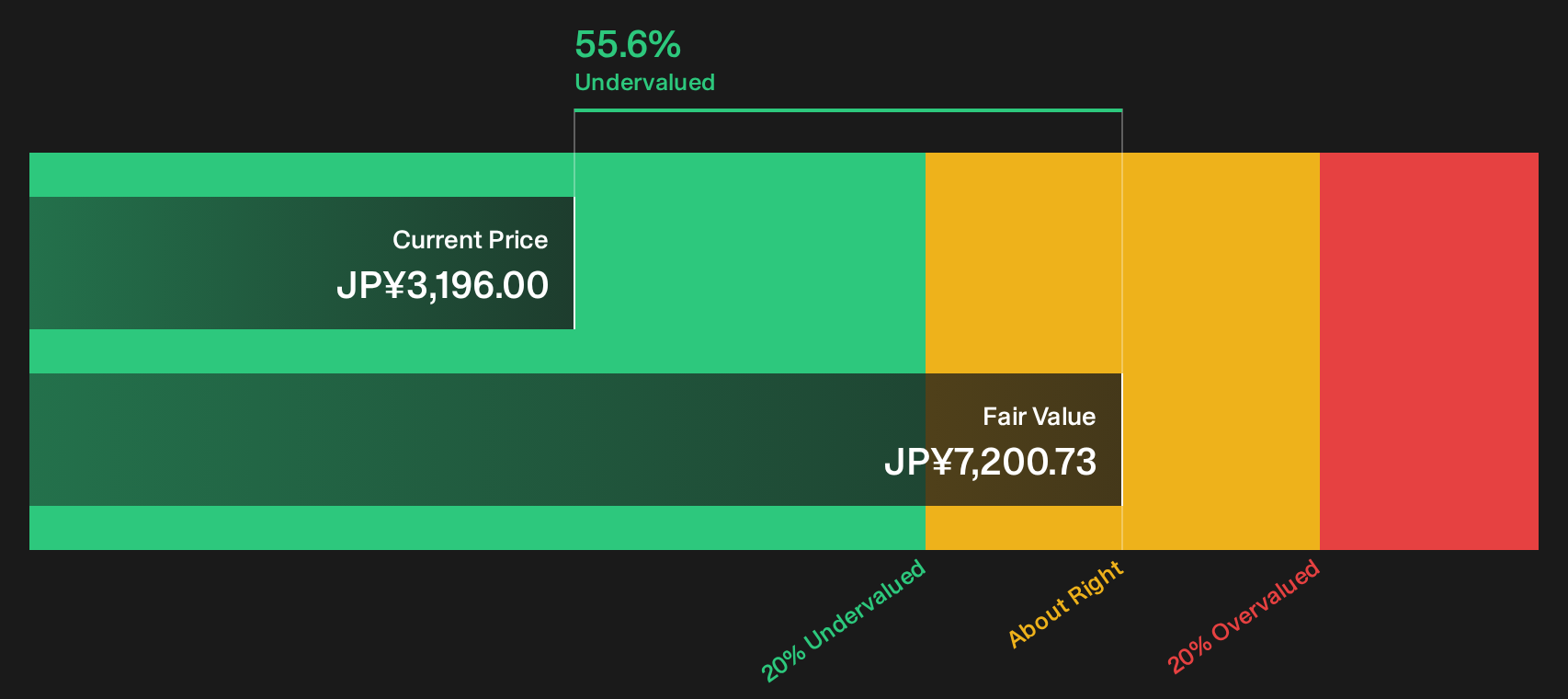
Sansan (TSE:4443)
Overview: Sansan provides cloud software that turns business cards and related documents into usable contact, invoice and contract data for Japanese enterprises.
Operations: Sansan generates about ¥46,847 million from its Sansan and Bill One business, ¥6,720 million from Eight, and smaller amounts from other services, almost entirely in Japan.
Market Cap: ¥268 billion
Sansan ties closely to the founder-led theme because the original Sansan cloud service still anchors the product line and guides how new tools like Bill One and Eight are built. Earnings have shifted sharply higher with net margin near 12.6% and forecast ROE in the 32 to 36% range, leaving investors to judge what happens if a single key assumption breaks.
If that single assumption about Sansan proves fragile, read the 3 key rewards and 1 important warning sign and see how those margins could either accelerate or stall.

CyberAgent (TSE:4751)
Overview: CyberAgent runs Japan focused internet advertising, media streaming, gaming and related AI services, led by its founder across core platforms.
Operations: CyberAgent generates about ¥478.2b from Internet Advertisement, ¥269.7b from Game and ¥246.6b from Media & IP, almost entirely in Japan.
Market Cap: ¥628.6b
CyberAgent fits the Founder Led Companies theme because founder Saburo Takahashi still shapes the Ameba and internet advertising roadmap, where much of the long term value story sits. That influence is now most visible in how media and IP earnings contribute alongside games.
"ABEMA is now profitable and weekly active users reached 31.37 million in FY 2026 Q3. Any further scaling of original shows such as Kyo-Suki and Shuffle Island plus anniversary-style event programming can give CyberAgent more pricing power on advertising and subscriptions and support higher Media & IP revenue and net margins."
What happens if one key assumption about how advertisers respond to that media footprint shifts could matter a lot for future profitability.
That pivot point is exactly what the full narrative for CyberAgent unpacks, showing how CyberAgent’s media scale, ad demand and gaming cycle could be decoupling in underappreciated ways.

Seeking Alternatives Before The Crowd
Fresh ideas move first. By the time everyone is talking about them, the easy entry points can be gone. Scan these under the radar lists while it matters and consider your options early.
- Explore early momentum in cash rich small caps by reviewing the curated 14 high quality undervalued stocks before other investors start focusing on the same companies.
- Follow structural shifts in automation by scanning the hand picked 88 robotics and automation stocks that could be positioned to support businesses upgrading factories and warehouses worldwide.
- Monitor potential opportunities in digital assets infrastructure using the focused 20 cryptocurrency and blockchain stocks before sentiment changes and valuations move away from today’s levels.
This article by Simply Wall St is general in nature. We provide commentary based on historical data and analyst forecasts only using an unbiased methodology and our articles are not intended to be financial advice. It does not constitute a recommendation to buy or sell any stock, and does not take account of your objectives, or your financial situation. We aim to bring you long-term focused analysis driven by fundamental data. Note that our analysis may not factor in the latest price-sensitive company announcements or qualitative material. Simply Wall St has no position in any stocks mentioned.
Have feedback on this article? Concerned about the content? Get in touch with us directly. Alternatively, email editorial-team@simplywallst.com