


The Zhitong Finance App learned that Wall Street professionals generally believe that in the AI Agent (AI Agent) competition circuit, chipmakers are still the best way for stock investors to participate in this wave — even though Meta Platforms (META.US) Muse products seem to temporarily seize the leading position.
“Leading the way is almost like a hot yam game,” said Paisley Nardini, head of investment strategy at Tema ETFS. The company manages $3.8 billion in assets and holds Meta shares. “I've heard people joking that in a few weeks we'll forget about Muse and go after the next hot topic.”
An AI agent is an autonomous AI system that can handle multi-step tasks such as reservations and financial management. The rise of such products has triggered a ripple effect in the market: on the one hand, investors are weighing which products may become the final choice for businesses and consumers, and on the other hand, evaluating the disruptive impact they may have on traditional business models.
However, in the midst of these questions, a definite trend has emerged: the computing power required for a new generation of AI agents far exceeds that of AI tools that were previously dominated by chatbots. This means that chip makers and other sectors in the AI infrastructure sector will continue to benefit. Since ChatGPT's inception nearly four years ago, these fields have been the mainstream choice for investors to deploy emerging technology.
Demand for computing power has surged, and smart devices have brought about “stepwise” changes
The essential difference between AI agents and previous AI tools is a fundamental change in their computing architecture. AMD (AMD.US) pointed out when releasing the Helios AI rack product in July that intelligent AI is driving a “step change” in computing requirements because the intelligent body requires multiple steps to reason, call tools, access data, and coordinate workloads. AMD estimates that in 2026, about 60% of the world's AI computing power will be used for inference tasks.
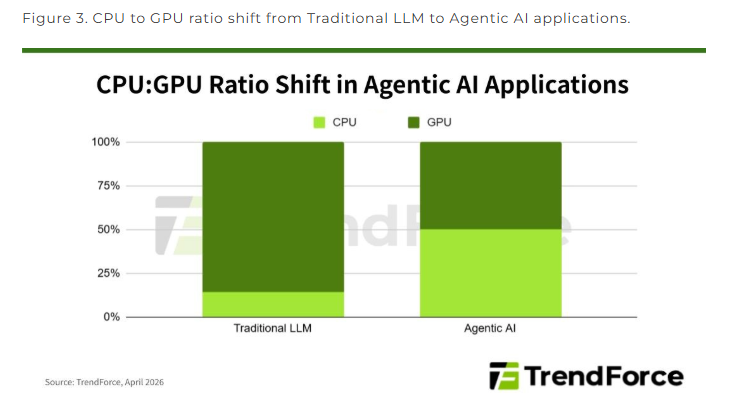
This trend is reshaping the demand structure of the entire semiconductor industry chain. According to TrendForce research data, traditional AI data centers require about 30 million CPU cores per gigawatt of power, while in the age of AI agents, this demand will soar to 120 million cores, a fourfold increase. In the future, the ratio between CPU and GPU is expected to change from the current disparity gap of 1:1 to 1:2, which will significantly boost market demand for CPUs.
“Instead of trying to bet on which company will eventually make the best smart body, we want to hold the underlying cornerstone on which smart bodies operate — stocks that can benefit no matter which company leads,” said Rick Lear, chief investment officer at Lear Investment Management. The key layout of its centralized position portfolio is expected to benefit from targets of the wave of AI agents, such as Nvidia (NVDA.US), Micron Technology (MU.US), and power company Williams (WMB.US).
“The position of the leader in the technology industry continues to change, but as soon as the smart circuit as a whole explodes, the market will need more chips, more memory, more power and infrastructure,” he pointed out. “This underlying logic will not change, even if Meta falls from its current glory again.”
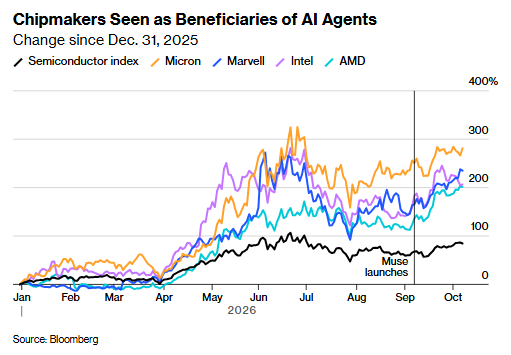
Since this year, AI infrastructure stocks have largely dominated the rise in the market. Of the 10 stocks that have increased the most in the S&P 500 index, 9 are related to this topic. Chipmakers performed particularly well, with the Philadelphia Stock Exchange semiconductor index surging 84%, driven by AI concept stocks such as Micron Technology, Maywell Technology (MRVL.US), Intel (INTC.US), and AMD.
Smart racetrack competition heats up
Meta launched its personal AI assistant Muse last month, which quickly garnered massive downloads and rave reviews. Muse's strong performance brought the Facebook parent company a hot September market. The stock price surged 27% in the same month, making it the best monthly performance in nearly four years.
Subsequently, OpenAI released Dots, a resident AI agent at the annual developer conference in September. It runs on the GPT-6 Astra platform, has an independent cloud computer and browser, and is open to ChatGPT Pro and enterprise premium users. Meanwhile, Alphabet (GOOGL.US)'s Gemini Spark and SpaceXAI's Grok Bot are also actively competing for AI smart device market share.
The rapid rise in popularity of Muse just shows that the AI market sentiment is changing rapidly, and momentum is often rapidly shifting to the latest or hottest products. Despite Meta's current boom, the first half of this year was questioned because the market believed that its investment of tens of billions of dollars in AI had little effect. Meanwhile, Alphabet has faced increasing scrutiny since the beginning of the year when it was viewed as an AI leader until recently.
This sharp fluctuation is the reason why many investors think AI infrastructure stocks are more reliable than participants in the smart device competition. “If you try to bet on Meta, Alphabet, Apple (AAPL.US), or any other company that will have the last laugh, it's almost like throwing a coin, and it's hard to predict whether to win or lose,” said Nardini of Tema ETFS. “Laying out infrastructure is a more direct path to profit, because the popularity of smart devices will drive demand for such hardware products over the long term.”
This view is rapidly becoming a market consensus, driving analysts to continuously raise profit expectations for AI infrastructure. Statistics show that the sector expects net profit growth of 63% and revenue growth of 54% in 2027. At the end of July, the market only expected profit growth of less than 48% and revenue growth of 32%. Forecasts for 2028 also continue to improve, indicating that Wall Street believes this trend will continue to be sustainable for years to come.
AI agents that continuously iterate are the core logic that supports these judgments. Citigroup analyst Atif Malik said that different types of semiconductors — including processors, storage, and network chips — may also benefit from the development of smart devices. In a research report on October 6, he estimated that the potential market size of CPU chips will grow at a compound annual rate of 60%.
“That's why the idea of laying out the infrastructure is very reasonable,” Nardini said. “Meta won't hold the torch high forever. After half a year, the industry leader may be replaced. But the demand for chips will not change.”