


The Zhitong Finance App learned that the US stock earnings season is approaching. NASDAQ's record high and Maywell management raised its performance growth target, providing a positive catalyst for the global AI optical interconnection industry chain to improve profit expectations — on October 6, the NASDAQ Composite Index rose 0.45% to a new closing high of 27,599.79 points; ASIC and AI data center optical interconnect chip leader Maywell (MRVL.US) raised its revenue target for the 2028 fiscal year from US$18 billion to US$20 billion, an increase of about 11.1%, and the stock price rose 5.1% on the same day. It reflects the market's positive expansion expectations for AI data center acceleration computing chips and CPUs, HBM/DRAM/NAND memory chips, and data center optical interconnect components.
Although the Nasdaq index and the Philadelphia Semiconductor Index fell by about 0.22% and 1.15% respectively on October 7, the recent bounce in technology stocks has brought the upcoming US stock earnings season and the AI computing power industry catalysis into the focus of the market.
Wall Street financial institution Jefferies (Jefferies) released the research report “Summit Preview: Power Supply Architecture Upgrades, Optical-In-Copper Interconnect Evolution, and Data Center Scale-Up Optical Interconnect Dominance”, which outlines five main interrelated investment lines around the OCP Global Summit held in San Jose on October 12-15:800G to 1.6T optical interconnection upgrade, Ethernet, UALink, and NVLink compete for dominance in scale-up interconnection, AI data center Near package optics (NPO) and co-package optics technology routes (CPO) change device value allocation, inference load drives memory architecture expansion, and 400V/800V DC power supply reshapes rack power systems.
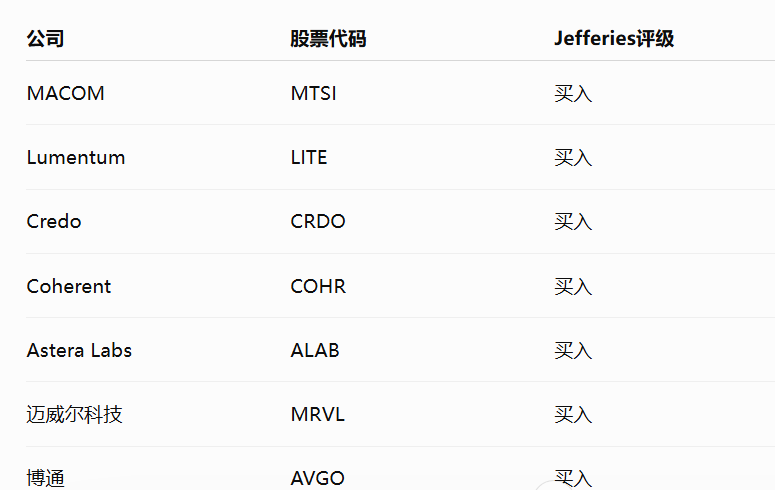
The most clearly preferred 1.6T targets in the Jefferies research report are Macom and Lumentum. At the same time, they believe that the ALC and OmniConnect opportunities of Credo, a leader in the dual high-speed transmission route of copper and optical interconnection, have not been given sufficient attention, and they are concerned about the commercialization of Coherent's PhotonLink, Astera Labs' memory controllers and switching chips, Lattice's low-power controllers, and the growth space for power semiconductors.
Looking at engineering and investment logic, Jefferies focuses on these investment opportunities and points to a change: after the AI computing power cluster continues and accelerates, high-speed data handling and transmission, memory configuration, and power conversion capabilities within AI data centers are becoming important constraints in determining whether GPUs can continue to output effective computing power resources and whether capital expenditure can be converted into revenue. As a result, related suppliers are expected to obtain higher single-frame value and profit contributions.
The AI rack upgrade can be described as entering a “battle for data transmission efficiency”: as cutting-edge AI agents such as Muse and Astra become popular around the world, the scale of AI computing power clusters continues to expand, and the bandwidth, latency, and energy consumption of high-speed interconnections are increasingly affecting GPU utilization and overall computing power output. On the eve of the OCP summit, Jefferies listed the 800G to 1.6T upgrade, NPO/CPO architecture evolution, and scale-up interconnection competition as the core observation directions, and clearly listed Macom and Lumentum as the most preferred 1.6T beneficiaries, focusing on the former's opportunities in the fields of optical detectors, transimpedance amplifiers and drivers, as well as the latter's layout in the field of high-speed lasers and external light sources. Its investment implications are mainly that the expansion of AI infrastructure is increasing the value of key optoelectronic devices, can transform technological advantages into suppliers of customer adoption, scale delivery and profit growth, and is expected to become an important winner in optical interconnection upgrades.
Optical interconnection is moving towards the front end of investment: the dispute between 1.6T emission and “connectivity dominance”
The investment value of the 1.6T upgrade is reflected in simultaneous changes in optoelectronic device demand, product structure and supplier share. The Jefferies (Jefferies) stock strategist team listed Macom and Lumentum as the most preferred 1.6T beneficiaries for the reason that they are the key devices on the receiving end and transmitter side, respectively. For MACOM, the focus is on the competitive position and revenue contribution of optical detectors in 800G and 1.6T deployments, as well as the demand for more channel transimpedance amplifiers (TIA) and drivers after module manufacturers adopted NPO designs; Semtech's data center special event on October 15 may also bring new industry references to MACOM by disclosing TIA and driver market size.
For Lumentum, what is most worth tracking recently is the 1.6T transmitter product share, pricing, production capacity, and profit margin, as well as the demand structure for electrically absorption modulated lasers (EML) and continuous wave lasers (CW). Jefferies added that ASIC, which is larger than Mewell Technology, and Broadcom, the leader in optical chips, are at the observation center for the share of optical module DSP chips. The report indicates that early channel signals are beneficial to them. Jefferies strategists made an investment judgment based on this — upgrading the high-speed optical interconnection rate of data centers can expand industrial demand, but the company's profit flexibility also depends on device share, manufacturing capacity, and product portfolio. macom and Lumentum are just two companies Jefferies believes have outstanding exposure to this upgrade.
MACOM focuses on optoelectronic devices and high-speed analog chips for AI optical interconnection, including optical detectors that convert optical signals into current, transimpedance amplifiers (TIA) that convert and amplify weak optical currents into voltage signals, and high-speed driver chips that drive lasers or modulators to provide key transceiver devices for 800G/1.6T optical modules; Jefferies is particularly concerned about its share of optical detectors and multi-channel TIA and driver opportunities brought about by NPO architectures. Lumentum, on the other hand, focuses on high-performance light sources, optical transceiver modules, and optical circuit switching, including electrically absorption modulated lasers (EML), continuous wave lasers (CW), external laser sources (ELS) for NPO/CPO, and optical path switching (OCS) systems that support dynamic network optical path reconstruction. Its investment focuses on 1.6T product volume, laser product structure upgrades, and increased demand brought about by new optical interconnect architectures.
On the NPO and CPO side, Jefferies said that NPO and CPO push optical devices closer to computing or switching chips, and value distribution will be redeveloped along lasers, packages, and complete components. From an engineering point of view, shortening the transmission distance of high-speed electrical signals helps reduce the signal integrity and power consumption pressure of high-bandwidth connections; specifically, using near-package optics (NPO) or co-packaged optics (CPO) will affect the need for external laser sources, drivers, optical fiber components, and package integration. Lumentum will discuss CPO external laser sources, wide parallel VCSEL interconnections, and jointly introduce automated optical path switching (OCS) networks with Oracle at the summit. The key to the latter is whether customer interest can be translated into a deployment that meets actual operational requirements.
PhotonLink, launched by Coherent in September, has engaged with more than ten customers in each direction of CPO and NPO. Both architectures have core customers and long-term agreements, and are expected to contribute revenue in the fourth quarter of 2026; it covers lasers, VCSEL arrays, silicon, fiber components, and detectors. Whether customers purchase a single component or a complete component will directly affect the revenue and profit contribution of each deployment. Customer certification, manufacturing yield, and the progress of ultra-high power platforms are just as important. Meanwhile, Jefferies is concerned about whether Amax Osram's micro-VCSEL can enter Nvidia's future scale-up architecture, including potential NVL1152 Feynman opportunities; this route may change previous assumptions about the value of indium phosphide lasers.
Scale-up competition determines how accelerators form larger collaborative computing systems, and also determines the share of switching chips, copper connections, and optical connections. Jefferies focuses on the competition between EtherNet/Sue, UALink, and NVLink: Nvidia expands the scope of ecosystem participation through NVLink Fusion and may disclose an NPO route for the NVL576 scale-up; AMD launched Helios in July and plans to begin delivery to Microsoft and other customers in late 2026. The investment focus will further focus on implementation of deployment, progress in UALink adoption, and participation opportunities for Astera Labs and Broadcom. The 100G ULink switching chip per channel announced by Maywell is expected to be rolled out within the year, and AMD's next generation rack plans to scale up across racks by combining optical and copper connections.
According to the Jefferies strategist team, Credo provides another interesting technology path: it is expected that the first demonstration of ALC, which combines its own connectivity platform with MicroLED technology acquired from Hyperlume, aims to achieve power consumption and reliability performance close to active cable (AEC) at a distance of up to about 30 meters; judging from the report, MicroLED is more likely to target scale-out or even scale-in, while the potential micro-VCSEL route may be oriented towards scaling up. Additionally, whether Nvidia is considering certifying Credo's ZF Optics to resolve repeated link outages in new cloud service provider clusters using the Nvidia platform is also a focus of observation. Jefferies emphasizes that the bandwidth, latency, and stability of connections directly affect the synergy efficiency of expensive accelerators, and vendors that can improve these metrics have the opportunity to gain value beyond simply increasing the number of ports.
Memory and power are in front of the interconnection stage: the second strong profit curve for AI rack upgrades
The expansion of heavyweight AI inference workloads is opening up room for growth in memory controllers, switching chips, and hierarchical memory architectures. Jefferies pointed out that Maywell has emphasized that CXL and memory controllers can become important supporting opportunities as XPU deployments grow, and Astera Labs' Leo product line provides a specific landing point in this direction: Leo 2 E supports CPU memory expansion through CXL 3.2 and PCIe 6, and Leo 2 P supports cross-host memory pooling and sharing. Both support DDR4 and DDR5, enabling customers to reuse existing memory and improve resource utilization without increasing CPU slots. Currently, the new product line is surpassing the new product line. Large scale cloud customer sample delivery.
The GPU-oriented Leo X is connected to the dedicated memory layer with the Scorpio switch chip through PCIe and platform-specific protocols to form another product path different from CXL expansion on the CPU side; according to customer configurations, Astera Labs may simultaneously receive revenue from the memory controller and connected to the switch chip. The report also focuses on opportunities for Amazon and AMD to adopt UALink for next-generation racks, and whether Amazon will split supply shares between Astera Labs and Maywell, and once again emphasizes that Credo's OmniConnect opportunities are undervalued. Looking at the underlying logic of the inference system, Jefferies points out that a longer context and higher concurrency will expand the cache and working set capacity requirements, and rationally combine high-bandwidth memory with large capacity expansion and memory pooling to help improve the utilization rate of expensive computing resources, and also make memory connections and management chips a more important component of AI capital expenditure.
High-speed interconnection of high-density AI racks is simultaneously increasing the value of power conversion and system control, but the 400V/800V landing sequence determines the specific revenue realization rhythm, which means that optical interconnection mainly solves the bandwidth, delay and energy consumption problems of data transmission; high-voltage DC power supply reduces current and line losses in high-power distribution, and meets the power supply requirements of chips in the context of high-speed transmission through efficient power conversion. Together, the two support the accelerated expansion of AI clusters; “The order of landing determines the pace of revenue realization”, which mainly refers to different power supply solutions Deployment time will affect when power semiconductor and related control device suppliers will receive incremental revenue.
According to Jefferies strategists. Jefferies anticipates that Nvidia's October 12 keynote address and technical discussions around 800V DC, grid-connected, liquid cooling, and MGX will further clarify opportunities for Texas Instruments, Adderall, and Ansemi. According to the report, the delay in the Kyber rack and 800V transformation has led to a correction in related stocks; it is expected that the 400V solution will first be seen in the OCP Diablo 400 frame in the near future, and it is assumed that subsequent Oberon/Taycan racks will continue to increase power levels. HVDC power distribution can reduce current and cable losses at the same power, and the chip side still requires efficient voltage reduction. System architecture, conversion efficiency, solid state transformers, and rack power distribution design will jointly determine the requirements of next-generation GaN and SiC devices.
Jefferies strategists said that Nanowei Semiconductor's adoption of 800V is highly business-sensitive, and a side power cabinet may become a transition path before full rack-level 800V deployment. At the same time, Lattice's low-power FPGA can undertake system management, platform security, hardware monitoring and rack control, and act as a controller for continuous operation in AI servers, liquid cooling, and power supply systems. Intelligent collaboration between edge AI systems and machines may also expand their local programmable processing requirements.