


Delta Air Lines, which trades on the NYSE under the ticker DAL, has delivered robust share gains in recent years. That climb now raises a straightforward question for investors who focus on earnings: Is the current US$82.97 price adequately supported by what the airline is earning today and what it may reasonably generate over time?
- Over the past 3 years, Delta Air Lines has returned 137.7%, which puts real pressure on the idea that its recent earnings performance can comfortably support the higher valuation.
- Recent commentary on rising fuel costs, changing revenue expectations and higher ticket prices suggests that future profitability and cash generation may depend heavily on how effectively the airline manages both input costs and pricing power.
- Your read on Delta Air Lines is one view; the desks covering it have another. See what analysts think Delta Air Lines's shares could be worth.
The issue now is whether Delta Air Lines' earnings are strong and resilient enough to justify where the stock trades today.
If you are weighing whether Delta Air Lines' US$82.97 price is well supported by its recent earnings and fuel cost pressures, it can help to compare that setup with 29 high quality undervalued stocks.
Does Delta Air Lines Look Undervalued on Earnings?
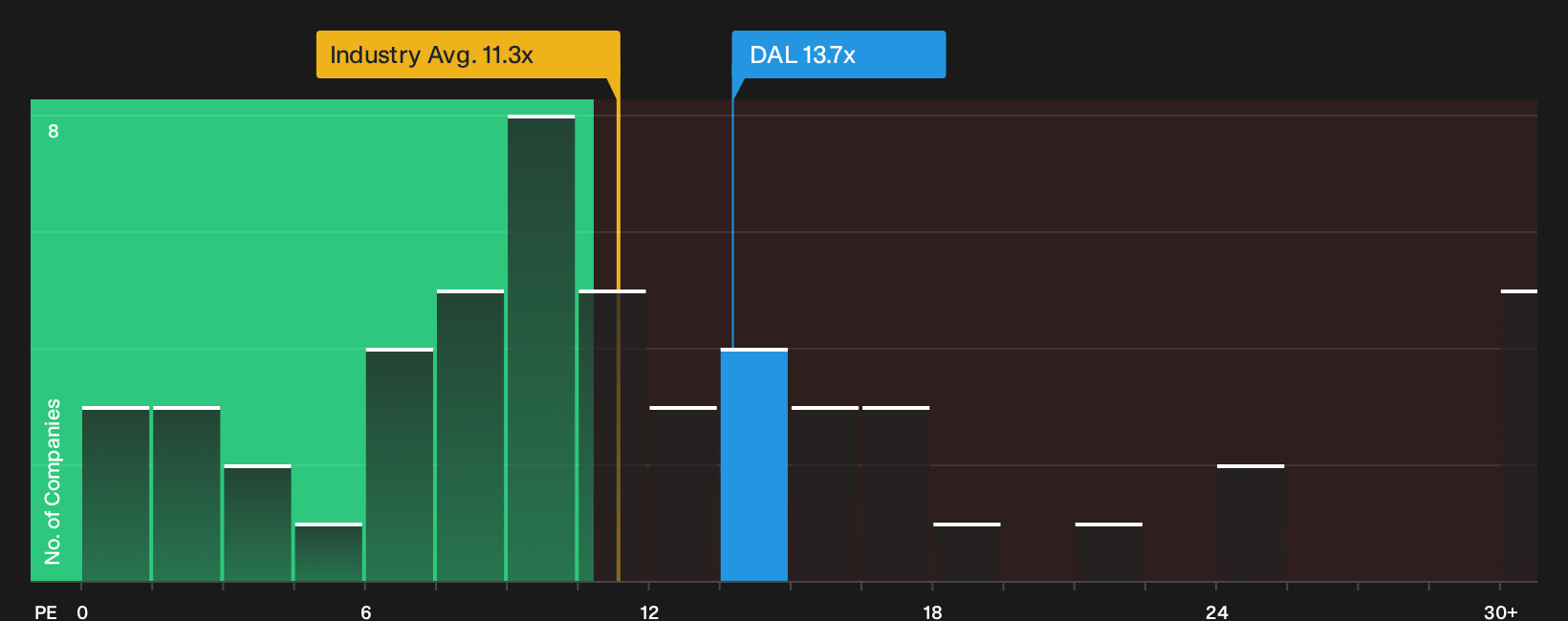
P/E works well for Delta Air Lines because earnings are a key focus for airlines with meaningful profitability and capital needs. At a P/E of 13.7x, Delta trades slightly above the airline industry average of 11.3x and just above the 13.2x peer group level. As a result, the stock does not screen as especially cheap on simple sector comparisons.
The fair value model suggests that, given Delta Air Lines' own mix of margins, growth expectations, size and risk, a higher P/E would be typical for this kind of earnings profile. This points to the current 13.7x as undervalued on that tailored yardstick. Despite recent commentary on fuel costs and revenue guidance resetting expectations, the market multiple still prices Delta at a discount to what this framework implies for its earnings power. This is the gap investors need to judge against their view of future demand and cost pressures. Explore the numbers behind Delta Air Lines's P/E valuation.
The Delta Air Lines Narrative: What Would Justify Today's Price?
For Delta Air Lines, Simply Wall St Narratives pick up where this valuation puzzle leaves off by explaining which paths for future growth, margins and earnings would need to occur for the stock to be worth materially more or less than today’s market price. Rather than relying on a single multiple or model output, each scenario sets out the specific assumptions behind its fair value estimate so you can track how those expectations compare with results as they are reported.
Community views on Delta Air Lines are split between those who see resilient premium demand and loyalty economics and those who worry more about thinner cushions if things go wrong.
Bull case: 19% undervalued
"Delta is capitalizing on resilient revenue streams such as premium, loyalty, and international segments, which are expected to continue growing…"
Discover why this Narrative puts Delta Air Lines at 19% undervalued.
Bear case: 31% overvalued
"Its balance sheet is somewhat strained and always at risk of sudden, exogenous shocks such as another pandemic or a trade war…"
Explore why this Narrative puts Delta Air Lines at 31% overvalued.
One more Delta Air Lines check that belongs beside the valuation work
Before you get comfortable with where Delta Air Lines trades, it helps to know that independent checks have flagged specific business risks that could matter more than the current P/E or narrative suggests. Take a closer look at 2 warning signs before settling on a valuation.
This article by Simply Wall St is general in nature. We provide commentary based on historical data and analyst forecasts only using an unbiased methodology and our articles are not intended to be financial advice. It does not constitute a recommendation to buy or sell any stock, and does not take account of your objectives, or your financial situation. We aim to bring you long-term focused analysis driven by fundamental data. Note that our analysis may not factor in the latest price-sensitive company announcements or qualitative material. Simply Wall St has no position in any stocks mentioned.
Have feedback on this article? Concerned about the content? Get in touch with us directly. Alternatively, email editorial-team@simplywallst.com