


HubSpot (HUBS) has kicked off a broad reset, announcing plans to cut about 7% of its workforce and overhaul product teams around customer outcomes and AI-focused execution.
The reset comes after a tough stretch for HubSpot shareholders. The stock has a 1-year total shareholder return that declined 48.82%, and a 5-year total shareholder return that fell 70.62%, even as the 90-day share price return of 11.74% and 7-day move of 6.62% suggest short term momentum is rebuilding from a lower base.
Seize this reset moment at HubSpot to compare it with a hand picked group of SaaS peers showing stronger momentum and financial resilience through our list of solid balance sheet and fundamentals (25 results).For HubSpot, the sharp share price reset followed by a short burst of strength raises a simple tension. Is the recent rebound pointing to improving conviction in the business, or just sentiment snapping back after heavy losses?
Most Popular Narrative: 7% Undervalued
On the most followed view of HubSpot, the shares at $231.84 are modestly below an implied fair value of $249.37. This keeps attention on how the reset and AI rollout translate into future earnings power under an 8.64% discount rate.
Rapid adoption and expansion of AI-based functionality such as Customer Agent, Prospecting Agent, and connectors to leading LLMs are driving higher customer engagement, sticky workflows, and early-stage monetization opportunities, especially via credit-based AI features. These developments are setting the stage for stronger net dollar retention and potentially higher net margins in 2026 and beyond.
See why 65 investors see HubSpot as 7% undervalued.
Result: Fair Value of $249.37 (UNDERVALUED)
Still, HubSpot faces clear risks if AI agent monetization underwhelms or if weaker SMB and mid market demand keeps net new ARR and customer additions under pressure.
Find out about the key risks to this HubSpot narrative.
Another View: HubSpot On Earnings-Based Valuation
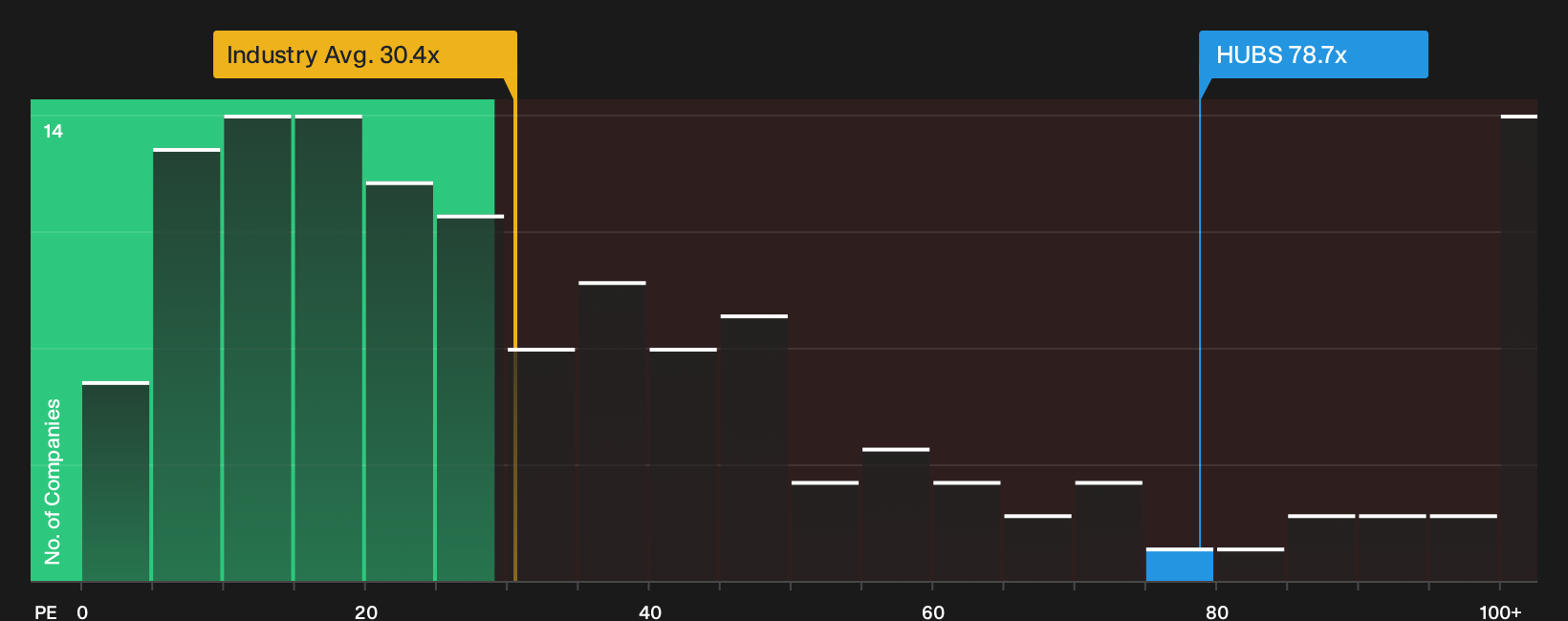
The earlier narrative focuses on discounted cash flows that imply significant potential upside for HubSpot. A straightforward earnings-based perspective tells a different story. At a P/E of 78.7x compared with 30.4x for the US Software industry, 47.2x for peers, and a fair ratio of 63.6x, the stock appears expensive rather than cheap. When expectations are this elevated, it raises the question of which view of value to rely on.
See what the numbers say about this price — find out in our valuation breakdown.
Next Steps
Mixed signals around HubSpot can either spook you or push you to sharpen your own thesis. Take a moment to weigh both sides and move quickly by checking the 3 key rewards and 2 important warning signs.
Looking for more HubSpot sized investment ideas?
If HubSpot has you rethinking your watchlist, do not stop here. Broader opportunities across sectors could align better with your risk tolerance and return goals.
- Target higher quality potential by reviewing a curated pool of attractively priced businesses through the 27 high quality undervalued stocks.
- Prioritise resilience and sleep-better-at-night holdings by scanning companies with sturdier finances in the list of solid balance sheet and fundamentals (25 results).
- Hunt for future standouts early by checking a focused set of under-the-radar opportunities using the 20 high quality undiscovered gems.
This article by Simply Wall St is general in nature. We provide commentary based on historical data and analyst forecasts only using an unbiased methodology and our articles are not intended to be financial advice. It does not constitute a recommendation to buy or sell any stock, and does not take account of your objectives, or your financial situation. We aim to bring you long-term focused analysis driven by fundamental data. Note that our analysis may not factor in the latest price-sensitive company announcements or qualitative material. Simply Wall St has no position in any stocks mentioned.
Have feedback on this article? Concerned about the content? Get in touch with us directly. Alternatively, email editorial-team@simplywallst.com