


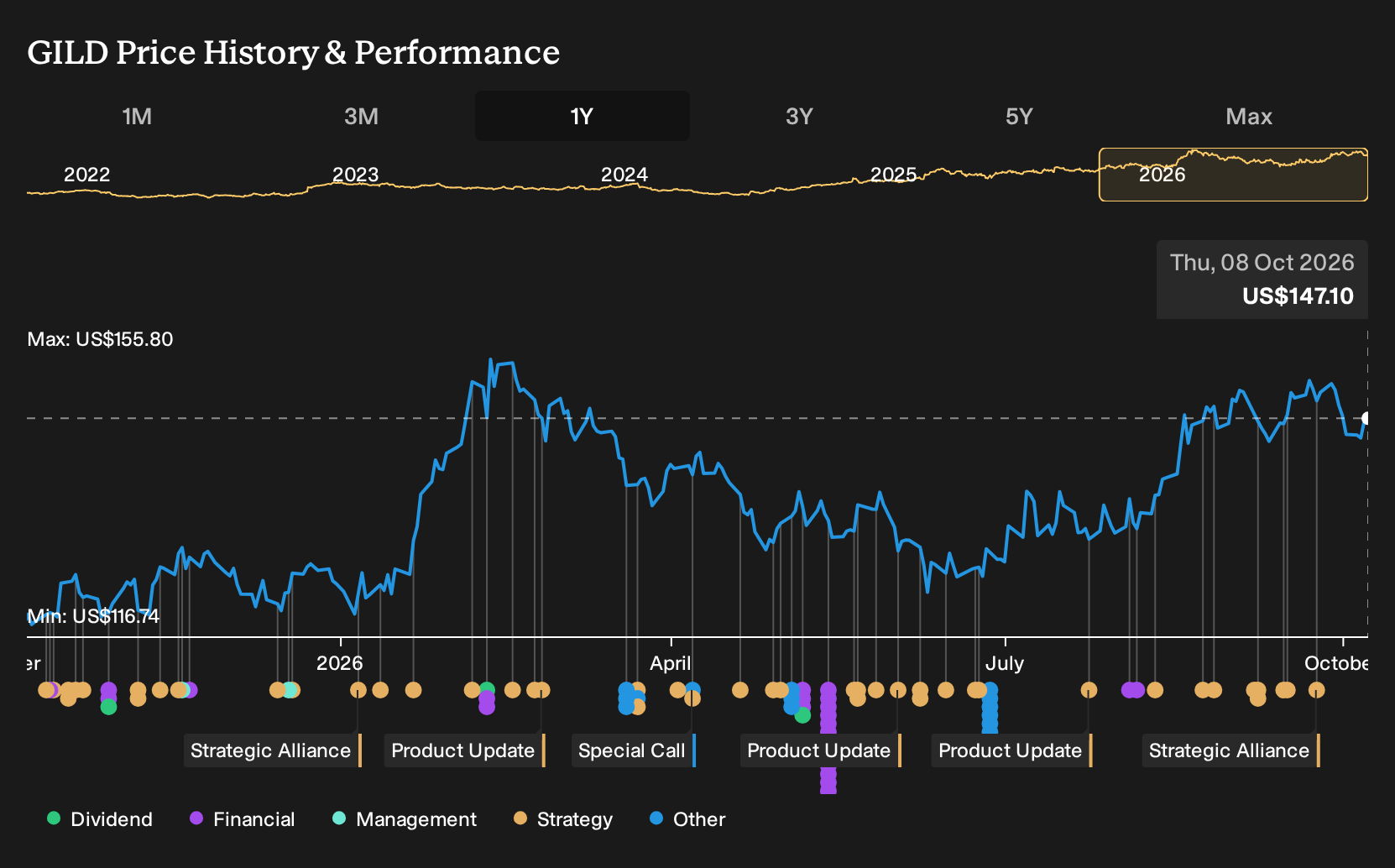
- Gilead Sciences reported a strong Q2, with revenue up 10.2% year on year and full year EPS guidance above analyst estimates, and extended a five year DevOps and agentic AI partnership with Cognizant that builds on more than a decade of collaboration.
- The combination of outperformance against quarterly expectations and a long term technology agreement points to management attention on both current execution and longer term operational efficiency within Gilead Sciences' core research and commercial systems.
- We will now see how Gilead Sciences' stronger Q2 results could influence its investment narrative built around HIV and oncology growth.
Scan how Gilead Sciences fits into a broader push toward AI enabled efficiency by comparing it with our hand picked 32 healthcare AI stocks across the healthcare sector.
Gilead Sciences Investment Narrative Recap
To own Gilead Sciences, you need to believe its HIV prevention and treatment engine can keep generating meaningful cash while oncology and immunology products gradually take on more weight. The stronger Q2, with 10.2% year on year revenue growth and EPS guidance ahead of expectations, speaks to execution but does not resolve the dependence on HIV.
The near term swing factor is whether HIV PrEP and long acting regimens scale fast enough to offset pricing and policy pressure. The biggest risk is that competition and reimbursement pressure across HIV and cell therapy keep margins subdued. The Cognizant AI and DevOps deal mainly supports execution rather than changing those core drivers.
The most relevant update here is the five year extension of Gilead Sciences' agreement with Cognizant to expand DevOps and agentic AI across research and commercial technology. This is focused on how efficiently the group can run clinical, regulatory and commercial work as the portfolio broadens beyond legacy virology therapies.
If the AI enabled tooling and streamlined delivery work as intended, this setup could help Gilead Sciences run more trials in parallel, shorten release cycles for internal software and reduce friction in global launches. The operational risk is that complexity rises faster than productivity, so investors will want to see clean project delivery, controlled costs and support for the key catalysts in HIV, oncology and immunology.
What The Current Gilead Sciences Forecasts Assume
Analysts are effectively asking you to underwrite a pivot in Gilead Sciences' earnings profile, from a loss today to solid profitability later in the decade, while its AI enabled execution push aims to keep research, clinical and commercial work on schedule.
The consensus framework in the latest report assumes revenue expands by 5.3% each year over the next three years, with profit margins rising from a loss position of 10.6% today to 32.4% after that period.
On that basis, earnings are projected to move from a loss of US$3.2b today to US$11.5b by 2029, alongside an implied P/E of 21.3x compared with a loss making multiple of 57.9x today.
Analysts also model a very small reduction in the share count, with outstanding shares declining by 0.06% annually over the next three years. This slightly lifts earnings per share if the profit path tracks the forecasts.
Against those income statement and share count assumptions, the AI and DevOps agreement with Cognizant mainly sits in the background as plumbing that needs to support that margin lift and R&D output rather than drive the top line on its own.
Gilead Sciences' narrative projects US$35.5b revenue and US$11.5b earnings by 2029. This setup requires 5.3% yearly revenue growth and an earnings increase of about US$14.7b from a loss of US$3.2b today.
For investors assessing Gilead Sciences, the key question is whether HIV prevention, long acting HIV treatment and the oncology and immunology pipeline can realistically support that move in margins and earnings while policy pressures and competition remain live issues.
Uncover why Gilead Sciences' fair value indicates an 8% potential upside to its current price that could narrow quickly.
Exploring Other Perspectives
One alternate view leans hard on policy risk. In that more cautious storyline, the lowest analysts were working off roughly US$33.5b of revenue and US$12.1b of earnings by 2029, yet still saw a lower price target. This serves as a reminder that even strong Q2 numbers and the Cognizant AI deal might reshape these narratives in different ways, so it is worth exploring several viewpoints before deciding how Gilead Sciences fits your portfolio.
Explore 4 other Gilead Sciences fair value estimates, including one that suggests there could be as much as 13% downside from the current price.
Reach Your Own Conclusion
Disagree with existing narratives? Extraordinary investment returns rarely come from following the herd, so go with your instincts.
- A great starting point for your Gilead Sciences research is our analysis highlighting 3 key rewards and 2 important warning signs that could impact your investment decision.
- See our latest analysis for Gilead Sciences. The report includes a comprehensive fundamental analysis summarized in a single visual, the Snowflake, making it easy to evaluate Gilead Sciences' overall financial health at a glance.
Looking for more Gilead Sciences sized investment ideas?
If Gilead Sciences is on your radar because of its cash generation and pipeline mix, it can help to line it up against a wider set of opportunities that share traits you care about, whether that is income strength, balance sheet resilience or future upside potential.
- For investors who want income to do more of the work, check out 8 dividend fortresses that may suit a yield focused portfolio.
- If capital preservation and steadier risk profiles matter most to you, filter for companies in the 31 resilient stocks with low risk scores to see which ones pass those tests.
- When you are hunting for mispriced opportunities with quality fundamentals, scan the 27 high quality undervalued stocks that could warrant a closer look.
This article by Simply Wall St is general in nature. We provide commentary based on historical data and analyst forecasts only using an unbiased methodology and our articles are not intended to be financial advice. It does not constitute a recommendation to buy or sell any stock, and does not take account of your objectives, or your financial situation. We aim to bring you long-term focused analysis driven by fundamental data. Note that our analysis may not factor in the latest price-sensitive company announcements or qualitative material. Simply Wall St has no position in any stocks mentioned.
Have feedback on this article? Concerned about the content? Get in touch with us directly. Alternatively, email editorial-team@simplywallst.com