


The Zhitong Finance App learned that at a time when the Nasdaq Composite Index reached a record high and Wall Street analysts' expectations of a sharp expansion in AI-driven earnings for the upcoming US stock reporting season continued to heat up, the rise in oil prices on Thursday and the report that OpenAI's revenue fell short of the previously disclosed $70 billion report triggered market concerns surrounding the growth and delivery of AI applications, leading to a sharp drop of 3.39%. The sharp drop in oil prices on Friday and reports that OpenAI's annualized revenue is expected to grow strongly at the end of the year eased doubts, driving the stock prices of Nvidia, TSMC, Broadcom, Applied Materials, Ke Lei, and others to rebound after a sharp drop in the stock prices of the US stock market on Friday.
At a time when the global semiconductor sector recently pulled back, Wall Street financial giant Bernstein's stock analyst team recently released a report called “Asian Semiconductors and Global Storage: Results Forecast for the Third Quarter of 2026 - Is the AI Theme Still Worth Going Longer?” The research report gave a bullish answer that the global semiconductor sector, especially global memory chips, during the US stock earnings season “is still worth investing in.”
The Bernstein analyst team said that the rise in global credit financing costs due to the surge in 10-year and 30-year US bond yields, and major environmental constraints related to AI security and the big model update and iteration process may slow down investment in AI computing power infrastructure-related semiconductor stocks, but the early adjustments already reflect most of the risks. Major AI customers that urgently need to accelerate the AI computing infrastructure process will maintain strong demand even after costs have risen, and the cost transmission pressure on non-AI demand may be even greater.
On the operating side of the computing power industry, TSMC announced initial revenue for the third quarter of about NT$1.494 trillion, a sharp increase of 51% year on year; Samsung's initial operating profit was 107.4 trillion won, up 782.5% year on year, indicating that demand for wafers and storage is being realized. As a result, the main investment line of the Bernstein research report covers TSMC's sharp expansion of production capacity and unquestionably strong pricing power in chip foundry in the context of the AI boom, the storage sector and strong profit growth of semiconductor leaders related to a wide range of AI computing power tend to be sustainable over the long term, the inclination of TSMC production capacity towards CPUs and the Google ASIC scaling process led by MediaTek, as well as the valuation differentiation between mature manufacturing semiconductor companies and semiconductor companies focusing on edge AI and consumer electronics production capacity.
OpenAI is negotiating a pre-investment valuation of about 1.4 trillion US dollars; the valuation judgment given by Anthropic's potential IPO investors reached 1.8 trillion to 2 trillion US dollars, and there are expectations that match or exceed the scale of SpaceX's issuance. These are still within the scope of the IPO listing expectations promoted by financing negotiations and Silicon Valley venture capital.
Compared to AI application valuation narratives, the AI computing power supply chain already has a more specific basis for strong demand: the media revealed Anthropic's infrastructure arrangement of about $518 billion over the next ten years, of which about 80% is irrevocable or agreed upon. Anthropic's revenue in 2025 increased about 12 times the previous year, close to 4.6 billion US dollars, operating losses exceeded 8 billion US dollars, computing power and infrastructure expenses reached 7.33 billion US dollars, about three times that of 2024, accounting for about US$12.65 billion in total operating expenses 58%; Nvidia's data center revenue in the latest quarter was US$89 billion, up 117% year on year; South Korea's semiconductor exports in September were US$60.3 billion, up 262.8% year on year. Officials also indicated an increase in the number of storage exports and contract prices.
From the perspective of heavyweight AI inference workloads, Muse's continuous back-office execution and Astra's ability to perform complex computer tasks have expanded the scope of work that AI can handle; multi-step tasks, tool calls, and parallel agents may also increase model calls and context processing corresponding to each user. Anthropic has observed in its research system that multi-agent tasks use about 15 times more tokens than normal chats. What can be deduced from this is that with the full penetration of cutting-edge AI agents such as Muse, AI computing power requirements will spread along GPU computing, HBM and DRAM capacity bandwidth, KV cache and SSD storage, high-performance CPU tool execution, and high-speed data transmission systems based on optical interconnect chips; overall resource requirements ultimately depend on the combined effects of increased task volume and improved unit task efficiency.
From “killing valuations” to “taking over profits”? Wall Street sees a new round of upward momentum in the semiconductor sector
The AI superbull market currently sweeping the global stock market seems to be looking for a “profit takeover window” — that is, when 10-year US bond yields hit new highs for more than 20 years, leading to DCF's denominator expansion, as long as earnings per share continue to grow, the stock market does not need to rely on the price-earnings ratio to rise again to a high level; if interest rate/US bond yield pressure then eases, stable valuations may also increase earnings space. As for the so-called “profit pick-up window,” the semiconductor sector of the global stock market seems to meet all the core elements.
Another Wall Street financial giant, J.P. Morgan Chase, said that what the agency's strategist team is optimistic about is a rearrangement opportunity formed by easing position congestion, falling valuations, and profit resilience. They particularly prefer semiconductors. According to the latest research report released by the agency, since June, the earnings forecast for semiconductors per share for the next 12 months has been raised by about 30% to 40%, and the profit forecast for the global software sector has not improved accordingly; the capital expenditure forecasts for hyperscale cloud computing vendors recently quoted by the agency are: about 950 billion US dollars in 2026, about 1.4 trillion US dollars in 2027, at least 3 trillion US dollars in 2030, and it is expected that the pace of AI-related revenue growth in 2027 will show a blowout expansion trajectory.
The core change brought about by the recently popular Meta Muse AI agent and the OpenAI Astra large model/AI agent “comparable to AGI” is that a single user command can trigger continuous, multi-stage computational work. A research, programming, or office task may in turn include planning, retrieving, reading documents, calling tools, executing code, checking results, and fixing errors. Multiple steps require re-calling the model, and complex tasks may also use parallel exploration and verification. Such an almost endless and increasingly complex AI workload will accelerate the transmission of growth opportunities to a complete AI inference load computing power system beyond the GPU.
From the perspective of AI inference system architecture, more complex AI tasks led by Meta Muse often include longer context, multiple rounds of model calls, tool execution, and result verification: prefill (prefill) requires processing input, decode (decode) continuously generates output, and key value cache (KV Cache) takes up more memory as context and concurrency scale expand, and computational throughput, memory bandwidth, and capacity need to be increased collaboratively. Therefore, as cutting-edge intelligence such as Meta Muse further detonates demand for AI computing power, the core reasoning for the AI computing power industry is that GPUs and TPU undertake model computation, high-performance data center CPU tool execution and task orchestration, and HBM, server DRAM, storage and high-performance network infrastructure, and data center optical interconnect devices all support efficient data transportation and state management; ultimately, a complete set of AI computing power server clusters will be needed to deliver sustainable services.
Strong AI demand supports bullish expectations for semiconductors in the earnings season: TSMC expands production and raises foundry prices, and storage continues to open up room for valuation improvements
Strong profit support for many Asian chip makers and foundries such as TSMC comes from a combination of scarce production capacity, product upgrades, and price increases. Bernstein expects revenue growth of 41% in 2026, and a month-on-month increase of about 10% or more in the fourth quarter. The forecast is that there is still room for improvement; the price increase for advanced processes in 2027 is a single digit to a low double digit, and the price increase for mature processes will begin to be reflected in the first half of next year.
The Bernstein Report sees initial sales of iPhones as support, but reports of Apple cutting production of parts for some models were added on Friday, making the fourth quarter guidance more meaningful. Furthermore, TSMC's exclusive 3nm and below advanced manufacturing capacity and 2.5D/3D advanced packaging production capacity continues to be scarce, enabling TSMC to continue to raise prices and upgrade process+advanced packaging combinations through foundry production capacity lines, transforming the demand intensity of any semiconductor chain associated with AI computing power into revenue growth.
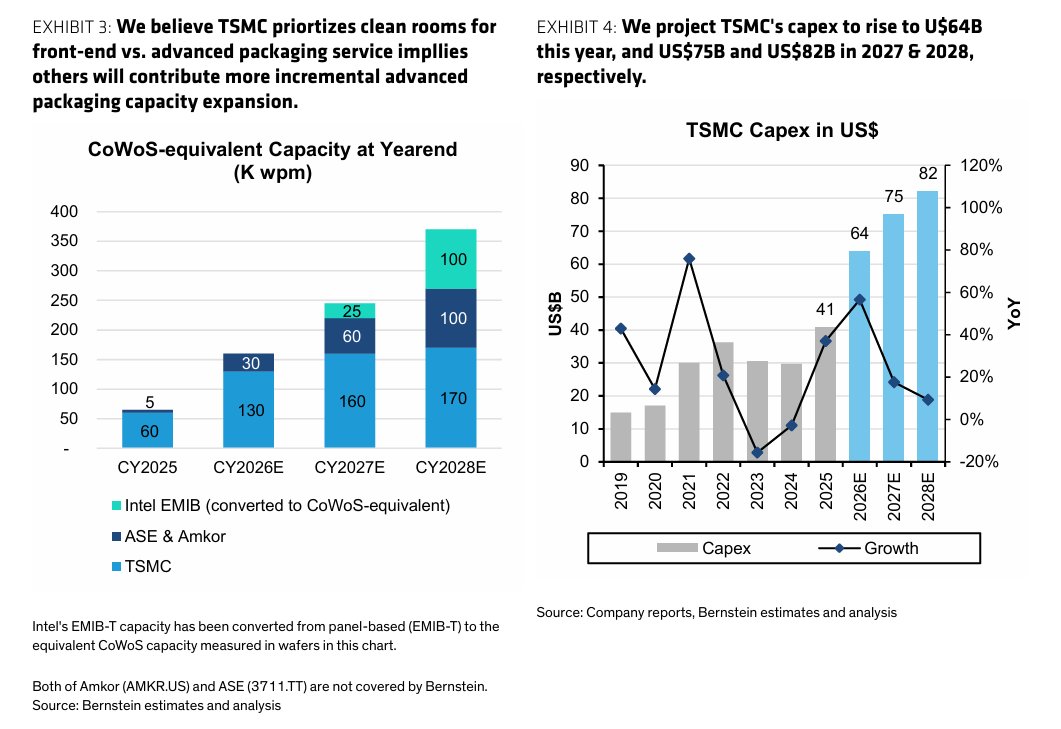
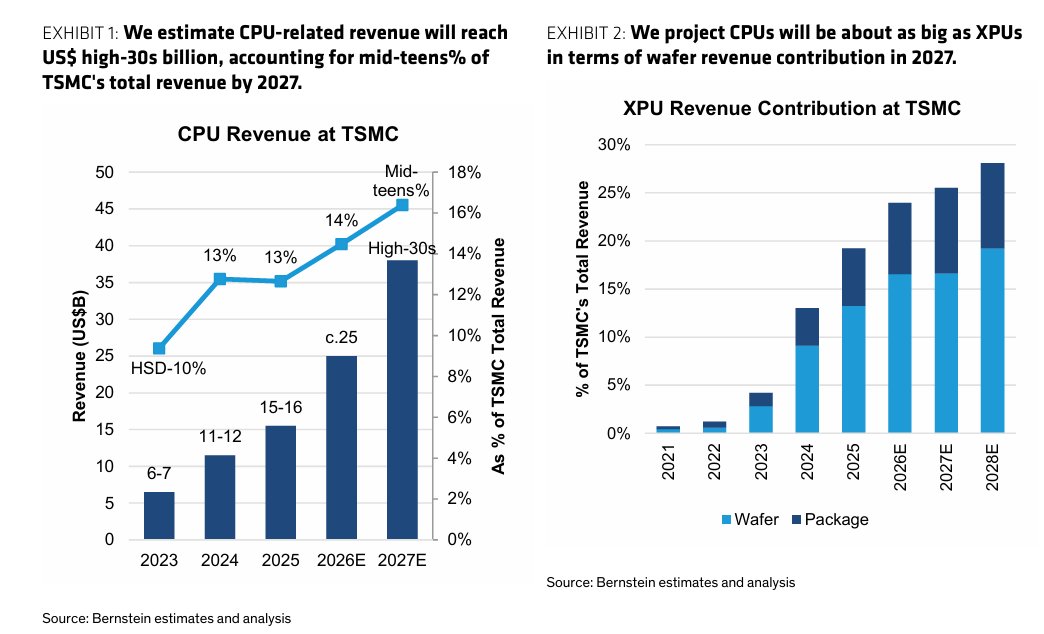
Bernstein's team of analysts highlighted in the research report that the AI intelligence frenzy led by Muse is expanding computing power investments to high-performance data center CPUs and custom ASICs/XPUs/TPUs. Burns such as task orchestration and data processing have increased. Bernstein expects TSMC's CPU wafer revenue to be close to 40 billion US dollars in 2027, which is comparable to the revenue from customized ASIC/XPU wafers, each accounting for about half of total revenue; XPU also contributes the strongest packaging revenue. Incremental production capacity is skewed towards CPU, ASIC/XPU, and Google and Amazon's self-developed CPUs benefit. Most CPUs use traditional packages, and clean room resources are scarce. TSMC prioritizes expanding manufacturing in the future, and Sun Moon Light, Anjiao, and Intel EMIB are expected to take on more package increments. The report predicts that TSMC's capital expenditure from 2026 to 2028 will be 64 billion, 75 billion, and 82 billion US dollars, respectively, but it is not expected that this financial report will immediately raise the 2026 guidance.
In the next phase of the global storage sector market, it is likely that it will be more dependent on long-term continuous expansion of profits and the upgrading of shareholder returns. The report quoted third party forecasts that DRAM and NAND prices both rose 15% to 20% month-on-month in the fourth quarter, slightly higher than the agency's own expectations; at the same time, delays in HBM4 progress, and the increase in HBM in 2027 may be lower than expected, and employee bonuses increased, limiting profits beyond expectations.
Therefore, Bernstein analysts are paying more attention to long-term supply agreements in the memory chip sector to increase profit visibility, and shareholder returns to drive up valuations. The agency clearly favors Samsung and Changxin for storage: Samsung is believed to be establishing a leading position in HBM4, and the valuation is low; Changxin is supported by domestic substitution, execution capabilities, and relative valuation advantages. The expansion of China's storage supply also significantly poses long-term competitive pressure on the world's top three memory chip manufacturers.
Bernstein revealed stock selection preferences in the semiconductor sector: Asian semiconductors such as MediaTek, Samsung, and TSMC ranked first, and mature processes focused on matching growth with valuation
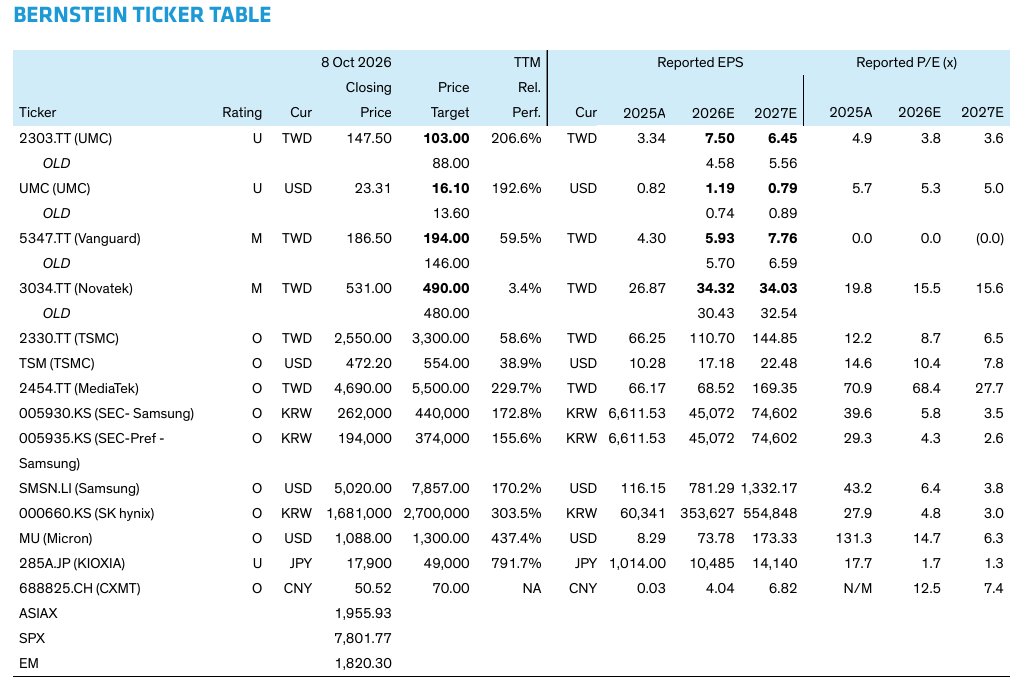
MediaTek is a new preferred semiconductor stock target added by Bernstein's analyst team to the semiconductor sector coverage of the global stock market. The following chart shows Bernstein's list of semiconductor stocks that analysts were optimistic about during the opening of the US stock reporting season. Asian semiconductor giants such as MediaTek, Samsung, TSMC, Kioxia, and Changxin ranked in the top list. The US memory chip giant, Micron (MU.US), which is also one of the three original memory chip manufacturers, is the only US semiconductor giant on the list.
Among them, the most notable is Bernstein's strong bullish position of up to 92% room for Samsung's preferred stock, followed by SK Hynix's target price, which means more than 60% room for potential growth over the next 12 months.
Bernstein raised the 2028 global data center XPU ASIC market forecast from 140 billion to 160 billion US dollars to 250 billion to 300 billion US dollars. The forecasts for 2026 and 2027 are 50 billion to 70 billion US dollars and 130 billion to 150 billion US dollars, respectively. For mature models, open source models, and AI agent workloads that have a relatively stable model structure, huge call volume, and can maintain high utilization rates for a long time, special AI chips such as TPU (Google TPU is the most typical AI ASIC technology route developed by major cloud computing companies) can be deeply optimized around low-precision matrix calculation, memory access, and chip interconnection, thereby improving the cost per token, throughput per watt, and total cost of ownership; at the same time, Google's TPU computing power clusters can also undertake large-scale training tasks, so the more accurate trend is GPU and ASIC/TPU forms a heterogeneous division of computing power.
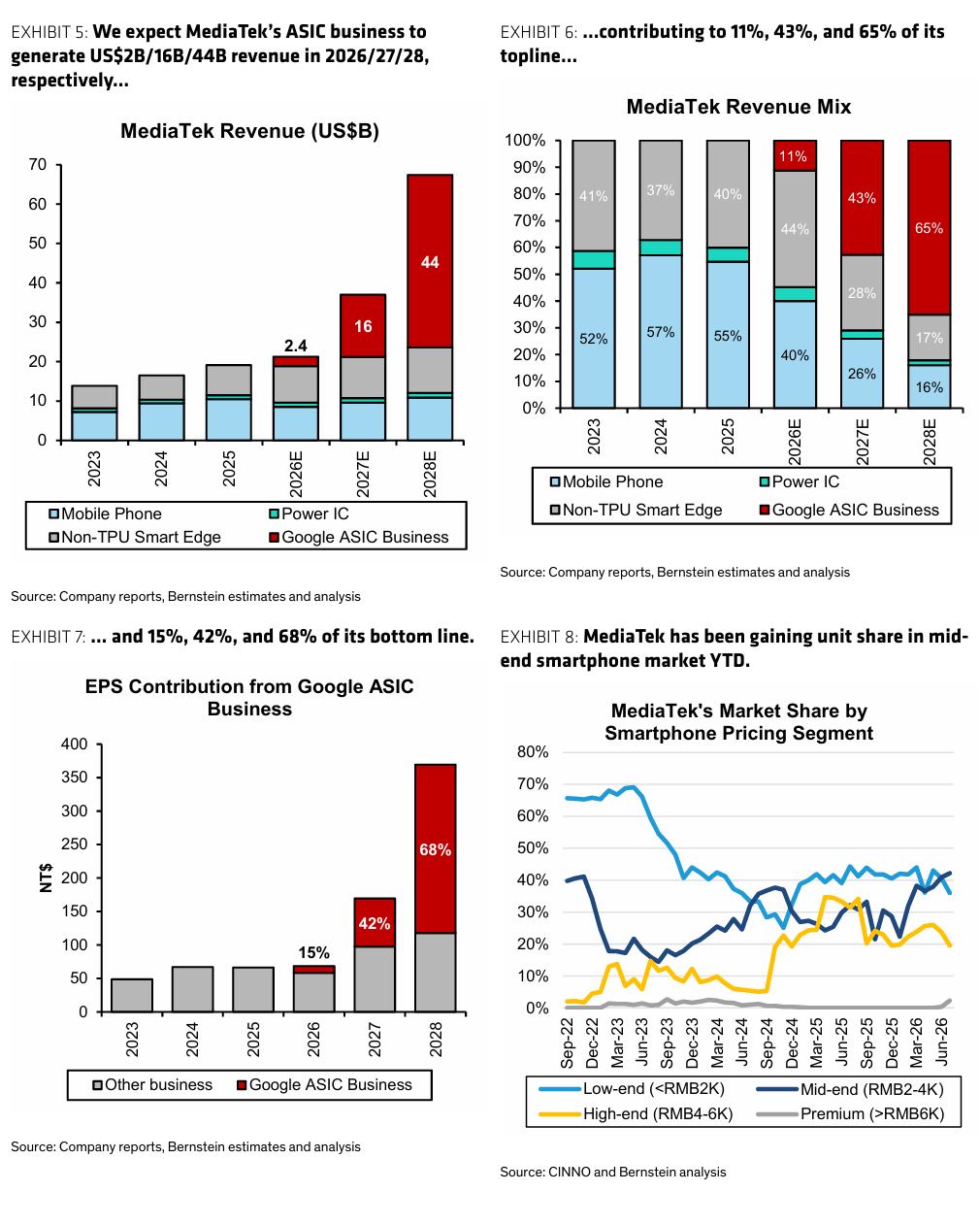
The agency said that batch shipments of TPU v8 have begun, and the yield of the V9 key carrier board has improved, creating conditions for delivery and profit improvement in 2027; even considering the intensification of v10 competition in 2029 and the reduction in valuation multiples, Bernstein still judges that there is room for growth. The report predicts that ASIC's revenue will reach 16 billion dollars and 44 billion US dollars in 2028, respectively. The revenue share is expected to rise from 11% in 2026 to 65% in 2028, and the profit share is expected to rise from 15% to an astonishing 68%. The increase in mobile SoC share while buffering the impact of storage price increases. The core of the bullish investment logic is to work with Google to build TPU or a broader ASIC custom chip business to change the company's growth and profit structure.
Regarding UMC, a chip foundry giant focusing on mature chip manufacturing and consumer electronics, Bernstein said that UMC benefits from connectivity, power management requirements, and Samsung's transfer of display drive orders. The average sales price is expected to rise 7% and 5% from 2027 to 2028, but the new business contribution and profit forecast are lower than market expectations and remain in line with the market; the target price was raised from 88 to NT$103, an implicit decrease of 30.2%.
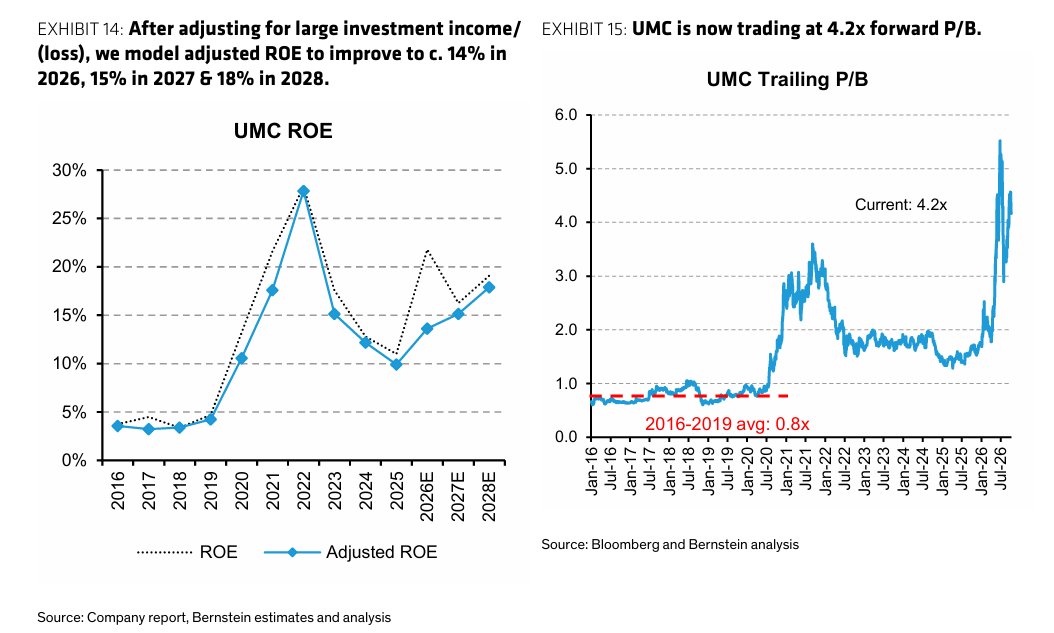
Bernstein also said that the world's advanced new VSMC plant is benefiting from intermediaries and power management requirements, and is expected to be close to full load once it is put into operation. Product upgrades will offset some depreciation pressure, but the valuation is sufficient and remains at the same level as the general market. The target price was raised from 146 to NT$194, with room for growth of 4.0%. Lianyong benefits from edge vision and customer inventory replenishment, but the low price storage inventory dividend will gradually subside and remain the same as the general market. The target price was raised from 480 to NT$490, an implicit decrease of 7.7%.