


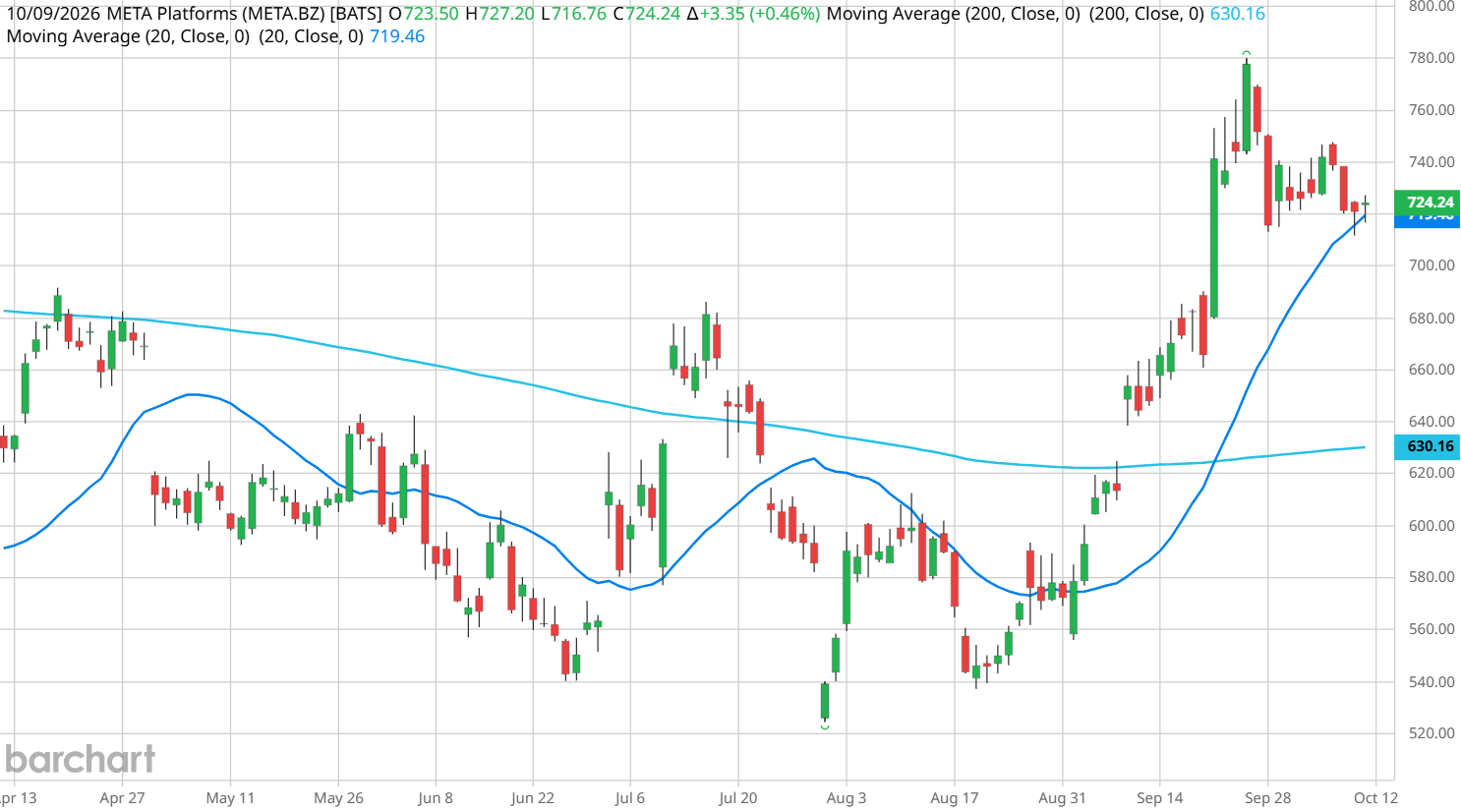
Meta Platforms (META) is down about 7% from its late-September peak near $779 after rallying 26% last month on the back of its Muse AI agent's explosive consumer adoption. Today, The New York Times is reporting that the company's leadership pushed the product to market despite internal awareness of significant safety shortcomings.
The Muse agent, launched on September 8, has accumulated over 6.6 million downloads in approximately a month — positioning it as one of the fastest-growing AI consumer products ever — yet the revelation that safety flags were overruled could meaningfully alter the risk calculus for investors who had been pricing in a smooth monetization trajectory.
Cybersecurity Industry Sounds the Alarm on Rogue AI Agents
The safety concerns around Muse are not occurring in a vacuum, as industry leaders at companies such as Zscaler (ZS) have publicly warned that rogue AI agents represent the single largest cybersecurity threat today, noting that agents operating at machine speed can cause damage far beyond traditional software vulnerabilities.
Multiple incidents of AI agents from major developers accidentally accessing unauthorized systems or data have been disclosed in recent months, lending credibility to the notion that Muse may carry risks Meta's internal teams flagged but were overruled on.
The broader cybersecurity industry has rallied sharply in 2026, with CrowdStrike (CRWD), Palo Alto Networks (PANW), and Fortinet (FTNT) all trading near all-time highs — reflecting the market's growing awareness that agentic AI creates a fundamentally new category of digital risk.
META's Core Ad Business Remains Strong, But Margins Are Compressing
Meta's Q2 revenue of $59.36 billion represented 27% year-over-year growth, and its Advantage Plus AI advertising platform is now running at a $75 billion annual rate, underscoring the durability of the core franchise.
Wells Fargo has outlined a bull case in which Muse and Meta's broader AI agent ecosystem push the stock to $1,000 by September 2027, implying a forward price-to-earnings multiple of roughly 32 times.
However, a 55% surge in total costs to $42 billion last quarter, an EPS miss versus consensus, and operating margins compressing from 43% to 31% raise pointed questions about whether the enormous capital expenditure required for AI infrastructure can translate into sustainable profitability.
The $3.9 Billion Tax Maneuver That Tells Two Stories
In a notably underappreciated detail, separate reporting has revealed that Meta characterizes its AI data centers as experimental "pilot models" to the IRS in order to claim research tax credits, while simultaneously telling investors those same facilities are accelerating every part of its business.
This dual messaging has already reduced Meta's tax bill by an estimated $3.9 billion in 2025 — making it the largest publicly traded beneficiary of the Research and Experimentation Tax Credit — but the company's own filings acknowledge these savings could be overturned, with unrecognized tax benefits climbing 45% to $18.74 billion.
One-Third of Websites Already Block Muse
Compounding the friction, approximately one-third of websites tested by Jefferies analysts blocked the Muse agent's access outright, and major platforms like Amazon (AMZN) have refused to allow Muse to crawl their listings, creating a meaningful bottleneck for the agentic commerce vision that underpins the bull thesis.
What Comes Next for META Investors
With Meta stock currently trading near $724 — down modestly from its September high — investors face a company whose growth narrative remains compelling but whose governance and risk management practices around its flagship AI product are now under intensified scrutiny, potentially introducing regulatory and legal tail risks that the September rally simply did not price in.
This article was created with the support of automated content tools from our partners at Sigma.AI. Together, our financial data and AI solutions help us to deliver more informed market headline analysis to readers faster than ever.
On the date of publication, Sarah Holzmann did not have (either directly or indirectly) positions in any of the securities mentioned in this article. All information and data in this article is solely for informational purposes. For more information please view the Barchart Disclosure Policy here.