


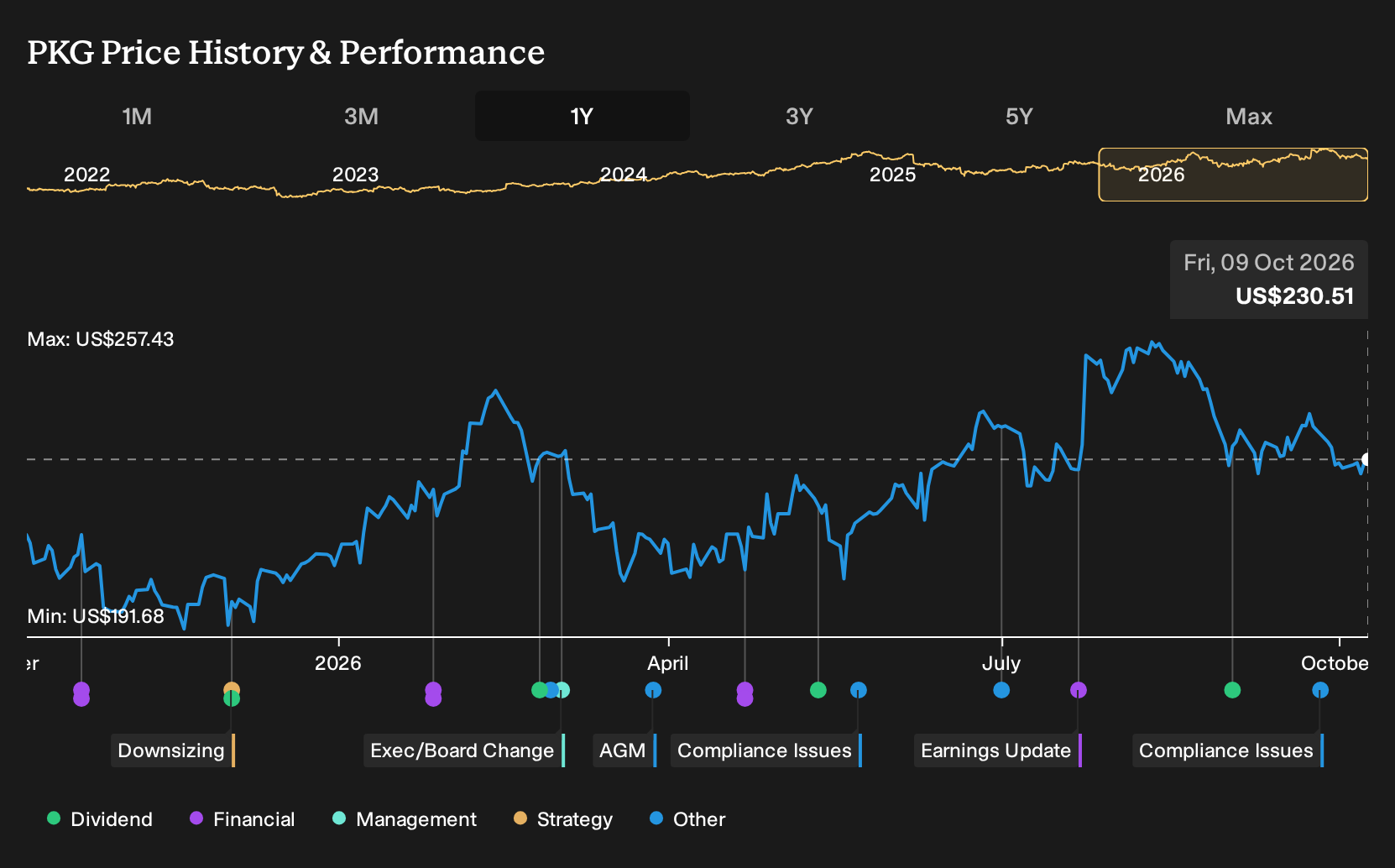
- Packaging Corporation of America reported that it previously filed a Dam Failure Analysis and Hazard Potential Assessment for the Grandmother Falls Hydroelectric Project with FERC, recommending a shift from high to low hazard potential classification based on engineering work by Mead & Hunt.
- The requested downgrade to low hazard potential, if accepted by regulators, could reshape future safety compliance obligations and cost structures around this non-core hydro asset within Packaging Corporation of America’s broader industrial footprint.
- This development raises questions about how Packaging Corporation of America’s investment narrative may relate to the proposed hazard downgrade at Grandmother Falls.
Scan 31 resilient stocks with low risk scores that, like Packaging Corporation of America, place rigorous compliance and asset risk management at the center of their long term investment story.
Packaging Corporation of America Investment Narrative Recap
To own Packaging Corporation of America, you need to believe its heavy investment in mills, Greif integration and multiple 2026 containerboard price increases can offset pressure from higher recycled fiber, freight and energy costs. The key near term swing factor is how much of those US$70 and US$140 per ton price moves actually hold in customer contracts.
The Grandmother Falls filing looks modest for that core thesis. It relates to a small hydro project, not the box or paper network, so any effect on earnings or near term catalysts around pricing, mill uptime or synergy capture appears limited. The bigger risk still sits with weaker corrugated demand and squeezed margins.
Among recent developments, the push to install about US$250 million of gas turbines at the Jackson and Riverville mills ties most directly to the new FERC submission. Both developments indicate that Packaging Corporation of America treats infrastructure, energy exposure and compliance as part of its operating toolkit rather than as side issues.
If regulators agree Grandmother Falls carries lower hazard potential, the hydro project could require a different long term risk framework. At the same time, gas turbines aim to reduce purchased power reliance. Together, these moves frame a story in which energy and asset risk management support the same catalysts investors already watch, including mill efficiency, pricing follow through and eventual margin recovery.
Packaging Corporation of America's current analyst storyline points to revenues of US$11.3b and earnings of US$1.6b by 2029, built on forecast revenue growth of 5.8% per year and an earnings step up of about US$912.6m from US$687.4m today.
Uncover why Packaging Corporation of America's fair value indicates a 12% potential upside to its current price that may not last much longer.
Exploring Other Perspectives
Margin risk is where the bearish analysts really lean in. You can see it in their view that Packaging Corporation of America reaches about US$11.2b of revenue and US$1.4b of earnings by 2029, which is below consensus. Those estimates were set before the Grandmother Falls filing, so you should expect opinions to shift as the regulatory story evolves.
Explore 2 other Packaging Corporation of America fair value estimates, including one that suggests as much as 15% downside from the current price.
Form Your Own Verdict
Don't just follow the ticker. Dig into the data and build a conviction that's truly your own.
- A great starting point for your Packaging Corporation of America research is our analysis highlighting 3 key rewards and 4 important warning signs that could impact your investment decision.
- See our latest analysis for Packaging Corporation of America. The report includes a comprehensive fundamental analysis summarized in a single visual, the Snowflake, making it easy to evaluate Packaging Corporation of America's overall financial health at a glance.
Looking For More Investment Ideas Beyond Packaging Corporation of America?
If this Packaging Corporation of America story has sharpened your thinking on risk, returns and balance sheet strength, use that same lens to scan a wider set of companies with the Simply Wall St Screener.
- If you want potential value combined with quality fundamentals, start with 27 high quality undervalued stocks that already clear a high bar for both balance sheet strength and cash generation.
- For investors who care most about resilient income streams, focus on 8 dividend fortresses that pair higher yields with supporting financial metrics.
- If capital preservation is your first filter, narrow your search to a list of solid balance sheet and fundamentals (25 results) that can help you avoid fragile capital structures.
This article by Simply Wall St is general in nature. We provide commentary based on historical data and analyst forecasts only using an unbiased methodology and our articles are not intended to be financial advice. It does not constitute a recommendation to buy or sell any stock, and does not take account of your objectives, or your financial situation. We aim to bring you long-term focused analysis driven by fundamental data. Note that our analysis may not factor in the latest price-sensitive company announcements or qualitative material. Simply Wall St has no position in any stocks mentioned.
Have feedback on this article? Concerned about the content? Get in touch with us directly. Alternatively, email editorial-team@simplywallst.com