


Google’s AI ambitions once gave Unity (U) investors a reason to sell. Now, they offer a reason to take another look. Earlier this year, Unity shares plunged 22% in a single session after Google (GOOGL) unveiled Project Genie, fueling concerns that AI-generated gaming environments could threaten traditional development tools.
Now, Unity Software, which provides tools for developers to build, run, and monetize games, has seen its shares rise 1% following news of an AI gaming partnership with Google. The stock stood at $45.54, bringing its year-to-date gain to 2.88% and its 52-week advance to 24.84% as of Oct. 7.
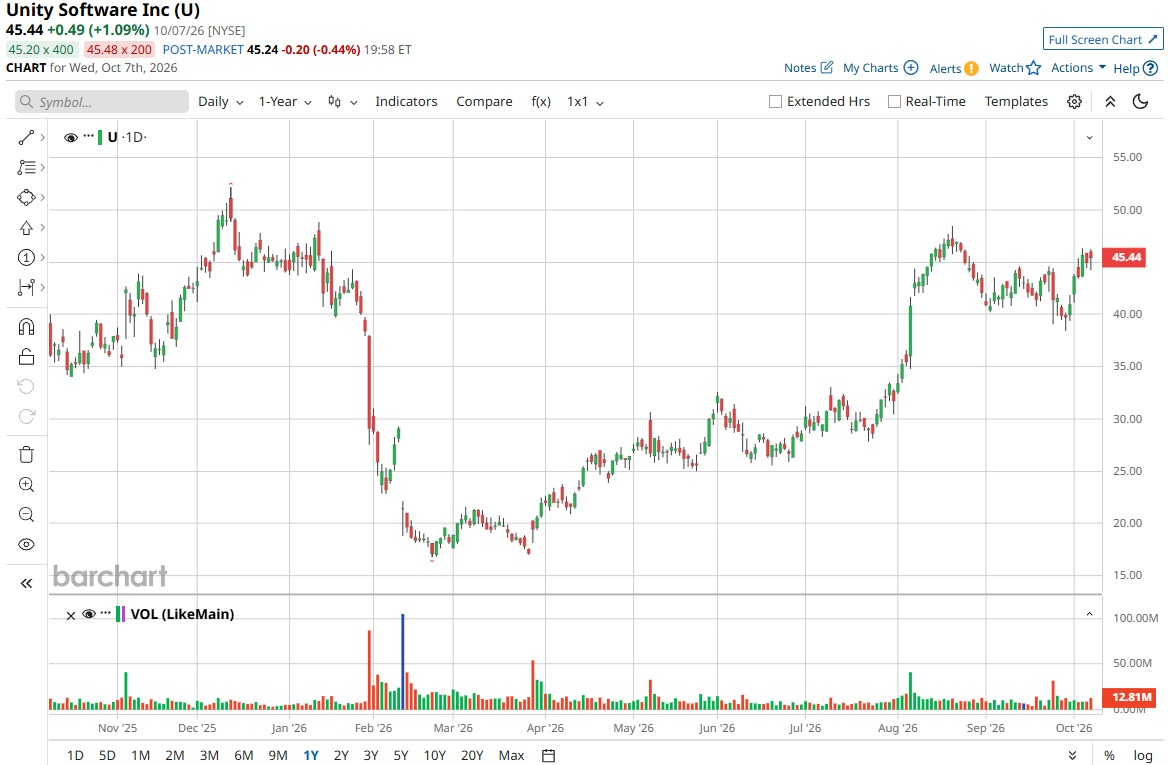
This partnership puts Google in a different light for Unity investors and not just a potential competitive threat, but a collaborator that could help expand its gaming opportunities.
Still, a share-price rally is not proof of a stronger business. With the Google partnership adding a new growth opportunity, should investors view U as a buying opportunity after the surge, or a stock whose promise still needs to translate into results? Let’s dig into the details.
What Google’s Gaming Deal Means for Unity
Unity’s Oct. 7 agreement with Google aims to bring more people into game creation and give them a reason to use Unity’s technology as their ideas become more ambitious. Google supplies the AI capabilities and consumer reach, while Unity provides the engine needed to build more sophisticated games.
That journey starts with Google’s experimental Playground, where adults can create and customize playable games using text prompts rather than code. Unity Spark, expected later this year, will take the concept further with advanced game mechanics and high-fidelity 3D capabilities.
Google also plans to showcase standout Playground creations across its network and direct users toward Unity Spark. Google Play Games profiles will support features such as leaderboards and multiplayer matchmaking, helping creators build an audience as well as a game.
This gives Unity a way to benefit from AI-driven game creation rather than merely defend against it. However, more creators will not necessarily mean more profits. The deal strengthens Unity’s growth possibilities, but execution and evidence that adoption produces revenue will determine how much those possibilities are worth.
The partnership comes as Unity’s existing business continues to expand, with second-quarter revenue rising 23.9% year over year to $546.5 million. That growth provides a useful starting point, but assessing U after the rally also requires a closer look at the businesses generating those sales and how much of that revenue reaches the bottom line.
Unity’s Advertising Business Leads the Recovery
Unity Software reported second-quarter revenue of $546.5 million, up 23.9% year over year and 6.1% above the $515.1 million consensus. Its adjusted EPS figure reached $0.28 versus $0.25 expected, representing a reported 12.4% beat. U recorded adjusted EBITDA of $160.2 million, exceeding the $136.6 million forecast by 17.2% and delivering a 29.3% margin.
The operating margin improved to -5.9% from -26.9%, narrowing losses but remaining negative. Unity also reported an 18% increase in billings to $557.8 million. Its third-quarter adjusted EBITDA guidance midpoint of $187.5 million exceeded analysts’ $152.2 million estimate. This outlook points to further improvement in adjusted profitability.
The strongest growth came from advertising, with Grow Solutions revenue rising 35% to $389 million from $287 million. This increase reflected Unity Vector’s contribution to the Unity Ads Network. U also reported strategic revenue growth of 38% to $486 million. The company’s CEO, Matthew Bromberg, credited runtime-data integration, saying, “Our astounding performance is fueling a 63% year-over-year increase in our Strategic Grow business.”
Unity reported Create Solutions revenue of $158 million versus $154 million, representing reported growth of 2%. The segment benefited from higher subscription revenue, although cloud and hosting revenue declined following the 2025 portfolio reset. That decline partially offset the subscription gains.
Unity is also expanding developers’ options. Its Sept. 24 Meta Platforms (META) VR Glasses announcement enables adapting existing Quest titles and building new experiences. That could support demand for development tools, although no revenue contribution was quantified in the material verified here.
Wall Street’s Outlook
Unity’s next earnings release is listed for Nov. 4, with analysts forecasting $0.18 EPS for the quarter ended September 2026. Compared with $0.01 a year earlier, that implies 1,700% growth, although the small comparison base makes the increase look especially dramatic.
That expected improvement fits the confidence Piper Sandler expressed on June 2, when it raised its price target from $35 to $40, a level that implied nearly 12% downside. Analyst James Callahan maintained an “Overweight” rating, arguing that AI-related risks were overblown and Unity remained deeply discounted after January’s Genie update.
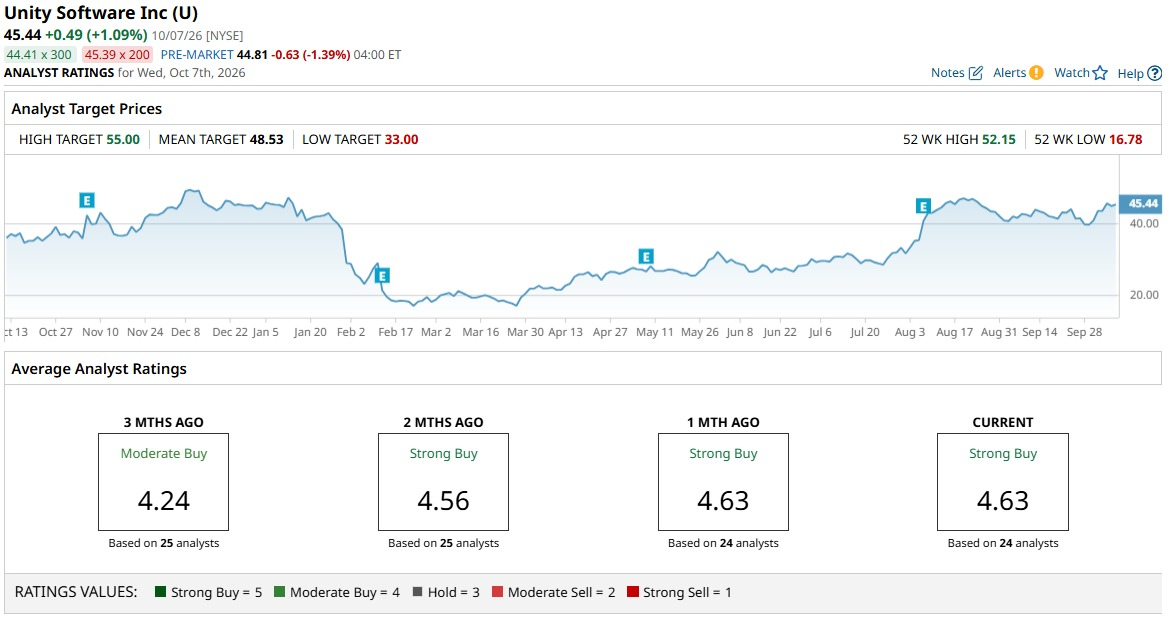
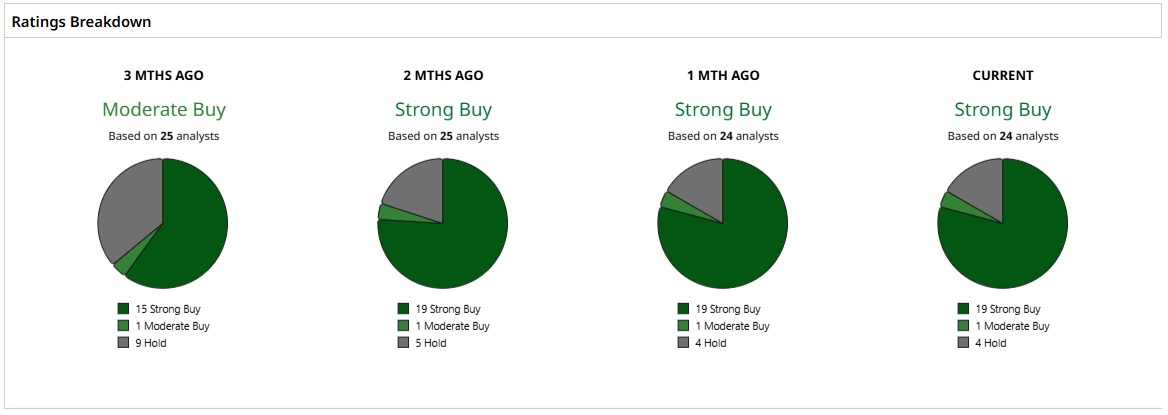
The broader analyst snapshot is more encouraging, though it also suggests modest remaining upside. Across 24 surveyed analysts, Unity carries a “Strong Buy” consensus, which is optimistic. Their average $48.53 target implies approximately 6.6% upside. That leaves a narrower opportunity than the bullish rating might suggest.
Conclusion
Unity’s Google partnership strengthens the growth case, giving investors another reason to consider U alongside analysts’ “Strong Buy” consensus. The deal could attract more creators, but its earnings contribution remains uncertain. With shares already rallying and the average analyst target suggesting 6.6% upside, buying gradually looks more reasonable than chasing the price. Further gains are possible if improving results support higher forecasts. Investors should view Unity positively, while recognizing that the partnership’s promise still needs to translate into financial results.
On the date of publication, Ebube Jones did not have (either directly or indirectly) positions in any of the securities mentioned in this article. All information and data in this article is solely for informational purposes. For more information please view the Barchart Disclosure Policy here.