


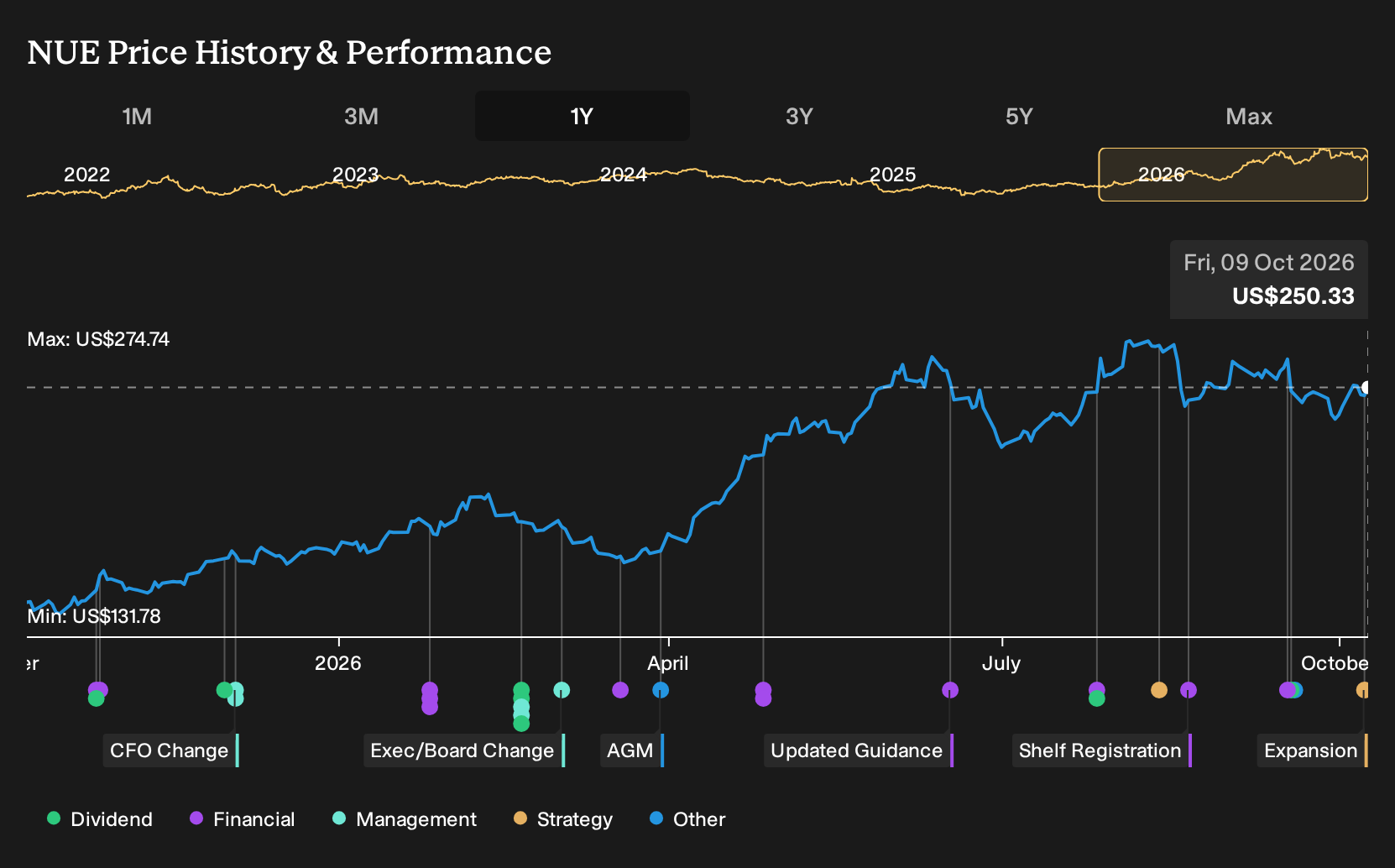
- Nucor Corporation recently approved a US$105 million expansion of its Nucor Towers & Structures facility in Crawfordsville, Indiana, adding over 120,000 square feet of automated manufacturing space for utility poles and related transmission products, subject to regulatory approvals.
- The Crawfordsville expansion is expected to create 100 jobs with average annual wages of US$87,500. This indicates that Nucor is committing more capital and skilled labor to higher value steel products tied to long term power grid demand.
- We will now explore how Nucor's expanded utility pole capacity could influence the broader investment narrative around its downstream steel products.
Nucor Investment Narrative Recap
To own Nucor, you need to be comfortable tying your capital to North American steel demand, trade protection in the U.S., and the build out of higher margin steel products. The Crawfordsville expansion fits that story by putting more weight on utility focused steel products that are linked to long term grid investment rather than pure commodity cycles.
In the near term, the key swing factor still looks like execution on large projects such as the West Virginia sheet mill, while managing raw material cost volatility. The Indiana expansion itself is relatively modest against a US$15b to US$20b multi year capital program, so it does not materially change the main risk reward balance right now.
The Crawfordsville decision sits alongside Nucor’s broader capital program, where several mills and downstream assets are already contributing EBITDA, and 2026 capex is guided to about US$2.5b. For you as a shareholder, the operational question is whether these projects move from construction to consistent cash generation in the timelines management has laid out.
Analysts highlight towers and structures as a potential higher margin contributor once facilities in Alabama, Indiana, and Utah are ramped, with an EBITDA ambition of at least US$150m. The new utility pole capacity directly relates to that towers narrative, so execution quality here may act as a useful real world signal for how Nucor handles the rest of its growth projects.
How Nucor’s Grid Bet Lines Up With Analyst Forecasts
Nucor’s Crawfordsville expansion plugs into a much wider set of expectations that analysts already have for the business. Those projections anchor on slow but steady top line growth, margin improvement as newer assets mature, and a bigger earnings base by the late 2020s if large projects move from construction to more stable operation.
Across the analyst set, the working case is that Nucor can grow revenue by about 3.9% each year over the next three years while lifting profit margins from 8.0% today to 11.4% in that same period. On those assumptions, consensus earnings are expected to move from US$2.9b today to US$4.6b by 2029, with a wide spread of views that runs from US$3.9b at the low end to US$5.2b at the high end.
That shift from US$2.9b of earnings to US$4.6b implies an increase of roughly US$1.7b. This would need to come from a mix of higher utilization, better pricing power, and improved product mix across steel mills and downstream operations such as towers and structures. For investors watching the Crawfordsville project, the key question is whether expanded utility pole production helps support those margin and earnings ambitions or remains too small to move the group-level needle in a visible way.
Nucor's narrative projects US$40.5b revenue and US$4.6b earnings by 2029. This assumes 3.9% yearly revenue growth and roughly US$1.7b earnings increase from US$2.9b today.
On valuation, the analyst framework links that 2029 earnings figure of US$4.6b and the revenue estimate of US$40.5b to a P/E multiple of 17.7x, compared with about 19.6x today and an indicated 19.9x for the broader US Metals and Mining industry. In that setup, the consensus target price of US$283.62 sits about 12.4% above the current share price of US$248.38. Individual targets range from US$231.00 to US$310.00, which shows there is real disagreement on how far execution on projects and capital returns will support that profile.
The Nucor Towers & Structures footprint, including Crawfordsville, fits into this model as one of several downstream earnings contributors. It sits alongside mills that are already described as EBITDA positive and a capital expenditure plan of roughly US$2.5b for 2026. For a watchlist built around grid and transmission demand, these utility pole and tower assets provide a concrete way to think about how capital tied to steel can be exposed to long term electricity infrastructure spending rather than only to short cycle construction swings.
Uncover why Nucor's fair value indicates a 13% potential upside to its current price, which could narrow quickly.
Exploring Other Perspectives
One alternate view puts more weight on project risk. Those bearish analysts worry that heavy spending on towers and structures could lag softer demand, which might cap earnings closer to US$3.8b by 2029 on about US$39.2b of revenue. That represents a much more cautious Nucor story. Use the Crawfordsville expansion as a trigger to compare these forecasts and decide which narrative feels closer to your own expectations.
Explore 3 other Nucor fair value estimates, including one that suggests it could be worth just $283.62.
The Verdict Is Yours
Don't just follow the ticker; dig into the data and build a conviction that's truly your own.
- A great starting point for your Nucor research is our analysis highlighting 3 key rewards and 1 important warning sign that could impact your investment decision.
- See our latest analysis for Nucor. The report includes a comprehensive fundamental analysis summarized in a single visual, the Snowflake, making it easy to evaluate Nucor's overall financial health at a glance.
Looking for more investment ideas beyond Nucor?
If tracking Nucor has sharpened your interest in how different businesses turn capital projects into long term cash generation, it can be useful to line it up against other opportunities using the Simply Wall St Screener.
- If you want potential value combined with quality fundamentals, scan a curated set of 28 high quality undervalued stocks that may warrant a closer look beside Nucor in your research.
- For investors who care most about balance sheet strength, focus on a list of solid balance sheet and fundamentals (25 results) that can help you compare debt profiles and financial resilience across the market.
- If you are hunting for less followed opportunities with strong numbers, broaden your watchlist with a 20 high quality undiscovered gems that could sit alongside more established holdings.
This article by Simply Wall St is general in nature. We provide commentary based on historical data and analyst forecasts only using an unbiased methodology and our articles are not intended to be financial advice. It does not constitute a recommendation to buy or sell any stock, and does not take account of your objectives, or your financial situation. We aim to bring you long-term focused analysis driven by fundamental data. Note that our analysis may not factor in the latest price-sensitive company announcements or qualitative material. Simply Wall St has no position in any stocks mentioned.
Have feedback on this article? Concerned about the content? Get in touch with us directly. Alternatively, email editorial-team@simplywallst.com