


After the market on August 28, Zhaoyan Pharmaceutical (06127) released the 26H1 performance report. During the reporting period, the company achieved operating income of 704 million yuan, an increase of 5.27% over the previous year; realized net profit of 748 million yuan, an increase of 1126.80% over the previous year; net profit without deductions to mother increased 2931.69% year on year.
It's just that the market didn't give more premium to paper profits under this “monkey cycle.” The day after the announcement was issued, Zhaoyan New Pharmaceutical's H share price closed down 3.32%. The decline continued until September 11, with a cumulative drop of 16.21% in the range.
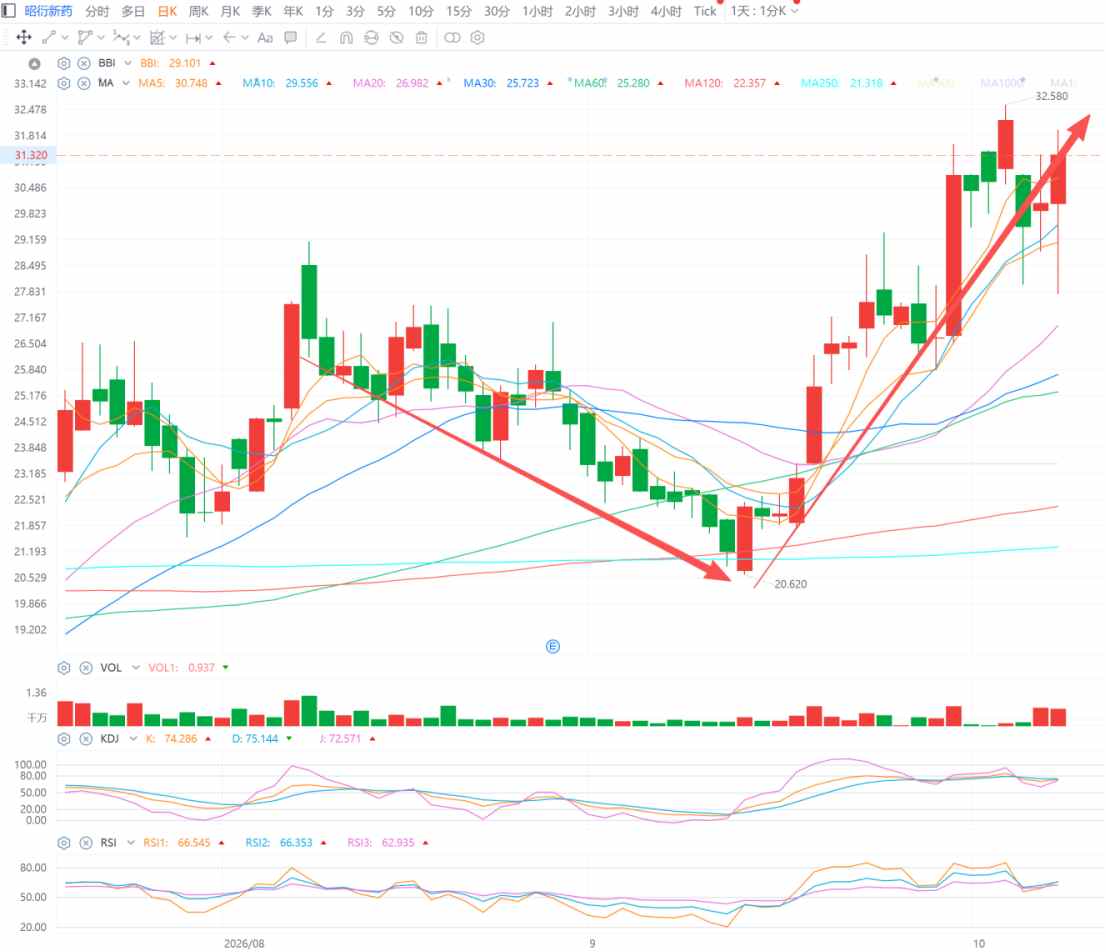
However, when Zhaoyan Pharmaceutical officially disclosed the 26H1 financial report on September 29, its H share price closed sharply by 15.62% the next day. Driven by a sharp rise in volume and price, the company's stock price hit an intraday high of HK$32.58 on October 6, setting a new high for Hong Kong stocks in the past three years.
Why would the same financial data bring different market reactions to Zhaoyan New Pharmaceutical?
When “monkey mao” meets industry beta
In the two segments of disclosing the 2026 interim results report and the official interim report, Zhaoyan New Pharmaceutical has emerged from a “V-shaped” market.
Looking at the market, from August 10 to September 11, the closing price of Zhaoyan Pharmaceutical's H shares fell from HK$26.64 to HK$21.20, with a cumulative decline of 20.42% in the range. During this period, the moving average showed a standard bearish arrangement structure; in terms of momentum indicators, both the RSI and KDJ indicators entered an obvious short-term oversold zone in the latter half of the market, but short-term backdraw conditions failed to be confirmed at the bottom of the MACD trend, and the MACD indicator did not show a bottom divergence with rising momentum at the time.
In terms of quantitative energy, the overall stock price of Zhaoyan Pharmaceutical showed a downward trend of contraction from August 10 to September 11. Within the range, the main decline in the company's stock price from August 28 to September 11 was significantly lower than the previous period, indicating that there was no extreme release of market selling pressure in the second half of the market; on September 11, its intraday turnover rate was also as low as 1.99%, which was lower than the average daily turnover rate of 4.13%. The performance of insufficient turnover at such a low level also showed that capital had not yet formed a consensus bottom line opinion
Therefore, this round of decline in Zhaoyan Pharmaceutical's stock price is clearly not an end of market capital fears, but rather a continuous reduction in positions and insufficient acceptance after the decline in institutional risk appetite.
The beta factor in the industry is clearly one of the important factors guiding the market trend of Zhaoyan New Drug in the above range.
The Zhitong Finance App observed that from August 10 to September 11, the Hang Seng Healthcare Index moved from an earlier upward trend to a high level of sideways trading, and the range index fell 4.43%; at the same time, the medical R&D outsourcing index fell 10.52%; on the technical side, the relative strength curve of Zhaoyan Pharmaceutical's stock price continued to be below the industry curve.
The H share price of Zhaoyan Pharmaceutical clearly outperformed the industry in the above range. On the other hand, it also shows that the beta factor in the industry only guided it in the direction of decline to a certain extent, leading to the core catalytic factor leading to the start of the main decline period. It is still the performance report disclosed by the company on August 28.
Interpreting this performance report at this point in time, the market apparently focused on “revaluation of monkey prices brings paper profits.” Although investors saw a “high increase in profits,” the performance report also showed that the security assessment business, which is the company's core business, is still in the loss repair stage. Coupled with the downward guidance of beta factors in the industry at the time, the market initially priced Zhaoyan's new drug based on “profit quality discounts,” so after the company disclosed the rapid interim results, the stock price continued the downward trend in the previous period.
Under favorable catalysis, H shares showed greater elasticity
As mentioned above, after nearly a month of declining stock prices, Zhaoyan Pharmaceutical's stock price showed clear technical oversold indicators on September 11, and short-term momentum was simultaneously extremely compressed. At that time, its trading volume had dropped from over 16 million shares on August 10 to less than 2.5 million shares.
As oversold signals became more obvious and bears in the market dried up significantly, the “ignition” of the beta in the industry sounded the trumpet for a new round of rebound for Zhaoyan's new drug hammer. On September 14, the biomedical and CXO sectors of Hong Kong stocks led the way. Gloria Ying soared 14% on the same day, driving stock price increases for Kanglong Chemical, Tiger Pharmaceuticals, and Zhaoyan New Pharmaceuticals. Under the guidance of industry beta, Zhaoyan Pharmaceutical's H shares closed up 5.38% on the same day, bringing the first positive improvement to its market after being oversold.
When the market trend reversed, investors also began pricing the positive factors in Zhaoyan New Drug's performance.
In the performance report disclosed on August 28, Zhaoyan Pharmaceutical not only showed its exaggerated profit growth rate affected by the “monkey cycle,” but also revealed its net cash flow from current operating activities of 457 million yuan, a sharp increase of 180.89% over the previous year.
According to the Zhitong Finance App, as one of the CRO with the largest reserves of experimental monkeys in China, about 90% of the experimental monkeys stored in Zhaoyan Pharmaceutical are self-supporting, so the company's cash flow performance is less affected by fluctuations in monkey prices; instead, it has become an important window for reflecting the performance of its main security assessment business. On the other hand, rising monkey prices have further raised the Zhaoyan New Drug's “scarce production capacity moat with its own monkey source,” so some investors chose to value the company according to a security evaluation platform that controls scarce inhuman primate model resources.
After the official disclosure of the 26H1 financial report on September 29, the above view was also verified: new orders for the first quarter of 2026 were about 910 million yuan, a year-on-year increase of 111.6%; the cumulative number of orders in progress was about 3.1 billion yuan, an increase of 40.9% over the previous year. In other words, the volume and price level of Zhaoyan New Pharmaceutical's Q1 orders continued smoothly into the Q2 quarter. The high increase in orders meant that the company's “monkey price flexibility” had a clear operating and fulfillment path.
On the news side, Hengrui Pharmaceutical announced a $2.6 billion BD deal with Novo Nordisk on September 29, which is also further boosting market demand expectations for outsourced services such as drug development and safety evaluation. Driven by news and fundamentals, the above two logics directly supported the single-day stock price increase of Zhaoyan Pharmaceutical on September 18 and September 30.
It is worth mentioning that in this round of market since September 14, Zhaoyan Pharmaceutical's H shares have shown greater elasticity.
According to the data, the ranged increase in the Hong Kong stock price of Zhaoyan Pharmaceutical reached 40.2%, which is significantly higher than the 22.9% increase in its A-share price and the 9.34% increase in the A-share medical R&D outsourcing index over the same period. The A/H daily earnings correlation coefficient within the range of Zhaoyan Pharmaceutical's stock price reached 0.818. However, to a certain extent, this shows that Zhaoyan New Pharmaceutical's A shares are linked to sector sentiment, but the excess earnings on its H shares are obvious, showing stronger independent pricing characteristics.
Judging from external factors, around September 30, domestic innovative drug overseas BD transactions continued to be active. The simultaneous strengthening of the Hang Seng Hong Kong Stock Connect Innovative Drug Index, Hong Kong Stock Innovative Drugs, and CXO standards undoubtedly provided a good market environment advantage for Zhaoyan New Pharmaceutical's H share market.
Judging from the stock price performance, since Zhaoyan New Pharmaceutical had AH discounts for a long time before, when the company experienced an inflection point of orders, revaluation of biological assets, and GLP qualifications resonated with the AI Pharmaceuticals narrative, when the overall valuation anchor of A-share CXO was more stable, the A-share stock price increase clearly tended to be steady, while H shares were more likely to break out of the “low base+high elasticity” market.
Furthermore, after the official disclosure of the 26H1 financial report, the restoration of Zhaoyan Pharmaceutical's main safety review business was further confirmed by the financial report. Hong Kong stock capital will clearly be more willing to allocate Zhaoyan New Pharmaceutical's highly flexible alpha standard, which has the scarce advantage of “rising monkey prices+supply rigidity for experimental monkeys and order inflection points.”