


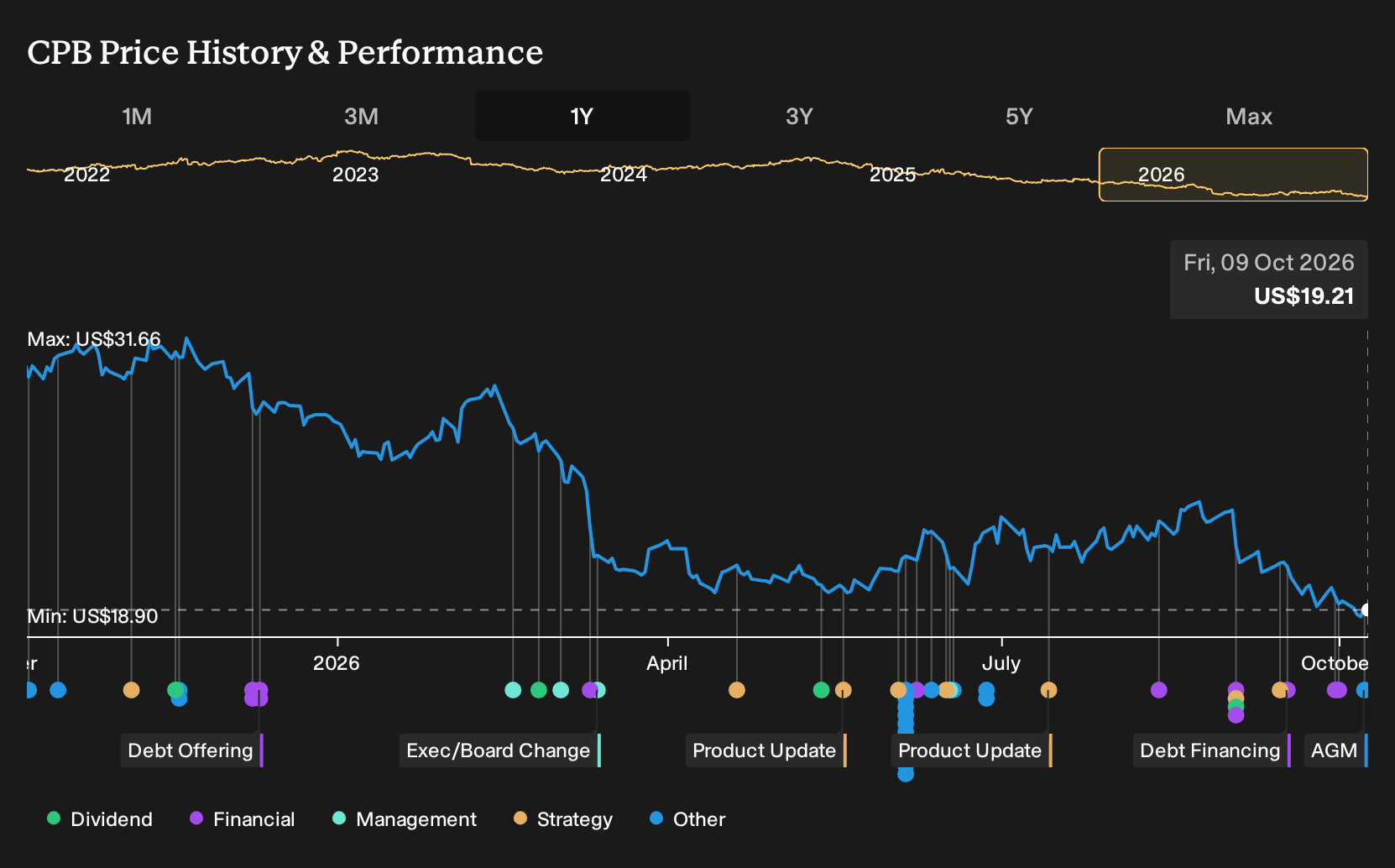
- Campbell's has completed a $300 million fixed to floating rate subordinated, unsecured note offering due 2057, priced at 100% with a 1% discount per security and a variable coupon on callable junior subordinated paper.
- The new long dated, variable rate debt and a 36% dividend cut indicate that management is prioritising cash preservation and balance sheet resilience over near term cash returns.
- We will now examine how Campbell's investment narrative is affected by this long dated subordinated note issuance and dividend reduction.
Campbell's Investment Narrative Recap
To stay in Campbell's, you need to believe the branded soup, sauces and snacks portfolio can stabilize volumes and margins after a tough stretch of shrinking unit sales and weaker earnings. The near term swing factor is execution on pricing, marketing and that US$500 million savings program without further hurting Snacks consumption.
The recent US$300 million subordinated, variable rate notes and 36% dividend cut point to a sharper focus on balance sheet resilience. For now, this mostly affects financial flexibility, not day to day demand. The bigger near term risk still sits in ongoing volume declines and any renewed pressure from raw material and logistics inflation.
The fresh piece of information that ties closest to the current setup is the 36% reduction in Campbell's dividend, especially given earlier flags that the prior 5.21% yield was not well covered by earnings. Income focused holders now face lower cash returns while the company retains more cash inside the business.
That shift connects directly to today’s key catalysts. Management now has more room to fund the long running cost savings plan, absorb persistent Snacks weakness and deal with input cost volatility without relying as heavily on operating cash flow to cover both debt and a high payout. Execution on those savings and on core brands like Rao’s, Goldfish and condensed soups remains the practical test.
What The Campbell's Forecasts Assume
Campbell's narrative projects US$9.6b in revenue and US$594.6 million in earnings by 2029. This rests on analyst expectations that revenue stays broadly flat while profit margins rise from 4.1% today to 6.2% over the next three years, and it implies an earnings increase of about US$196.6 million from US$398.0 million today.
Uncover how Campbell's fair value indicates an 8% potential upside to its current price that could narrow quickly if sentiment on Campbell's improves.
Exploring Other Perspectives
One alternative view focuses on tariffs instead of cost cuts. The most bearish analysts were already working off revenue of about US$9.3b and earnings of roughly US$454.9 million by 2029, well below the consensus path. Those forecasts came before the new US$300 million Campbell's notes and dividend cut, so their story could shift again.
Explore 4 other Campbell's fair value estimates, including one that suggests the possibility of as much as 17% downside from the current price.
The Verdict Is Yours
Don't just follow the ticker. Dig into the data and build a conviction that's truly your own.
- A great starting point for your Campbell's research is our analysis highlighting 2 key rewards and 4 important warning signs that could impact your investment decision.
- See our latest analysis for Campbell's. The report includes a comprehensive fundamental analysis summarized in a single visual, the Snowflake, making it easy to evaluate Campbell's overall financial health at a glance.
Looking For More Investment Ideas Beyond Campbell's?
If Campbell's has you thinking differently about balance sheet strength, income reliability and valuation, it can be useful to line it up against other listed businesses with similar traits. The Simply Wall St Screener lets you scan the market quickly and filter for exactly the profile that suits your risk appetite and return goals.
- If capital preservation is high on your list, start with a set of companies that screen well on financial resilience by reviewing our 31 resilient stocks with low risk scores.
- Income focused investors can compare Campbell's new payout profile with peers that currently offer stronger yields and balance sheet support by scanning this curated group of 8 dividend fortresses.
- For those looking to back sturdier balance sheets after Campbell's shift in priorities, filter for companies that combine solid fundamentals with conservative leverage through the list of solid balance sheet and fundamentals (25 results).
This article by Simply Wall St is general in nature. We provide commentary based on historical data and analyst forecasts only using an unbiased methodology and our articles are not intended to be financial advice. It does not constitute a recommendation to buy or sell any stock, and does not take account of your objectives, or your financial situation. We aim to bring you long-term focused analysis driven by fundamental data. Note that our analysis may not factor in the latest price-sensitive company announcements or qualitative material. Simply Wall St has no position in any stocks mentioned.
Have feedback on this article? Concerned about the content? Get in touch with us directly. Alternatively, email editorial-team@simplywallst.com