


The much-anticipated third quarter earnings season for US stocks is about to begin in full. This also means that the global stock market will be intensively tested by “the pace of profit implementation linked to AI computing power resources, financing costs under the surge in US bond yields, and energy inflation under continued geopolitical pressure.” This week, Wall Street superfinancial giants, including BlackRock and J.P. Morgan Chase, took the lead in disclosing results. Among them, BlackRock will showcase the latest changes in global capital allocation and asset management business. At the same time, the asset management giant's performance will also reveal whether global institutional and retail capital is still flocking to AI computing-power-themed ETF funds and investors are enthusiastic about participating in private equity funds related to AI computing power infrastructure. Asmack and TSMC will generate revenue from semiconductor manufacturing equipment, AI chip manufacturing, advanced packaging, and future semiconductor production expansion. The three levels of rhythm comprehensively test the AI investment boom.
The US CPI inflation data for September, which will be released on Monday, can be described as directly affecting the market's important judgment on the pricing trajectory of the Federal Reserve's interest rate hike and whether the Fed will continue to raise interest rates in October. For US stocks and even the global stock market, which are still operating near historical highs and continue to be strongly led by AI-related technology stocks, the real market focus question has become: whether the huge profit increase created by AI can continue to outperform the rising speed of global capital costs under rising expectations of energy inflation and interest rate hikes, and the pessimistic “AI bubble bursting” rhetoric of AI questioners such as “big short” Bury.
According to top analysts from Wall Street financial giants such as Goldman Sachs and Citi, the US stock earnings season is expected to provide strong AI profit catalyst based on an unprecedented AI infrastructure frenzy. However, the situation in the Middle East, Russia, and Ukraine will continue to pose strong external pressure this week. Combined with US CPI inflation data and retail sales data with the title of “horror data”, it can be said that the stock market will experience sharp fluctuations or violent one-way down/violent one-way decline starting this week. Probability of increase It can be described as very high.
For the US stock market and the MSCI global stock market benchmark stock index, which has repeatedly set new record highs in recent years and has entered a new round of long-term bull market trajectory, the increasingly fanatical “AI belief” around the “AI computing power investment theme” has played the core of the bull market and the strongest bullish driving force. It can be said that as long as this wave of “AI belief” continues to heat up and sweep through the global stock market, the US stock market and the global stock market will continue to experience an extremely strong bull market boom curve. The two most cutting-edge AI agents, Meta Muse and OpenAI Astra, which have recently taken the world by storm, can be described as strengthening the “AI faith” of investors focusing on technology stocks around the world, and the upcoming earnings season will undoubtedly be a big test or possibly an extremely strong positive catalyst for this unprecedented frenzy of faith.
The core change brought about by the recently popular Meta Muse AI agent and the OpenAI Astra large model/AI agent “comparable to AGI” is that a single user command can trigger continuous, multi-stage computational work. A research, programming, or office task may in turn include planning, retrieving, reading documents, calling tools, executing code, checking results, and fixing errors. Multiple steps require re-calling the model, and complex tasks may also use parallel exploration and verification. Such an almost endless and increasingly complex AI workload will accelerate the transmission of growth opportunities to a complete AI inference load computing power system beyond the GPU.
J.P. Morgan said that what the agency's strategist team is optimistic about is a rearrangement opportunity formed by easing position congestion, falling valuations, and profit resilience. They particularly prefer semiconductors. According to the latest research report released by the agency, since June, the earnings forecast for semiconductors per share for the next 12 months has been raised by about 30% to 40%, and the profit forecast for the global software sector has not improved accordingly; the capital expenditure forecasts for hyperscale cloud computing vendors recently quoted by the agency are: about 950 billion US dollars in 2026, about 1.4 trillion US dollars in 2027, at least 3 trillion US dollars in 2030, and it is expected that the pace of AI-related revenue growth in 2027 will show a blowout expansion trajectory.
US stock earnings season kicks off: AI believes in profit and fights against the high yield curve, and CPI becomes a key variable
From the perspective of AI inference system architecture, more complex AI tasks led by Meta Muse often include longer context, multiple rounds of model calls, tool execution, and result verification: prefill (prefill) requires processing input, decode (decode) continuously generates output, and key value cache (KV Cache) takes up more memory as context and concurrency scale expand, and computational throughput, memory bandwidth, and capacity need to be increased collaboratively. Therefore, as cutting-edge intelligence such as Meta Muse further detonates demand for AI computing power, the core reasoning for the AI computing power industry is that GPUs and TPU undertake model computation, high-performance data center CPU tool execution and task orchestration, and HBM, server DRAM, storage and high-performance network infrastructure, and data center optical interconnect devices all support efficient data transportation and state management; ultimately, a complete set of AI computing power server clusters will be needed to deliver sustainable services.
After the Nasdaq Composite Index hit a record high last week and the “AI chip superpower” Nvidia, which has a high weight in the NASDAQ and S&P 500 indices, reached a record high, global investors' enthusiasm for the revenue and profits of US companies exceeded expectations, especially for tech giants closely linked to AI computing power that exceeded analysts' agreed expectations.
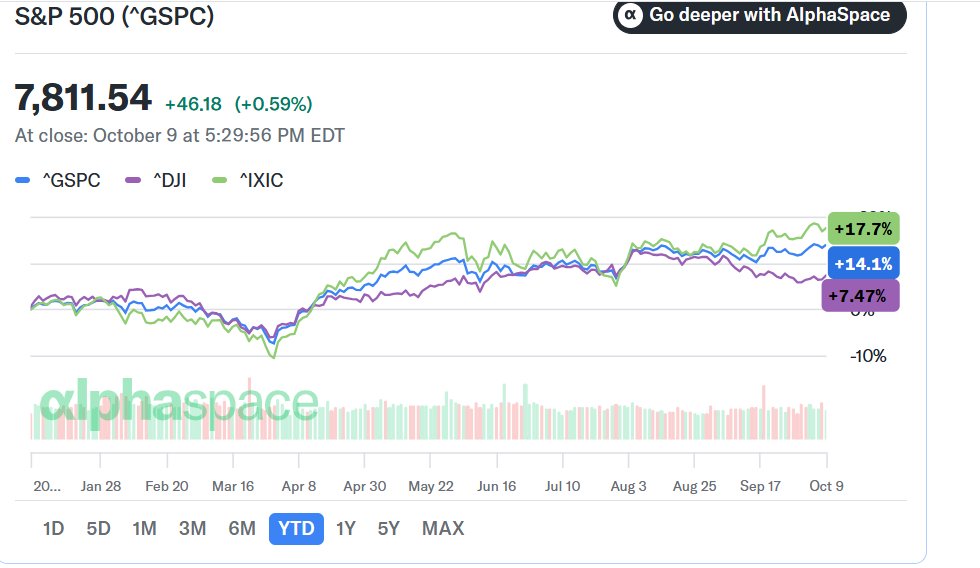
The market entered this key performance disclosure season window with a rebound as well as differences. At the close of October 9, the Dow rose 0.83%, the S&P 500 rose 0.59% to 7811.51 points, and the Nasdaq Composite Index rose 0.64% to 27366.17 points; however, the Philadelphia Semiconductor Index still fell 0.41%. This means that financial expectations are supporting overall risk appetite, yet investors' scrutiny of core supply chain valuations, financing pressure, and revenue realisation related to AI computing power has not been eliminated.
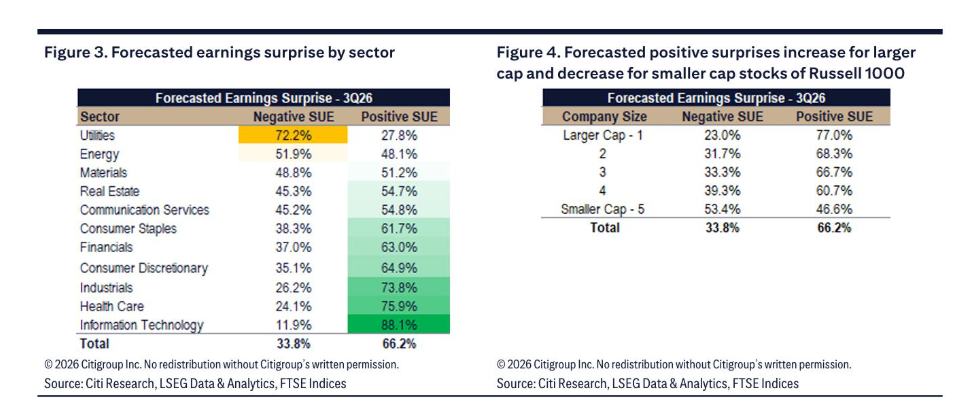
Wall Street financial giant Citigroup's latest quarterly quantitative study of earnings reports provides a specific basis for technology companies to lead S&P and NASDAQ component companies to exceed expectations: Citigroup's exclusive model predicts that 66.2% of the Russell 1000 constituent stocks will experience positive profit surprises (that is, profits exceed consistent market expectations) and related positive stock price return trajectories (that is, the Citigroup model also predicts the positive direction of related stock price returns), which is significantly higher than the already strong 60.9% in the previous quarter, reaching the highest level since the fourth quarter of 2021; the US stock market The information technology (equivalent to technology themes), healthcare, and industrial sectors are leading the way with 88.1%, 75.9%, and 73.8% positive profit surprise forecasts and positive share price returns, respectively, and Citi emphasizes that investment opportunities are further biased in favor of large market capitalization companies such as Nvidia, AMD, Intel, Texas Instruments, Applied Materials, and Kelei, which focus on AI computing infrastructure construction topics. A new round of bull market rotation is expected to spill over into the medical and industrial business in the future.
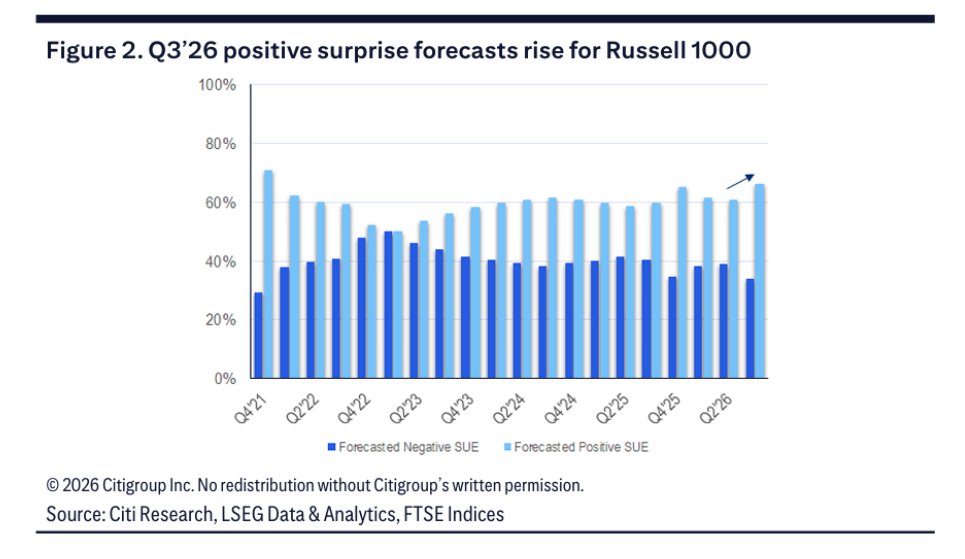
The AI superbull market currently sweeping the global stock market seems to be looking for a “profit takeover window” — that is, when 10-year US bond yields hit new highs for more than 20 years, leading to DCF's denominator expansion, as long as earnings per share continue to grow, the stock market does not need to rely on the price-earnings ratio to rise again to a high level; if interest rate/US bond yield pressure then eases, stable valuations may also increase earnings space.
A team of top strategists from Citibank said that Wall Street analysts, whose profit increased year-on-year in the third quarter of the S&P 500 index, agreed that it had been significantly revised from 26.7% at the beginning of the quarter to 29.6%. The energy and AI technology topics are the main sources of incremental improvements, and all 11 industries are expected to achieve year-on-year profit growth. Citigroup also combined earnings forecasts with fundamental ratings of stock stocks and crowding in long transactions to select candidates such as Nvidia, AMD, Intel, Applied Materials, and Ke Lei for “Surprise Forecast for the Positive Earnings Season + the Most Optimistic Stock Rating of 'Buy'”, and pointed out that healthcare and industry also have a wide range of opportunities to realize their performance.
While the market is focusing on the earnings season, it can be said that the global geopolitical aspect dominated by the Middle East, Russia, and Ukraine has yet to provide a stable smooth wind. Trump's statement about progress in US-Iran negotiations and no plans to attack Iran before the midterm elections improved market sentiment on Friday; however, on October 11, Iran claimed that America's response to the conditions for reopening the Strait of Hormuz was “insufficient,” and Saudi Riyadh Airport was attacked continuously over the weekend. On the Russian side, Trump announced an “energy cease-fire,” but Zelensky said he was still awaiting specific arrangements, and said that Russian attacks were continuing. What is happening now is that diplomatic efforts to cool down coexist with military conflict, and it cannot yet be considered that the energy supply risk has been lifted.
The trend in oil prices reflects this tug-of-law. On October 9, Brent and WTI crude oil futures settled at $104.72 and $91.85 per barrel, respectively, up about 0.4%; compared with the pre-war settlement price on February 27, they rose by about 44.5% and 37.0%, respectively. Positive news related to the US-Iran negotiations when oil prices rose last week drove the intraday decline, but the shutdown of production due to the US Gulf of Mexico hurricane pushed prices higher. As long as energy transportation, refining supply, and energy infrastructure in the Hormuz and Mander Straits have not been substantially restored, a brief drop in oil prices will make it difficult to completely relieve the pressure on corporate costs and inflation.
Furthermore, long-term US bond yields can be said to have raised the threshold for this earnings season. The US 10-year Treasury yield hit about 5.364% last week, the highest since 2002; the 30-year yield rose to about 5.732% in the intraday period. The yield of the 30-year treasury bond auction on October 8 reached 5.618%, the highest auction level since August 2000. By Friday, the Ministry of Finance's end-of-day curve showed 10-year and 30-year yields of 5.24% and 5.60%, respectively: although they have fallen from extreme highs, long-term capital prices faced by companies and the stock market have risen markedly.
The recent decline in the probability of interest rate hikes does not contradict the fact that long-term yields remain high. The probability of interest rate hikes reflects the policy choices of the next meeting, and the 10-year and 30-year capital prices also include future actual interest rates, inflation compensation, and risk compensation for holding long-term bonds. On October 9, the actual yield of 10-year TIPS reached 2.91%, and the 30-year term reached 3.32%; the 10-year term premium estimated by the New York Federal Reserve model rose to 96 basis points last week, a 12-year high. This shows that capital cost pressure comes not only from oil prices, but also from financial financing needs, long-term uncertainty, and investors' demand for real returns.
The cost of AI financing itself is also affecting global stock markets and bond markets. After the tech giants issued long-term corporate bonds, some investors hedged interest rate risks by selling US bond futures, or freed up capital for corporate bonds; rising interest rates also extended the expected life of mortgage securities, bringing further debt sales hedging. This makes AI investment and interest rates work both ways: construction demand drives financing, financing increases long-term capital supply pressure, and higher interest rates in turn test the return on construction projects.
Pressure is also spreading across markets. The yield on UK 10-year treasury bonds hit 5.527% last week, the highest since 2007; the 30-year term reached 6.05%, the highest since 1998. Japan's 30-year yield set a historical record of 4.235%, reflecting a combination of factors such as energy inflation, fiscal spending, and the central bank's reduction in debt purchases. As a reference for global pricing, rising yields on US bonds will increase the returns that other long-term assets need to provide, but each country's fiscal and monetary policies determine the extent of the impact.
France is particularly wary. The yield on 10-year treasury bonds previously rose to 4.994%, a 24-year high; the French-Italian spread reached the highest 30 basis points since the establishment of the euro. The French-German spread previously broke through 150 basis points and narrowed to 135 basis points on Friday. The pressure facing France is the rise in global interest rates compounded by difficulties in reducing the country's deficit, the 117.6% government debt/GDP ratio, and uncertainty about the presidential election. The tension of the European debt crisis is shifting from traditional peripheral countries to the fiscal credibility of core powers. The real dangerous transmission chain is undoubtedly that higher financing costs gradually erode fiscal space as debt rolls, and then spread through bank debt holding, financing costs, and credit contraction; currently, Italy and Spain can still attract selective buying, indicating that the market has not evolved into an indiscriminate Eurozone credit flight.
This week's most direct US Federal Reserve interest rate hike trajectory and one of the triggers for a surge in long-term US bond yields will be the US CPI for September at 20:30 Beijing time on October 14. Various surveys expect the overall CPI growth rate to be about 3.6% to 3.7% year on year, and the core is about 2.5% year on year. As of the end of last week, open market information showed that the probability of interest rate hikes in October was about 19%, and about 80% corresponds to keeping interest rates unchanged. If core inflation is moderate, expectations of suspending interest rate hikes will be supported; if the core price clearly exceeds expectations again, the market may simultaneously raise the policy interest rate path and corporate financing costs.
The real “cutoff line” of AI is that the space between return on new investment and capital costs is continuously being compressed, rather than a fixed integer US Treasury yield threshold. The multiple breakthroughs in this financial reporting season were that TSMC and Asma verified demand and profits continued to grow, financial institutions verified that financing channels were still smooth, healthcare and industry expanded profit support, and moderate CPI relieved interest rate pressure. What the market is looking forward to is this evidence that the AI superbull market's computing power chain leaders and cloud computing supergiants still have a strong ability to turn advances in cutting-edge AI technology into cash returns sufficient to cover higher capital prices.
From large commercial banks on Wall Street to the “satellite supershock wave” dominated by Starlink, the much-anticipated earnings season for US stocks has once again arrived
Fasten your seatbelt and don't stick your hands and feet out of the car because earnings season is back. Starting Tuesday, the third quarter earnings season will officially kick off. This week was led by major Wall Street investment banks. As October gradually deepens, other industries will join one after another.
At the beginning of the earnings week, investors will welcome the results of J.P. Morgan Chase (JPM.US), Goldman Sachs (GS.US), Wells Fargo (WFC.US), and Citigroup (C.US); UnitedHealth (UNH.US) and Johnson & Johnson (JNJ.US) will provide an observation window for the state of the global healthcare sector.
Bank of America (BAC.US) and Morgan Stanley (MS.US) will continue to release financial reports from major banks on Wednesday, and alternative asset management giant BLK.US (BLK.US) and semiconductor manufacturing equipment giant ASML.US (ASML.US), headquartered in the Netherlands, will also announce results on the same day.
As another test of the AI investment theme, TSM.US (TSM.US), an AI chip manufacturer with AI computing power leaders such as Nvidia, AMD, and Broadcom, which is the “king of global chip foundry,” will release financial reports at around noon Beijing time on Thursday.
This week was also a week of intense publication of economic data. Consumer inflation data released on Wednesday will be an important factor for the Federal Reserve to decide on interest rate policy at the upcoming October Federal Open Market Committee meeting. Investors will also learn about wholesale inflation through the Producer Price Index report on Thursday, and will welcome data on industrial production and manufacturing activity on Friday.
The market can be described as eager to hear how the big commercial banks on Wall Street view the sharp rise in yield. As Wall Street's biggest banks began reporting results this week, they had just gone through one of the best stages of performance in the past decade. In other words, this would have been the case had it not been for a series of factors driving yields to decades-long highs.
With J.P. Morgan Chase, Goldman Sachs, and Citi taking the lead, Bank of America and Morgan Stanley then take over on Wednesday. Everyone's eyes will be on how these financial giants can discuss the impact of higher interest rates.
Analysts expect bank profits and transaction and investment banking revenue to decline sequentially after reaping strong earnings in the past few quarters, but overall, profits should still increase year over year.
Over the past month, financial sector ETFs (ETF code: XLF.US) fell by about 4%, ranking second to last of all sectors in the S&P 500, only better than utility sector ETFs (XLU). By Friday's close, the total market capitalization of the five major banks had evaporated about $270 billion as the financial sector came under pressure.
Looking ahead, according to a Truist Securities survey, only 35% of institutional investors expect bank stocks to outperform the market, down from 68% in July and 82% in December last year.
Take Goldman Sachs, for example. CEO David Solomon said at a conference hosted by Barclays in late September that compared with the same period last year, the level of activity in the bank's fixed income, foreign exchange and commodities trading business was “slightly weak.”
Morgan Stanley Co-President Daniel Simkowitz's summary of the same event was very apt, and he also revealed in advance what investors should expect this week: “I think it's safe to say that the third quarter was not as good as the second quarter.”
The inflation data for late Wednesday Beijing time may determine the Fed's next move. If I were to sum up the US economy in 2026 in one word, apart from “AI,” the term would probably be “inflation.”
Especially since the outbreak of the war in Iran in late February, prices of gasoline, food, computer parts, semiconductors, and a large number of other commodities have risen, and have always been the focus of attention of American consumers. The US is experiencing a fifth year of higher than target inflation.
In September, these price increases prompted the Federal Open Market Committee to implement the 25 basis point rate hike for the first time in three years, raising the target interest rate range to 3.75% — 4%. Federal Reserve Chairman Kevin Walsh said, “One obvious fact is that inflation is too high and has been going on for too long.”
Price pressure has not shown any signs of easing, and US Treasury yields are still at their highest level for more than 20 years after the rate hike, so investors quickly turned their attention to October, and for good reason. The September “Economic Forecast Summary”, also known as a bitmap, shows that most FOMC voting members believe that interest rates will need to be raised by at least 25 basis points this year. Four of the members advocated a further 50 basis points in interest rate hikes.
The September consumer price index report, which is due to be released on Wednesday, will be an important factor in deciding whether the next 25 basis point monetary policy tightening will be implemented in October or until December.
Bank of America economist Stephen Juno wrote in a report to clients on Thursday: “Although the rate of inflation is still above the level in line with the Federal Reserve's 2% target, after recent dovish remarks by Federal Reserve officials, this data may not be enough to significantly push the market to bet on an October rate hike.”
Consistent with his judgment, recent speeches by officials including the “top three in the Federal Reserve” New York Federal Reserve Chairman John Williams showed that there is room for a wait-and-see attitude in October, and there is no need to rush to raise interest rates again.
One of Musk's recent major moves can be described as restarting the telecom war, and has also caused the market to start worrying about whether the traditional telecom and communications giants that occupy important market capitalization shares in the US stock market will face a “Davis double kill.” If you're guessing which major industry Elon Musk plans to disrupt next, the answer lies in traditional telecommunications and communications.
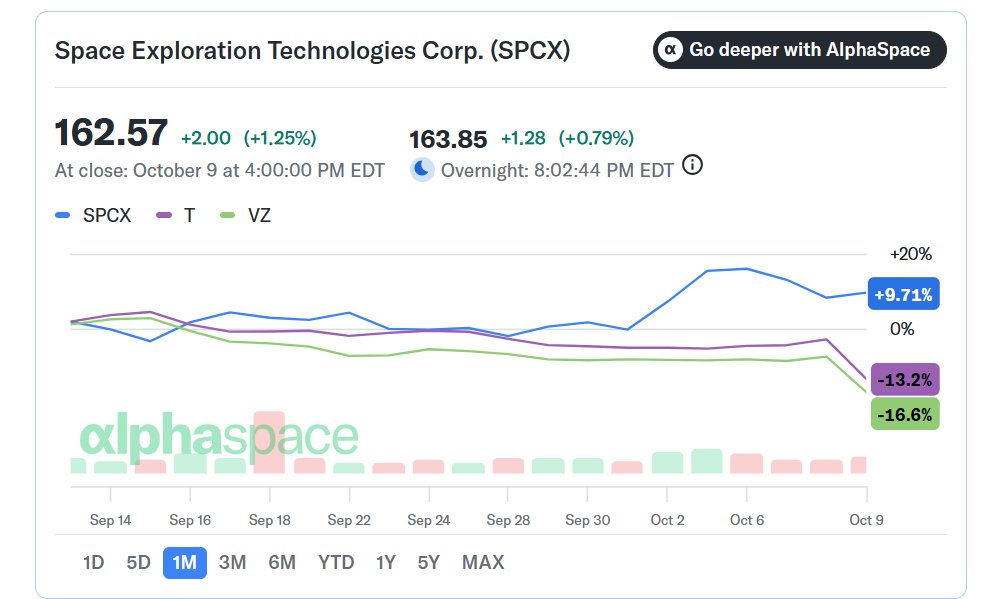
After SpaceX (SPCX.US), the “AI+ Space Exploration” global leader founded and headed by Musk, announced last week that it had reached an agreement to acquire a set of low-band spectrum licenses covering the entire US, the stock prices of major mobile communication operators fell in the latter half of last week.
Verizon (VZ.US) shares fell sharply by 5% as of Friday, AT&T (T.US) fell nearly 7%, and T-Mobile (TMUS.US) fell more than 6% as of Friday. The announcement raised concerns in the market that Starlink will impact the wireless telecommunications industry.
Starlink has established a leading position in the field of satellite communication technology, but the consumer-oriented telecommunication business, or mobile communication coverage network, is still a new field for it. SpaceX has acquired a set of spectrum assets from investment agency Grain Management, including a total of up to 14 MHz of paired spectrum in the 800MHz band.
At the company's performance conference in August, SpaceX Chief Operating Officer Gwen Shortwell said that Starlink plans to build a terrestrial wireless network and seek customers from Verizon, AT&T, and T-Mobile. She also said that SpaceX plans to launch the second-generation Starlink Mobile satellite in 2027.
“I expect we can get quite a few of their customers — AT&T, Verizon, and T-Mobile — because I think our service would be better,” Shotwell said during the conference call at the time.