


The Zhitong Finance App notes that the French debt turmoil has pushed European fiscal pressure into the spotlight in recent weeks, but with the release of a controversial new spending plan by the Italian government, investors' attention is rapidly turning to Italy.
Goldman Sachs analysts pointed out that the Italian government will submit a budget next week, which includes recently approved defense and energy grants. These grants will widen the country's fiscal deficit over the next two years and hopefully make Italy's debt-to-GDP ratio the highest in Europe.
Goldman Sachs senior European economist Filippo Tadei said that before next year's general election, these changes may put further pressure on Italian treasury bonds.
On October 2, the center-right government led by Prime Minister Meloni approved borrowing an additional 28 billion euros (31 billion US dollars) over the next two years to spend on defense and energy. Despite the reduction in scale, the spending plan raised Italy's 2027 deficit target to 3.4% of GDP and the 2028 target to 3.2%, higher than the 2.8% and 2.5% forecast in April, respectively, and higher than Goldman Sachs's forecast.
These measures are evenly distributed between defense and energy, accounting for approximately 0.3% of GDP in 2027 and 2028, respectively. Meanwhile, investors' concerns about uncontrolled government borrowing across Europe are growing.
France's treasury debt woes
In recent days, French treasury yields have soared to multi-year highs, and the country's debt crisis continues to ferment, fueling widespread market concerns about tight European public finances.
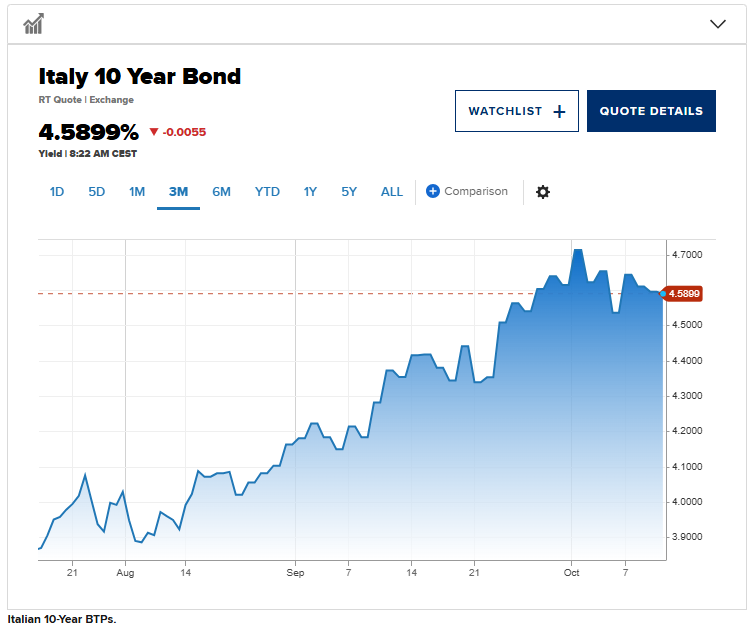
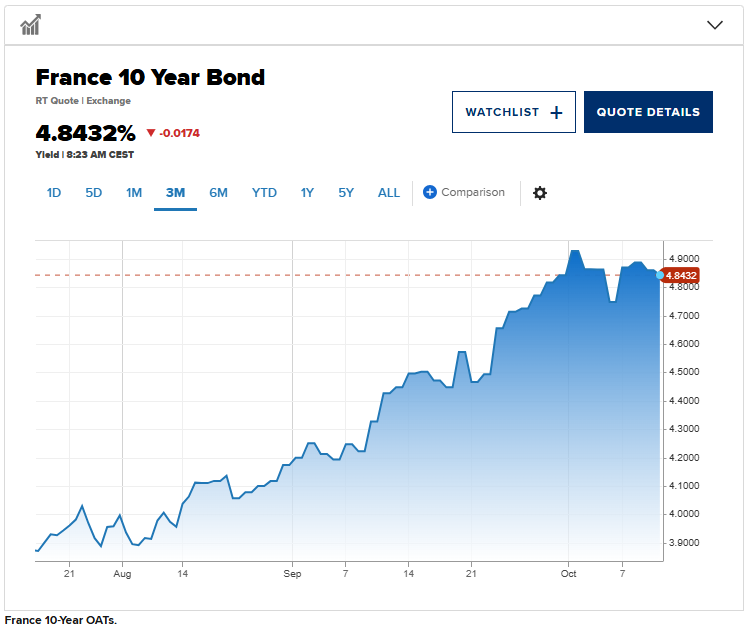
Affected by falling oil prices, the yield on France's benchmark 10-year treasury bond (OAT) fell 3 basis points to 4.85% last Friday. The 10-year Italian Treasury Bond (BTP) yield was last reported at 4.55%, down 5 basis points. As of press release, the interest rate spread between 10-year German treasury bonds (Bund), which is the Eurozone's benchmark, and Italian treasury bonds is about 108 basis points.
Tadei said that as the deficit widens, Italy's fiscal risk premium is likely to rise before the next general election scheduled to be held no later than December 22, 2027.
He explained that a balanced election may leave little room for fiscal consolidation, as both parties on the left and right want to bring in “partners who support increased spending” to form a viable alliance.
In a report on Thursday, he wrote: “Relaxed fiscal policies, tighter financial conditions, and a tight election situation seem to weaken debt prospects after four years of fiscal consolidation.”
“Significant upward accident”
Italian lawmakers voted last Thursday to pass the electoral system reform, shifting from a mixed system to a more proportional representation system. The right-wing coalition led by Meloni said that this change will bring about a more stable government and avoid chaotic cabinet formation negotiations after the election.
But left-wing opponents believe that these changes are aimed at helping Meloni stay in power.
Meloni's government will submit its last budget before the general election next week. The government was previously praised for reducing the deficit, and Italy's deficit rate fell to 3.1% in 2025.
The bond market has also rewarded the country's newfound political stability, and Meloni recently became Italy's longest-serving leader since World War II.
This increase in spending is in line with the EU's “State Exemption Clause,” which allows member states to obtain temporary budget flexibility for defense and energy investments to deal with the impact of Russia's war in Ukraine and the Middle East conflict.
However, Tadei said the new deficit target was a “significant upward accident.”
“We believe that a higher fiscal deficit combined with rising yields will allow the debt/GDP ratio to continue to rise until 2028 and then stabilize at around 137%. At that time, it will be the highest in Europe.” “In the current environment, rising yields pose a key challenge. We found that if the 10-year yield structurally rises above 4%, it is likely that Italy's debt/GDP ratio will enter an upward channel after that.”
“Tough financial choices”
Pacific Investment Management Company (PIMCO) portfolio manager Constantin Feit said that the recent sell-off in global bond yields has refocused the market's focus on countries with relatively weak fundamentals.
Faite pointed out that French treasury bonds are widely held by overseas investors, so they are more susceptible to negative news; in contrast, Italian sovereign bonds are mainly held by domestic investors, which is usually “a stabilizing factor.”
Feit said, “Although Italy's debt is higher, its basic fiscal balance is stronger, the path is relatively favorable, the political stability, and it has a history of making necessary adjustments.”
He added that compared to France, Italy currently appears to be in a “relatively better position” overall, with “stronger fundamentals, a clearer political landscape, and a past record of difficult fiscal decisions.”
But investors are already targeting opportunities in Italian debt.
Rynott de Boek, head of European interest rate strategy at UBS Investment Bank, recently announced a short position on Italian treasury bonds (BTP), betting that Dali debt could become the next weak link in European sovereign bonds.
DeBoke told the media: “I think Italy may catch up. At these higher yield levels, people will also be more concerned about Italy, even though Italy has implemented many reforms.”