


The Zhitong Finance App learned that during the afternoon session of the Asian session on Monday Beijing time, Brent crude oil futures and WTI crude oil futures fell to around the 103.18 and 90.31 US dollars, respectively, mainly due to the “Russian-Ukrainian energy cease-fire” initiative led by Trump in the energy trading market and Russia's promise to increase the supply of refined oil products. However, the cease-fire has not been jointly confirmed by both sides. The attack on Saudi Arabia and the attack on oil tankers in the Gulf indicate that the geopolitical risks in the Middle East have not completely subsided as actively anticipated by the market. According to a recent research report released by Wall Street financial giant Morgan Stanley, international crude oil prices have cooled down compared to the historical peak of over 110 US dollars in May, but the cost pressure on the agrochemical industry chain has not been lifted.
On October 9, the cracking price difference between NYMEX's ultra-low sulphur diesel and WTI fell by 6.45 US dollars to 96.80 US dollars/barrel in a single day in recent months, and is still at a high level. The futures cracking price difference between US diesel of the same type and WTI reached a record high of 102.20 US dollars/barrel on August 17, far exceeding the current 96.80 US dollars. Therefore, although the cracking price difference between NYMEX's ultra-low sulphur diesel and WTI has cooled down in recent months, it is still in a historically high range, indicating that the tight supply of diesel compared to crude oil has not been fundamentally eased.
Against the backdrop that energy prices dominated by a series of refined oil products such as crude oil and diesel are still at historically high levels, the research report “North American Chemicals: Urea Falls, Potash Fertilizer Is Lower, and Oilseed Pressing Profits Are Mostly Improved” published by Morgan Stanley recently revealed profit differentiation under high energy prices: urea and potash are under weak procurement pressure, and phosphate fertilizer is squeezed by high sulfur costs. North American nitrogen fertilizer has the advantage of low gas prices, while oilseed processing benefits from improved price differences between meal, oil and raw materials; farmers' purchasing power is weak in the medium term between grain and food. Inventories are tightening, and the opposite is true strength.
The Morgan Stanley strategist team maintains an “in-line” (in-line) view on stock market investment in the broad chemical industry in North America. The stock market investment derived from this focuses on cost advantages, processing price differences, and cash returns. In particular, agrochemical investments need to focus on profit margins between product sales prices and raw material costs, rather than betting on chemical price increases in general.
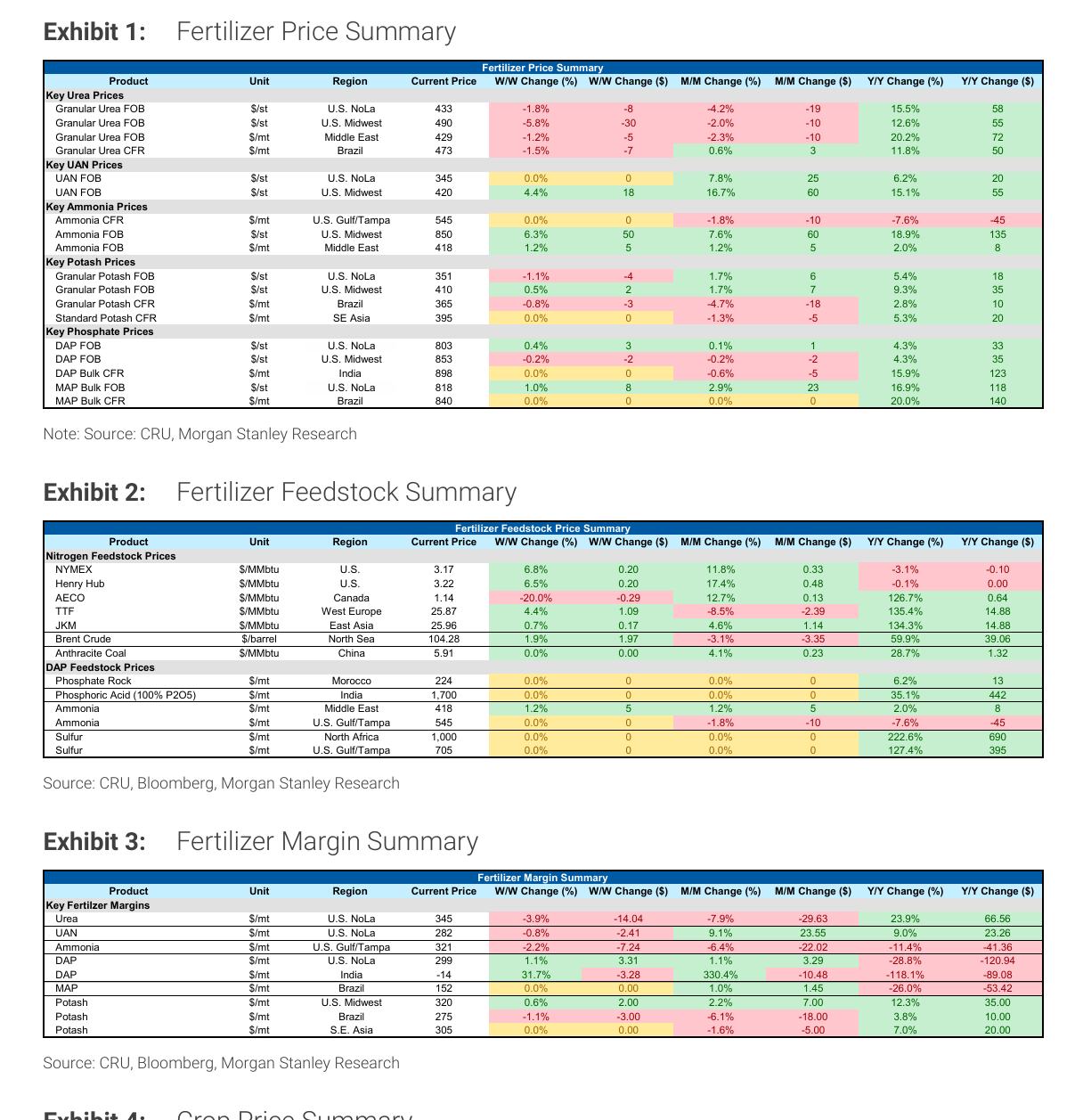
Morgan Stanley's latest tracking shows that high energy costs have not led to a general increase in the profits of agrochemical companies: the US urea cash spread fell 3.9% month-on-month, and the US trading market diammonium phosphate (DAP) cash spread fell sharply by 28.8% year on year, which is enough to show that continued high energy costs and high raw material prices did not necessarily translate into increased profits for producers, and also reflected the double restraint on profits of procurement demand in the entire North American chemical sector and continued high raw material costs; at the same time, the US soybean pressing price gap in recent months was 2.27 per bushel The US dollar rose to $2.50, and the relevant compression benchmarks in Brazil and Europe also improved markedly. ADM and some of Bungie's forward press profit indicators were revised at the same time.
The Damo strategist team emphasized that whether an enterprise can make a profit depends more on changes in product sales prices compared to raw material costs, as well as procurement, processing and hedging capabilities. Furthermore, the US agricultural supergiant Bungie has both an improvement in the compression business benchmark and a “gain” rating for Damo, which is the specific target for observing this main line of profit repair; the key aspect of subsequent investment is whether price difference improvements can be converted into actual cash profits.
Expensive oil does not equal rising fat! Dama's latest research cracked the “scissor gap” between cost and price
The macroeconomic environment where long-term US bond yields of 10 years or more have surged and remained at their highest level in 20 years and expectations of increasingly higher interest rates made this profit differentiation even more meaningful for investment. On October 7, US 10-year and 30-year Treasury yields hit 5.368% and 5.735% respectively, the highest levels in history since 2002; since then, official daily statistics fell back to 5.24% and 5.60% on the 9th, and are still high.
In the context of the ongoing haze of war between Russia, Ukraine, and the Middle East, the record-breaking energy inflation trend, strong fiscal financing requirements, and term premiums continued to rise sharply, compounded by a corporate financing frenzy linked to AI computing power infrastructure to seize US debt pools and long-term hedging markets on a large scale, putting pressure on the long-term and spreading to Europe and Japan through global asset allocation. The UK's 30-year yield rose to 6.05% on the 8th, a record high since 1998. For agrochemical companies, this not only increases inventory and production expansion financing costs, but also weakens the ability of customers to withstand high-priced agricultural materials.
Damo said that urea's short-term pricing dominance is shifting to buyers. According to the research report, India's 1.7 million ton tender received an offer of 5.35 million tons, about 3.15 times the purchase volume; the average weekly urea price in New Orleans in the US fell 1.8% to 433 US dollars/short ton, the Midwest fell 5.8% to 490 US dollars/short ton, and Brazil, Egypt, and the Middle East were under simultaneous pressure. However, the prices of UAN (urea ammonium nitrate solution) and ammonia rose by 4.4% and 6.3%, respectively, in the Midwest, which is not an overall weakening of nitrogen fertilizer. Natural gas has both raw materials and fuel properties for ammonia production: Henry Hub's price is 3.22 US dollars/million British thermal units, and the European TTF is 25.87 US dollars, which is about 8 times that of the US. North America's gas supply advantage is still there, but the US urea cash price spread has dropped 3.9% to 345 US dollars/tonne per week, reflecting that lower product prices and higher gas prices are squeezing profits together.
The Dama strategist team wrote that potash fertilizer is constrained by demand, while phosphate fertilizer is stuck in high raw material costs. According to the report, Brazil's potassium chloride fell to 355-375 US dollars/tonne, with weak demand and sufficient supply in the East Asian market; Russian ports' inclination towards grain shipments may limit potash exports, while Jordan's new railway plan provides about 16 million tons/year of potash and phosphate ore transportation capacity. In terms of phosphate fertilizer, the US DAP (diammonium phosphate) is 803 US dollars/short ton, India's DAP is 890 to 905 US dollars/metric ton, and Brazil's MAP (monoammonium phosphate) is 830-850 US dollars/metric ton, which is generally stable; although Middle East sulfur fell by 35 US dollars to 825 US dollars/metric ton every week, it is still more than 300 US dollars higher than before the conflict. The US DAP cash spread fell 28.8% year on year. India's benchmark was negative $14 per tonne: high sales prices did not translate into high profits, and sulfur prices still need to drop further to actually boost profit repair, restart production shut-down facilities, and resume China's phosphate fertilizer exports.
From fertilizer prices under geopolitical pressure to processing spreads: How can profit improvements fall to the level of stock investment
The Dama strategist team said that oilseed processing is a more obvious improvement direction now and around the medium term. The US CBOT soybean pressing price difference rose from 2.27 to 2.50 US dollars/bushels in recent months, mainly due to a 2.4% increase in soybean meal and a 1.0% increase in soybean oil, exceeding the 0.3% increase in soybean costs; the Brazilian pressing benchmark rose 25.2% to about 60 US dollars/metric ton, and the European rapeseed spot benchmark rose 21.7% to about 188 US dollars. The latter also benefited from a 5.1% drop in raw material prices.
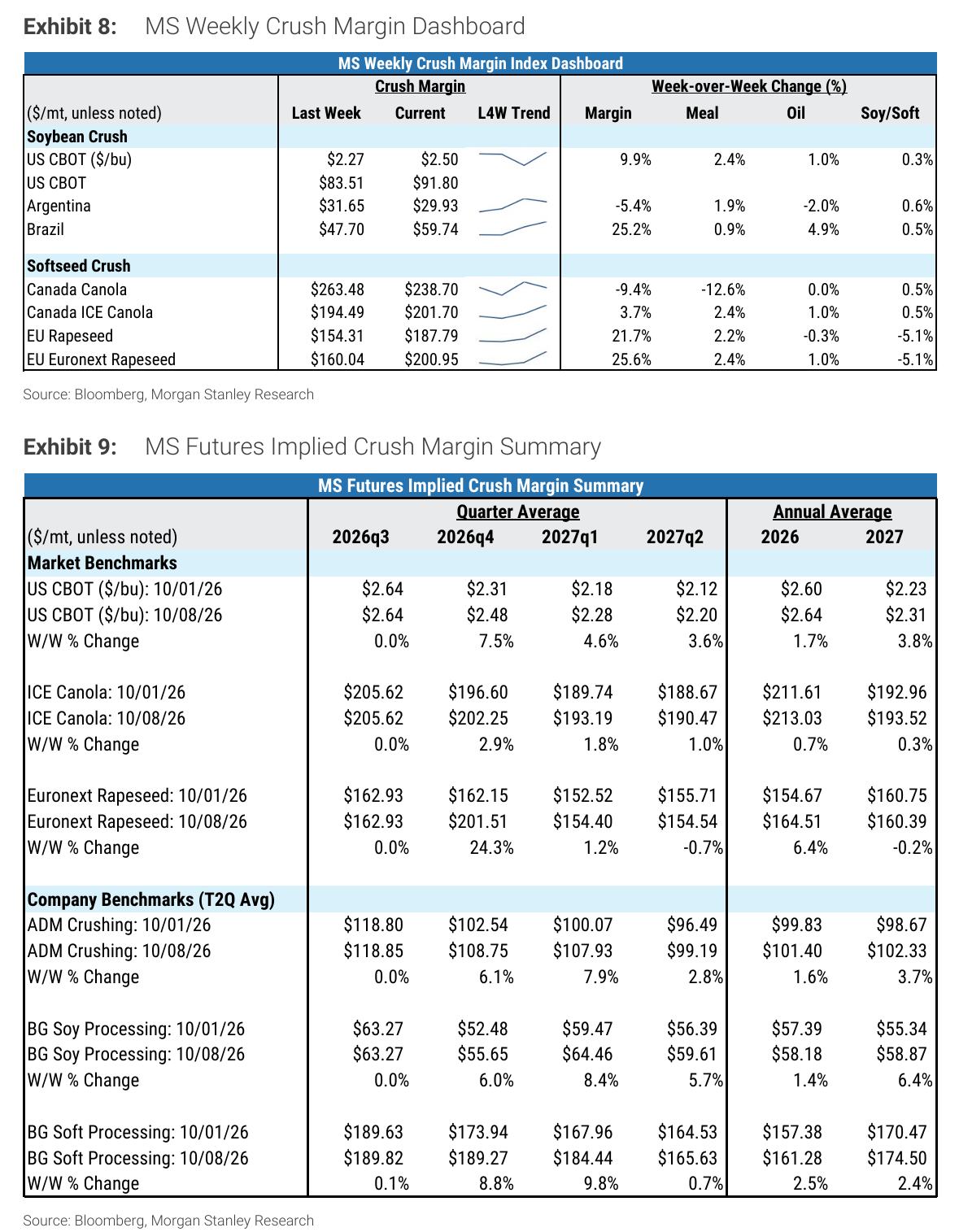
Furthermore, while the spot benchmarks for Argentine soybeans and Canadian rapeseed fell by 5.4% and 9.4% respectively, the Canadian futures agency index rose, indicating that the region and product structure determine profit differences. The reported price difference of the renewable diesel model rose 7.8% to 3.43 US dollars/gallon per week, which also reflects the linkage between biofuel and fat processing; it is important to note that the price difference in oilseed pressing here is a different indicator from the cracking price difference in petroleum refineries.
Farmers' purchasing power and grain stocks determine whether processing improvements and growth trends can continue. US soybean harvesting progress was 25%, below the five-year average of 33%, and export sales fell 47% per week; Brazil sowed 12%, faster than the historical average, but the predicted utilization rate of 87 million tons of pressing capacity was only 73%. Under the report's full cost model, the economic benefits of US corn and soybeans per acre in 2026/27 were negative 27.5 and negative 72.1 US dollars, respectively, limiting agricultural procurement capacity.
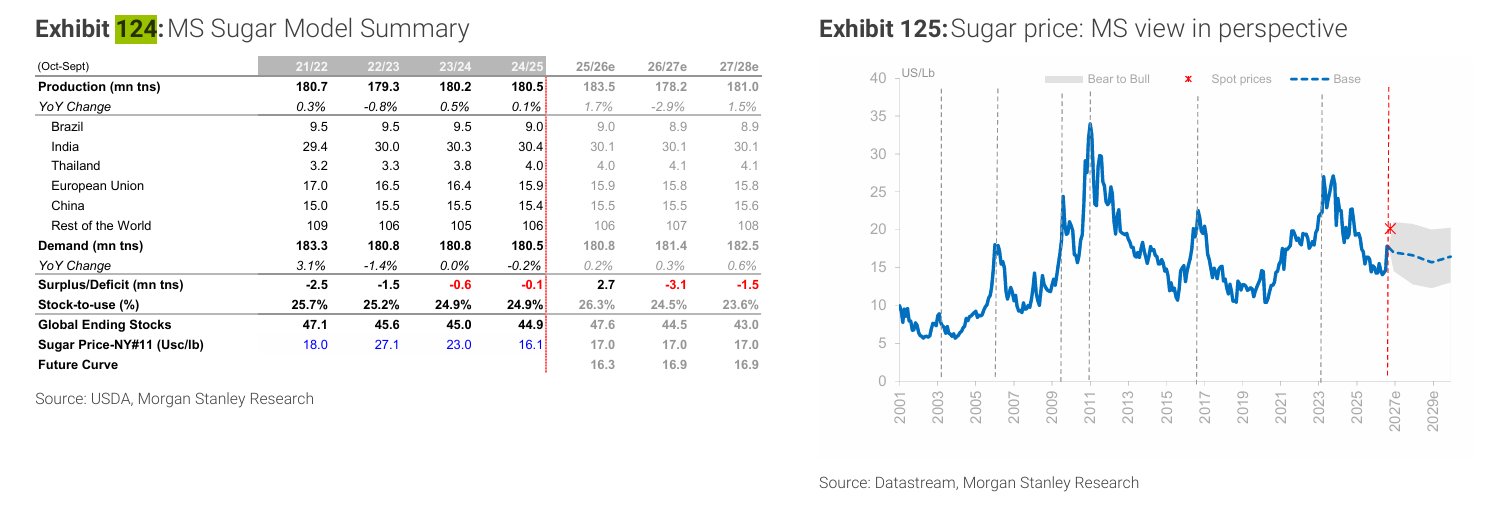
Meanwhile, the Damo Global Model predicts shortages of 4.9 million, 27.4 million, and 3.1 million tons of soybeans, corn, and sugar during the same period, respectively. Inventory consumption ratios will decline, providing support for agricultural product prices in the medium term. The 2027/28 supply and demand for soybeans and corn are expected to balance, and there is still a major gap in the supply of sugar futures. The September USDA US supply and demand schedule, and the comparison of fertilizer imports and inventories, planting area, exchange rates, and sugar-ethanol benefits of various countries together form the basis for judging procurement and processing cycles; comparisons of seeds, plant protection, and R&D complement the perspective of enterprise competitiveness.
The company-level incremental signals are mainly reflected in Bunge and ADM's processing benchmarks. According to calculation data from Damo Strategist, ADM's fourth quarter and 2027 pressing benchmarks improved by 6.1% and 3.7%, respectively; Bungie's soybean processing improved by 6.0% and 6.4%, respectively, and soft seed processing improved by 8.8% and 2.4%, respectively. These are implicit model indicators for futures. Actual profit realization depends on hedging, procurement base differences, logistics and processing costs. Combined with ratings, Bungie is a direct observer of the “processing benchmark improvement+holdings increase rating”; Nutrien also received an increase in holdings, but the Damo strategist team emphasized that the decline in fertilizer prices did not yet support the increase in profit expectations across the industry.
The investment inspiration given by Damo strategists is to prioritize identifying companies that have improved raw material procurement costs, product portfolios, and processing price differences. Among them, Bungie received an “increase” rating from Damo strategists, providing specific stock observation targets for fixing price differences in oilseed processing; other companies in the US stock market chemical industry that cover “increased holdings” include IFF, Eastman (EMN), Yikang (ECL), Linde (LIN), Leander (LYB), Sherman (SHW), and Vylor (VYLR).