


The Zhitong Finance App learned that Palantir (PLTR.US) Chief Technology Officer (CTO) Shyam Sankar refuted reports last weekend that the company's artificial intelligence (AI) platform Maven participated in the US military attack on a girls' school in Iran, which killed more than 100 children, and said that the incident was probably caused by human error.
On February 28 of this year, the US and Israel launched a military attack against Iran. An elementary school in Minab in Hormozgan province in southern Iran was affected. According to official Iranian data, more than 150 people were killed in the attack, of which about 120 were schoolchildren.
Some reports quoted sources involved in the investigation of the incident as disclosing that the US Central Command, which is responsible for this attack, relied too much on AI technology integrated into Palantir's “Maven Intelligent System” (MSS). In response, Shyam Sankar said in an interview: “The report is wrong. The likely cause is human error.” He reminded the outside world to wait for the final investigation results, but at the same time said that Palantir developed additional AI agents after the incident occurred to add more verification steps to the target identification and attack process. “In response to the urgent situation at the time, we developed additional AI tools to double check more work in addition to the processes we are responsible for,” he said.
Shyam Sankar also said that AI tools help military personnel improve the consistency of safety checks and target verification rather than independently selecting targets to hit. He said that previously it took 50 people to complete the task in two weeks, but now it only takes four hours for one person to complete it.
According to reports, the system integrates more than 150 data sources to organize intelligence, track operations, and assist commanders in target selection. The investigation found that some US military central command personnel expected the system to automatically detect outdated intelligence or information inconsistencies, but the system actually only processes low-level data provided by the government.
After the problem of mistargeting came to light, public opinion is also concerned about another question, namely whether the AI system used by the US military is also responsible for adopting incorrect information to participate in decision-making. Palantir, on the other hand, stated that the company is not responsible for the accuracy of the underlying data, nor is it responsible for identifying intelligence flaws.
At a time when stock prices are soaring, it is mired in moral controversy
Shyam Sankar previously pointed out that Palantir was founded after the “9/11 incident” and has been committed to providing world-class software to help the military predict where ambushes may occur, hunt down targets, and enable the military to make smarter decisions even when far from the front line, etc.
In August 2025, Palantir signed a contract worth up to $10 billion with the US Army to integrate the military's software and data requirements over the next ten years and consolidate 75 fragmented contracts into a single enterprise-level agreement. The partnership aims to help the military simplify efficiency and respond to growing war demands, and is seen as part of the Trump administration's policy to cut costs and improve efficiency through AI tools.
At the same time, as one of the core contractors of the US Army's next-generation mobile intelligence system, TITAN (Tactical Intelligence Target Access Node), Palantir not only helped develop this system, but also integrated multi-source data from satellites, drones, ground sensors, etc., and through its edge computing capabilities, it provides tactical units with near-real-time situation perception and attack decision support in poor front-line environments with low bandwidth or even network disconnection.
According to reports, the US Army has awarded its wholly-owned subsidiary Palantir USG a main contract agreement to produce and deliver 8 TITAN ground station systems. The latest order covers 4 advanced and 4 basic TITAN systems, as well as technology integration and alignment work for combat forces.
In addition, Palantir has also become a key technical partner of the US Department of Defense's flagship AI project “Project Maven” (Expert Program). The project was launched in 2017. The goal is to use AI algorithms to automatically identify potential targets in drone reconnaissance images, thereby speeding up the “death chain”. The platform provided by Palantir is responsible for integrating data from different sources — including satellite images, drone video, geographical location data for communication interception, etc. — so that AI algorithms can operate in complex battlefield environments to identify and classify targets.
In 2024, the Chief Technology Officer of the US Central Command confirmed that Project Maven's computer vision algorithms have been used to locate targets in Yemen and the Red Sea and support strike operations in Iraq and Syria.
However, some media quoted a senior military officer from the US 18th Airborne Force (the first US force to use AI to assist in combat) as estimating that when the accuracy rate of human analysts is 84%, the accuracy rate of the Project Maven system is about 60%. Sometimes trucks are even mistaken for trees. Under complex conditions such as snowy days, the accuracy of identifying targets such as anti-aircraft artillery may be less than 30%.
In addition to being deeply tied to the US military, Palantir also won a $30 million contract from the US Immigration and Customs Enforcement (ICE) in April 2025 to develop an operating system that can identify undocumented immigrants and track self-evictions.
In the capital market, Palantir is also well recognized. Since its listing on September 30, 2020, its stock price has accumulated a cumulative increase of nearly 20%, and its market value has increased to more than 500 billion US dollars, leaving defense contractors such as Thor Technology (RTX.US), Boeing (BA.US), and Lockheed Martin (LMT.US) out of reach.
However, as its influence expanded, the moral controversy faced by Palantir also became more prominent, with some critics directly referring to its “war technology” company. In addition to being used by the US military to attack Iran, a UN report indicates that there is reasonable reason to believe Palantir was deeply involved in Israel's activities in Gaza.
In an earlier interview, Yanis Varoufakis, a former Greek finance minister, and economist, described his meeting with Palantir representatives. Yanis Varoufakis said that Representative Palantir explained that in a densely populated urban area like Gaza, chaos caused by violent conflict will generate large amounts of data to train their artificial intelligence models to simulate human responses under pressure. “The more bombing and destruction, the better the training effect.”
Yanis Varoufakis said: “This is the first time in history that a nation has suffered from genocide and bombardment — the suffering itself — but has increased capital for a company, which then uses that capital to produce goods to sell elsewhere.”
Furthermore, ethicists and human rights groups are concerned that Palantir's technology is blurring the line between humans and machines in making fatal decisions. When AI can identify, recommend, and even execute attacks far faster than humans, the risk of misjudgment and the issue of attribution of responsibility becomes extremely acute, leading to irreversible tragic consequences.
Wall Street is optimistic that Palantir shares still have room to rise
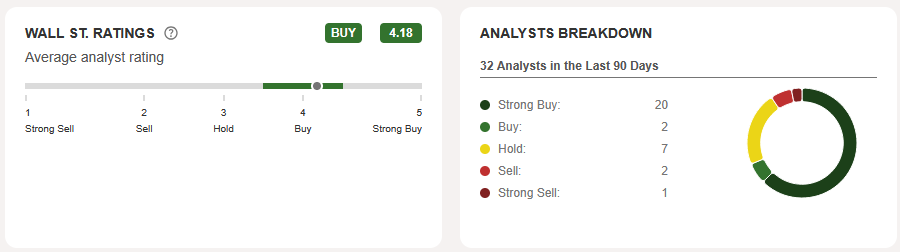
Despite the moral controversy, Wall Street generally believes there is room for further growth in Palantir's stock price. According to SeekingAlpha data, there are currently 32 analysts covering Palantir shares, with 22 giving a “buy” or higher rating, 7 giving a “hold” rating, and 3 giving a “sell” rating or lower. The stock's average target price of $209.05 means there is still room for an increase of about 3% from last Friday's closing price.
Barclays analyst Anthony Valentini said the US is in the “early stages of the modern industrial revolution,” which allows Palantir to benefit from widespread adoption of technology in defense, aerospace, and other industries.
Goldman Sachs analyst Gabriela Borges upgraded Palantir's rating from “neutral” to “buy” last week. The target price was set at $230, citing the recent poor performance of its stock price and rising valuation appeal.
Gabriela Borges believes Palantir's potential market size (TAM) is expanding as governments and businesses increasingly want to adopt sovereign AI solutions that allow them to retain control of data. The analyst also anticipates that as companies gradually move away from generic chatbot tools and switch to AI-driven software tailored to their own business operations, the market demand for customized AI applications will continue to grow.
Furthermore, according to Stocktwits data, retail investors' sentiment towards Palantir turned “extremely bullish” over the weekend, while the sentiment during the previous week was “neutral.” Over the past week, the volume of discussion information related to the stock increased by 271%, indicating a significant increase in retail investors' attention.