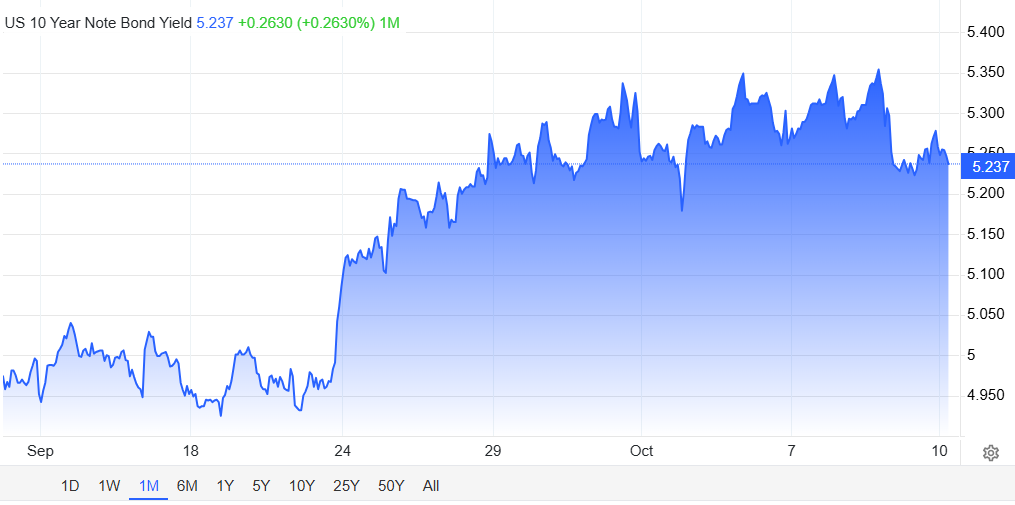
The Zhitong Finance App learned that after the Federal Reserve unanimously approved interest rate hikes last month, US bond yields jumped sharply; there was almost no change last week, hovering near a 24-year high. In the new week, investors are now waiting for two things: new data and suggestions from Federal Reserve Chairman Kevin Walsh about how fast the Federal Reserve will continue to raise interest rates.
The sell-off was held back by employment data, and yields were flat at a high level
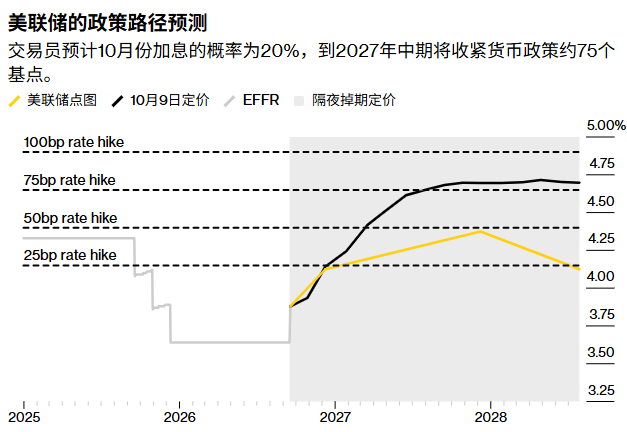
This round of bond sell-off was dampened by a sharp slowdown in employment growth shown by the non-farm payrolls report. This makes traders expect the Federal Reserve to stand still at its next meeting at the end of October — they still expect a 25 basis point rate hike in December, and two more times before the end of 2027.
According to reports, the 10-year US bond yield hit 5.364% in the intraday period on October 7, the highest since 2002, and hit 5.696% in the same period of the 30-year term; the 10-year yield has accumulated a cumulative increase of nearly 120 basis points since this year. The third quarter was the worst performing quarter for US bonds since 1994.
The risk is asymmetric: a higher CPI is much more troublesome than a lower one
The current position layout is increasing the risk: if the consumer price index (CPI) rises more than expected in September, it may reignite this round of sell-off because it will put the Federal Reserve under pressure to raise interest rates more aggressively.
Molly Brooks (Molly Brooks), an American interest rate strategist at TD Securities, believes that the risk in this CPI report is asymmetrical — the data is hotter and may indicate that the Fed needs to speed up the pace of austerity; while the data is weaker or in line with expectations, it will continue to support the Fed to remain cautious in the future.
The September CPI is scheduled to be announced on Wednesday (October 14). According to a survey of economists, the month-on-month increase is 0.6%, higher than the previous value of 0.4%; after excluding highly volatile food and energy prices, the core CPI is expected to slow from 0.3% to 0.2% month-on-month. Both year-on-year indicators are expected to rise, at 3.6% overall and 2.5% at the core.
Walsh's Window: The Last Week Before the Quiet Period
Walsh will participate in a discussion at the International Monetary Fund (IMF) annual meeting to be held in Bangkok, Thailand on Thursday. Two other high-profile officials — Federal Reserve Governor Christopher Waller (Christopher Waller) and Cleveland Federal Reserve Chairman Beth Hammack (Beth Hammack) — will also speak. The Federal Reserve will enter a regular quiet period of communication from Saturday until the two-day interest rate meeting that ends on October 28.
Brooks said, “This will be the last week before the quiet period, so the Federal Reserve's statement after the CPI will help the market to be less uncertain about the outcome of the next meeting.” At the same time, she said, “Walsh may continue to avoid forward-looking guidance, and this is what the market expects.”
Interest rate futures currently show an 80% probability that the October meeting will stand still; after only 29,000 new non-farm payrolls were added in September, the market's pricing for the October rate hike fell from about 70% to 20%-25%. Waller said on October 8 that interest rate hikes “don't have to take place in consecutive meetings” — this is interpreted by the market as a sign that it can be suspended in October. Also, the bond market was closed on Monday due to a public holiday, and the US stock market traded as usual.