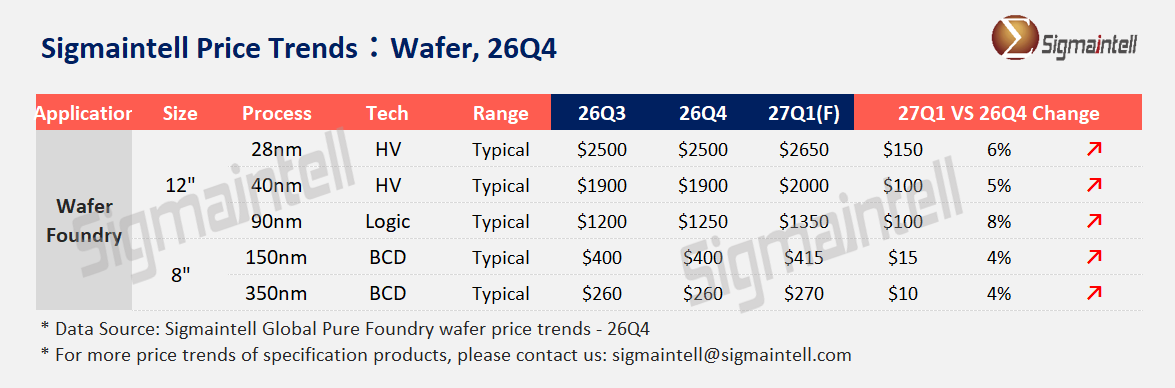
The Zhitong Finance App learned that Qunzhi Consulting published an article stating that the average capacity utilization rate of the world's major fabs is expected to be about 91% in the fourth quarter of 2026, and the operation of various foundries is generally at a high level. Combined with factors such as energy and material price increases, the overall rise in wafer foundry prices has been determined. Driven by demand for artificial intelligence support, mature process manufacturers are generally optimistic. For example, UMC 26Q4 expects the capacity utilization rate to be above 91%, an increase of more than 10 percentage points over the previous year; mainland Chinese manufacturers such as SMIC, Huahong, and Jinghe have already entered full production since the beginning of the year. In 26Q4, mature process foundry prices are still differentiated according to the process. Demand for 55nm and above processes for AI peripheral applications is extremely visible, driving prices to continue to rise; the 28/40nm process is between advanced computing power chips and peripheral chips. In this round of prices, demand drivers are relatively weak.
The detailed analysis of price trends for each process is as follows:
12 inch (28/40nm): “26Q4 remains flat, price increase pressure delayed release”
The 28/40nm downstream mainly covers MCU, Wi-Fi, OLED driver chips, etc. Demand stability showed compression-resistant characteristics during periods of market fluctuations, but growth moderated relatively during periods of AI demand explosion. The wave of price increases in mature manufacturing processes in 2026 had little impact on 28/40nm nodes, and overall prices remained flat in the first half of the year. Starting with 26Q4, with the recovery of applications such as communications, DDIC, and ISP, 28nm was represented by UMC, which showed a good recovery pace at the 22/28nm node. #群智咨询 (Sigmaintell) expects its 12-inch mature process (the main force is 22/28nm) Q4 production capacity utilization to reach about 93%, but in order to take care of newly finalized customers, the price finalized in 2026 has not been adjusted upward; the 40nm node is represented by SMIC. Due to the low prosperity of mobile phone and automobile customers in 2026, the foundry did not adjust this node price. Overall, 28/40nm foundries generally adopted the strategy of caring for price-sensitive customers in 2026. There was no significant increase in 26Q4 prices, and the price increase pressure brought about by costs is expected to be gradually released in 2027.
12 inch (55/90nm): “Prices continue to rise in 26Q4, and the increase is expected to continue to expand in 2027”
The 55/90nm process covers applications such as high-end power management chips and Nor Flash. In 2026, AI infrastructure will drive demand for applications such as Nor Flash, high-end MCU, high-end PMIC, and power devices. Furthermore, in consumer electronics, despite weak demand for mobile phones, tablets, and laptops, the maintenance market demand will increase significantly, playing a role in supporting capacity utilization. The 55/90nm process has begun the price increase cycle since the beginning of the year. The price increase in 26Q4 is relatively moderate. The main reason is that prices are expected to increase centrally in 2027, and none of the manufacturers are inclined to make major adjustments this quarter. Although the 55/90nm process has a significant number of second-tier manufacturers entering mass production in the second half of 2026, and the pricing strategy is aggressive, the initial customers are mainly low-level power simulation products or refurbished driver chips, which temporarily had little impact on the pricing of mainstream manufacturers.
8-inch wafers: “Order visibility is high, prices are rising steadily”
The 8-inch manufacturing process continues to be fully loaded due to the explosion of peripheral demand for AI-related power management ICs, power devices, etc., and the capacity utilization rate continues to be high. Order visibility is generally close to half a year. In particular, the 48V high-voltage PMIC used in AI servers is still the main process, and supply continues to be tight. Furthermore, due to the simultaneous contraction of the supply side, TSMC and Samsung both cut part of their 8-inch production capacity. It is expected that global 8-inch foundry production capacity will drop by about 6% year on year in 2026, and will continue to decline by about 2% in 2027. As a result, the price of the 8-inch process continued to rise, and the price will continue to rise in 2027 after implementing single/multiple price increases within 2026. In the 8-inch manufacturing process, manufacturers such as SMIC and the world's advanced manufacturers still have some room to expand production, but the expansion cycle is long, so it is difficult to reverse the shortage of 8-inch wafer production capacity in the short term.