


On the surface, Exelon (EXC) is a difficult nut to crack, especially for options traders. Fundamentally, EXC stock benefits from the explosive growth in artificial intelligence and rising demand from data centers. As Exelon commands one of the industry's largest portfolios of electricity generation capacity, it naturally enjoys impressive reach.
At the same time, this key narrative hasn’t consistently supported Exelon stock. On a year-to-date basis, EXC finds itself down more than 4%. Since early July, the ticker has been stuck in a downward spiral, enough so that it has “earned” an 88% Strong Sell rating by the Barchart Technical Opinion indicator.
According to Wall Street analysts, while EXC stock had previously enjoyed a surge in investor sentiment thanks to the AI tailwind, management also trimmed its “high-probability” data center load pipeline in an effort to weed out speculative projects. In fairness, this decision may offer long-term benefits but it nevertheless forced a risk adjustment by the market.
So, where does that leave us with EXC stock? Essentially, the 20-second elevator pitch is that the Exelon portfolio should remain extraordinarily relevant in the age of AI. But right now, the immediate risk assessment has changed the current behavioral state of EXC to one that is pessimism-dominated.
Still, the main question is whether the pessimism will persist — or if Exelon stock will transition to a more optimistic state. Quantitative history suggests that the latter is more likely, with an inductive reading implying a favorable pricing structure for the 43/44 bull call spread expiring Nov. 20.
Symmetric Payout for EXC Stock Hits a Sweet Spot
So, the basic reality of Exelon stock is that it’s a public utility equity. We’re not expecting a massive swing higher, especially over the next six weeks. Subsequently, buying a naked call may not be the most prudent strategy. Instead, a vertical spread — where the simultaneous sale of a short call helps offset the debit paid for the long call — may be more efficient.
True, bull spreads don’t offer unlimited upside like a naked call would (in theory). But since the expected return isn’t all that great, a capped-risk, capped-reward strategy would seem to fit the bill better for a name like EXC stock.
As for the 43/44 bull spread, there’s a mechanical reason why it should appeal to aggressive speculators: the $44 second-leg strike is the lowest target available that still offers a symmetric payout. In this case, you’re risking $50 (a nominally low figure) to potentially generate a profit of $50.
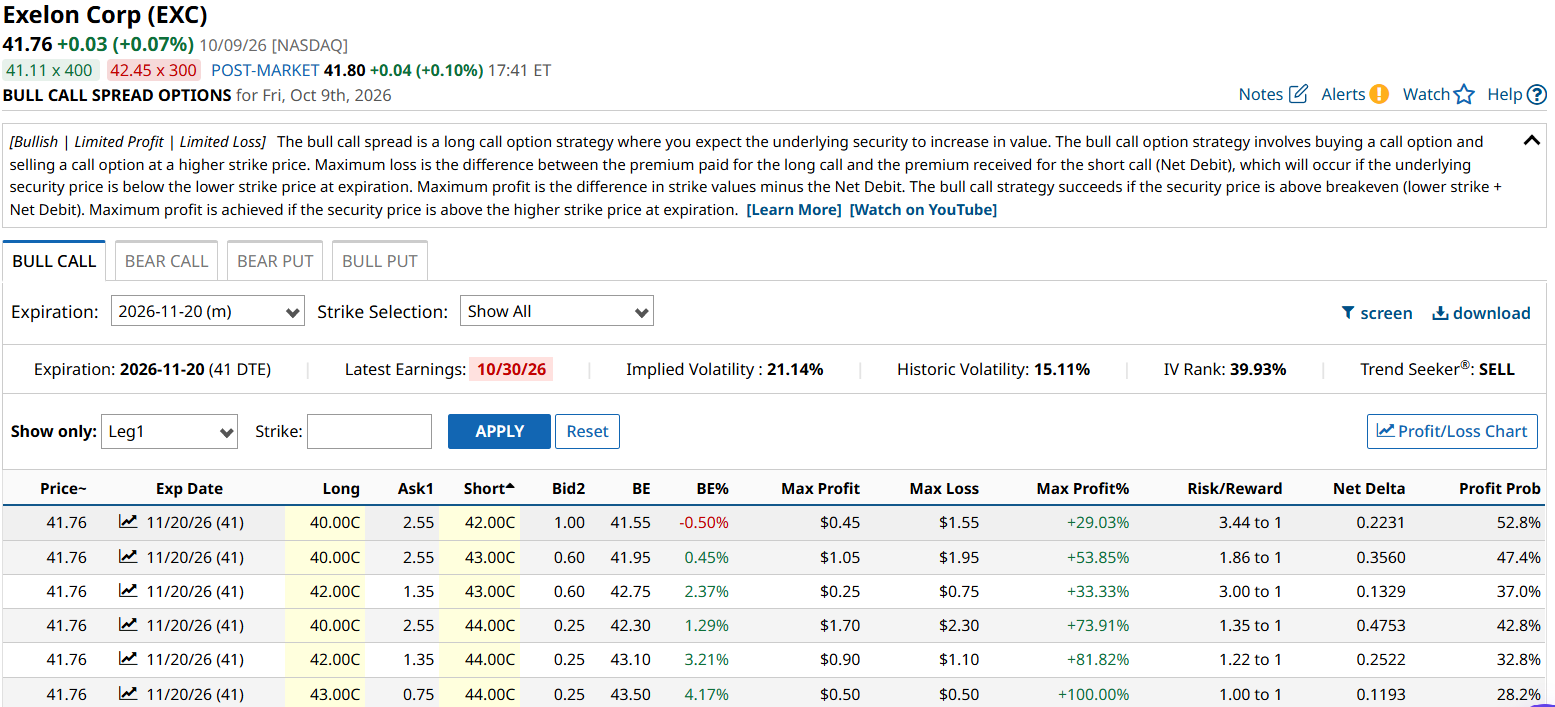
If you dropped the second-leg strike to $43, the maximum payout you can get on this trade (at time of writing) is only around 54%. That’s a huge drop-off in the reward. Why, then, would traders even consider it? The answer comes down to probabilities.
Take the 40/43 bull spread as an example. It features a maximum payout of 53.85% but a probability of profit (breakeven) of 47.4%. For our trade, the 43/44 spread, the payout is 100% at a probability of profit of only 28.2%.
Further, under the probability distribution of the Black-Scholes formula, the chance of Exelon stock reaching $43 on Nov. 20 is 35.05%, whereas the chance of it hitting $44 on expiration is 23.75%.
Here’s where the math comes in. Using an expected value calculation, the net expected value of the higher-probability 40/43 bull spread sits at $89.66 below parity, whereas the same calculation for the lower-probability 43/44 bull spread comes in at $26.20 below parity.
True, both trades technically suffer from negative expectancy but the 43/44 bull spread wins out because you’re putting less money at risk.
A Philosophical Take on Probabilities
As you can see, math-based risk management can make your decisions more efficient but they can’t necessarily turn a bad trade into a good one. After all, both of the above spreads will still likely get you underwater based on the premises that were presented. Therefore, in order to make these trades more viable, either the payout needs to rise or the probability does.
Of course, Wall Street is not in the business of handing out free money so it’s highly unlikely that the payout will increase in your favor without you being forced to accept a comparative magnitude of probabilistic risk. However, what you can change (so to speak) is the probability of your trades.
While the mathematical architecture underlining various forecasting models are logical and objective, the application of what axiom to privilege is philosophical. In standard modeling matrices for the equities market, the main philosophy is the random walk.
In other words, the calculation that EXC stock may hit $44 on Nov. 20 with a 23.75% probability is absolutely correct — assuming that EXC undergoes a random walk. But if it doesn’t undergo a random walk, if the walk is biased or nonrandom, then it’s entirely possible to generate a different probability.
The argument is not that there are “right” probabilities and “wrong” probabilities; rather, there are different frameworks that may be more reflective of market reality at specific moments in time.
Transitional Potentiality is What Makes Exelon Stock Enticing
As I mentioned earlier, EXC stock is currently structured in a bearish state. In fact, it’s extremely bearish. In the last two months, the ticker has printed 10 weekly candlesticks — and seven of them were in the red. That’s going to change the immediate perception of EXC for obvious reasons.
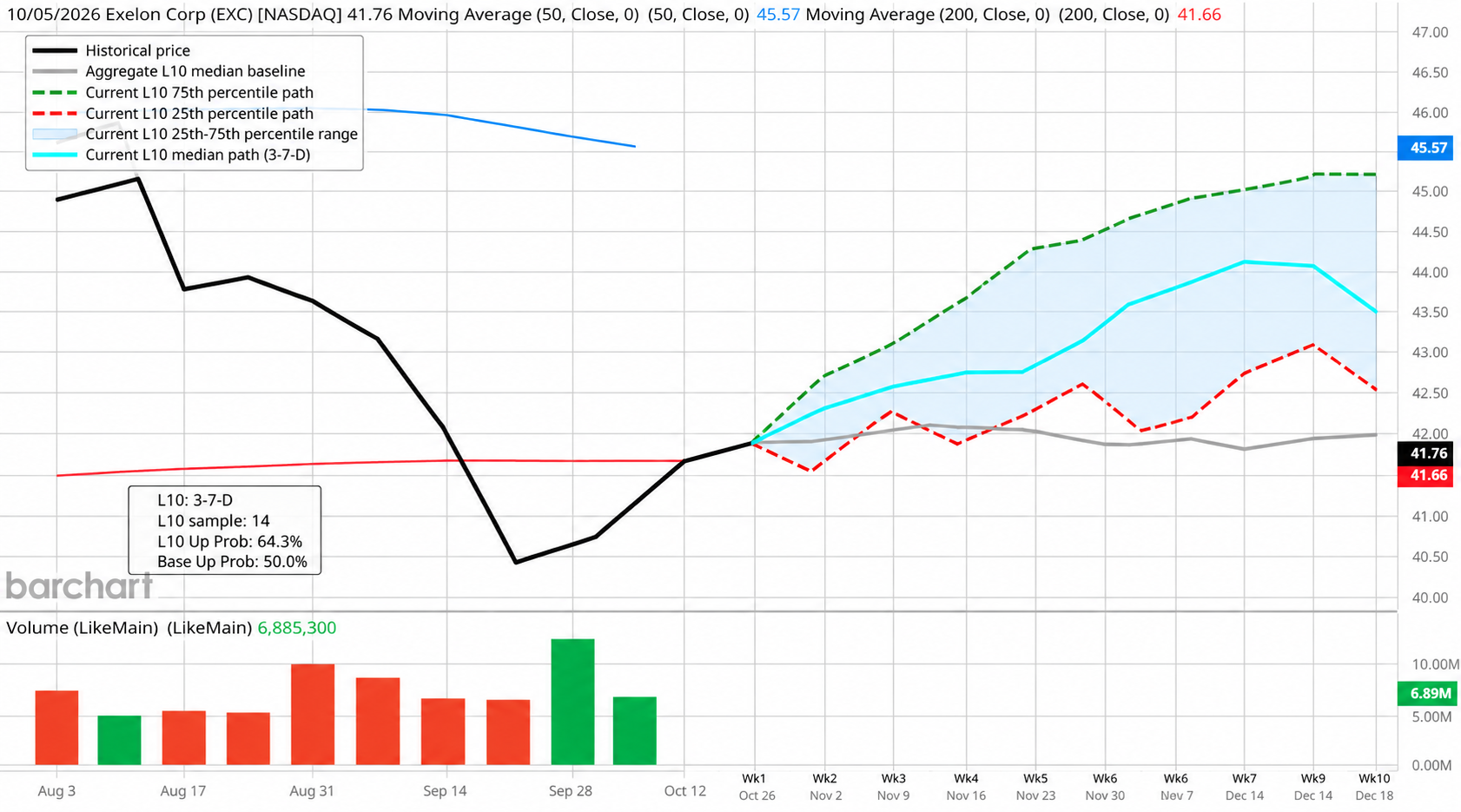
At the same time, we also know through historical data that when this particular bearish state materializes, Exelon stock tends to rise about 5.4% over the next six weeks as a median response. If were to infer a similar outcome this time around, that would put EXC right around the $44 price on Nov. 20.
Mathematically, that would mean that, under this inductive framework, the probability of EXC stock hitting $44 on expiration stands at 50%. Further, the breakeven probability would rise to 57.1%.
To be fair, as the $44 strike still only represents a symmetric payout, the trade would neither incur negative nor positive expectancy. However, because the breakeven probability is asymmetric in your favor, there may be a slight edge here.
Of course, this assessment mostly hinges on the transition from an extremely bearish state to a bullish one, which is not guaranteed to materialize. Nevertheless, if you find the framework convincing, Exelon stock should be on your radar.
On the date of publication, Josh Enomoto did not have (either directly or indirectly) positions in any of the securities mentioned in this article. All information and data in this article is solely for informational purposes. For more information please view the Barchart Disclosure Policy here.