


Radware (NasdaqGS:RDWR) is drawing fresh attention after launching its Agent Trust Management solution, a security layer designed to manage how AI agents access applications, data, and business workflows across sectors.
The latest product launch lands as Radware’s 1-month share price return of 11.04% and year-to-date share price gain of 30.28% point to building momentum, while a 3-year total shareholder return of 90.88% signals that longer term investors have already experienced substantial value shifts tied to earlier phases of the cyber security story.
Scan how Radware’s AI agent security push compares with other potential beneficiaries of this trend across 92 AI infrastructure stocks in the broader market.
After Radware’s sharp run and a share price now slightly above the average analyst target, the setup looks less clear cut. The question is whether the current valuation still leaves enough potential upside to justify taking on new risk.
Price-to-Earnings of 75.5x: Is it justified?
Radware’s current valuation screens as demanding, with a P/E of 75.5x that sits well above peers even after the recent share price strength to $30.98.
The P/E ratio compares the company’s share price to its earnings per share, so a higher figure often signals that investors are paying more today for each dollar of profit. For a cyber security specialist like Radware, a rich P/E can reflect confidence that revenue from services such as cloud application protection, DDoS defence, and AI driven security tools will support stronger profitability over time.
Recent fundamentals show some support for that optimism. Earnings have grown by 16% per year over the past 5 years and 21.9% over the past year, with net profit margins at 5.4% versus 4.9% a year earlier. At the same time, return on equity of 4.8% is considered low and one off items, including a $4.6m gain in the last 12 months, have had a material impact on reported results, which means the current earnings base may not be a clean run rate.
Compared to a peer average P/E of 33.7x, Radware’s 75.5x multiple is more than double, and it is also expensive against the broader US Software industry on 31x. With the stock trading above the SWS DCF model’s future cash flow value estimate of $19.46 and limited evidence of faster forecast revenue growth than the wider market, the market is placing a clear premium on Radware’s AI agent and cloud security story. This carries valuation risk if the execution or demand profile softens.
See what the numbers say about this price — find out in our valuation breakdown.
Result: Price-to-Earnings of 75.5x (OVERVALUED)
Still, any slowdown in revenue growth or weaker profitability could quickly challenge the premium P/E and make Radware’s recent share price gains look fragile.
Find out about the key risks to this Radware narrative.
Another View on Radware’s Value
The P/E looks stretched, yet the SWS DCF model paints an even starker picture for Radware. With the shares at $30.98 and the model’s future cash flow value at $19.46, the stock screens as overvalued on cash flows too. That raises a simple question for you: What needs to go right to support today’s price?
Look into how the SWS DCF model arrives at its fair value.
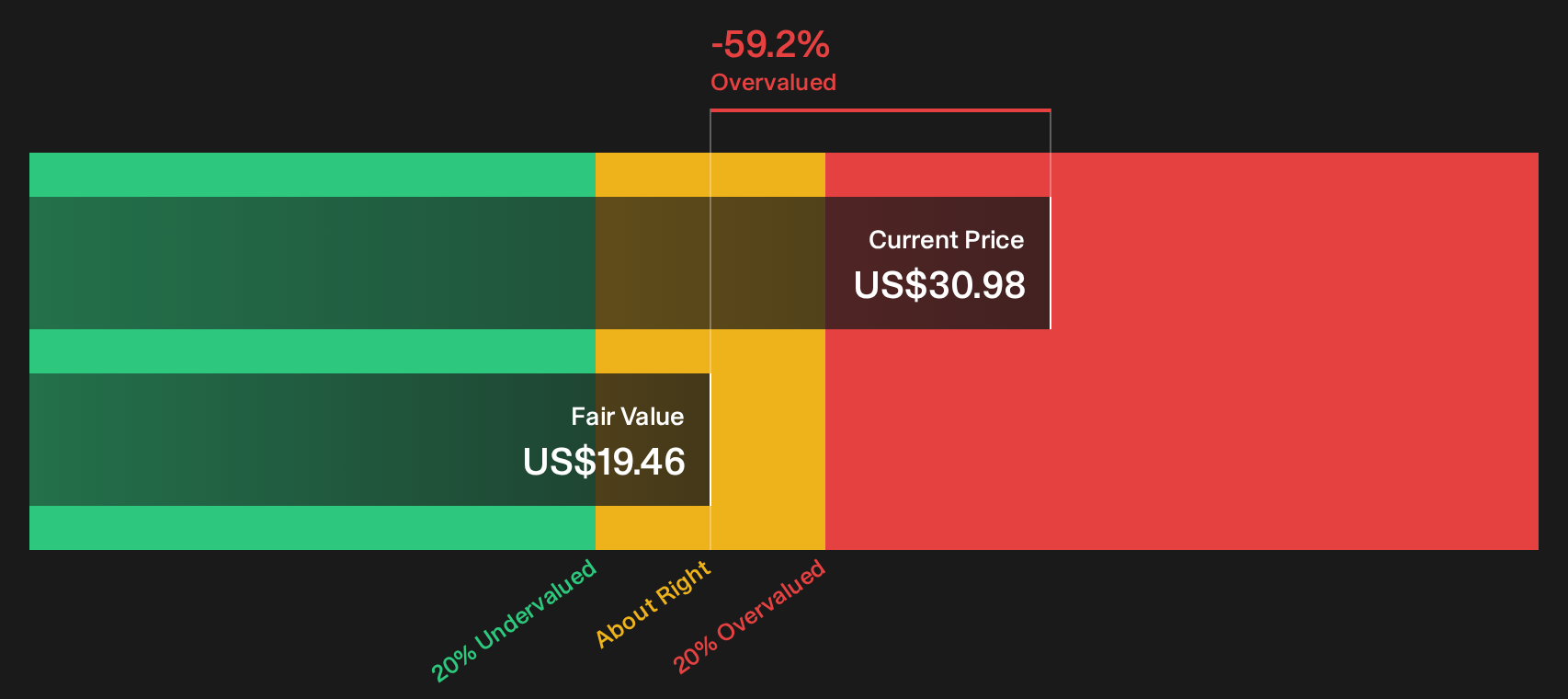
Simply Wall St performs a discounted cash flow (DCF) on every stock in the world every day (check out Radware for example). We show the entire calculation in full. You can track the result in your watchlist or portfolio and be alerted when this changes, or use our stock screener to discover 29 high quality undervalued stocks. If you save a screener we even alert you when new companies match - so you never miss a potential opportunity.
Next Steps
Mixed signals on Radware’s price and fundamentals can feel messy, so move fast, review the full data set carefully, and weigh both the 1 key reward and 2 important warning signs.
Looking for more ideas beyond Radware?
If Radware’s set up feels fully priced, consider broadening your search. Fresh ideas often come from scanning quality watchlists rather than focusing on a single ticker.
- Target potential mispricing by reviewing a curated mix of strong fundamentals and attractive valuations across the 29 high quality undervalued stocks.
- Strengthen your defence by focusing on resilient balance sheets and robust financial footing using the list of solid balance sheet and fundamentals (25 results).
- Hunt for under-the-radar opportunities with solid numbers before they become crowded trades through the 20 high quality undiscovered gems.
This article by Simply Wall St is general in nature. We provide commentary based on historical data and analyst forecasts only using an unbiased methodology and our articles are not intended to be financial advice. It does not constitute a recommendation to buy or sell any stock, and does not take account of your objectives, or your financial situation. We aim to bring you long-term focused analysis driven by fundamental data. Note that our analysis may not factor in the latest price-sensitive company announcements or qualitative material. Simply Wall St has no position in any stocks mentioned.
Have feedback on this article? Concerned about the content? Get in touch with us directly. Alternatively, email editorial-team@simplywallst.com