


The Zhitong Finance App learned that as US Treasury yields soar to decades-high levels, investors are leaving US mortgage-backed securities (MBS) funds on a large scale. In the past three weeks, the scale of capital outflows from such funds all ranked among the seven worst since the beginning of 2021, reflecting that sharp fluctuations in interest rates are prompting investors to withdraw from riskier fixed income assets at an accelerated pace.
According to the data, the Bloomberg US Mortgage-Backed Securities Index recorded the second-worst monthly performance on record in September. Previously, driven by factors such as soaring oil prices, heightened inflation concerns, and market expectations that the Federal Reserve would raise interest rates further, US Treasury bonds were sold off on a large scale, and yields continued to rise, putting tremendous pressure on the mortgage bond market.
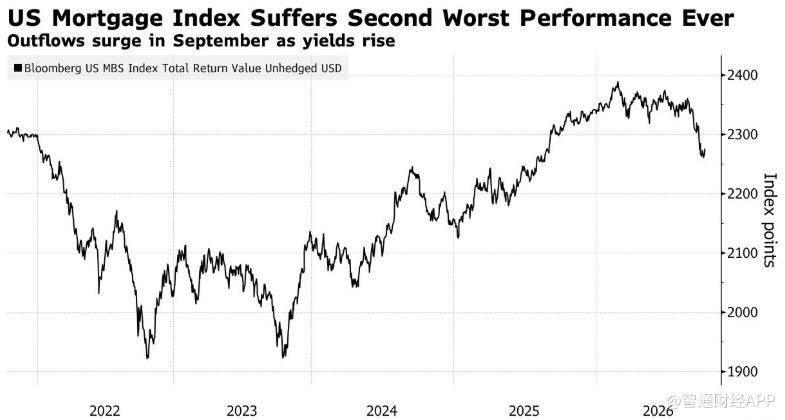
Mortgage-backed securities are particularly sensitive to sudden changes in bond yields, because US Treasury yields are an important pricing benchmark for borrowing costs across the economy. When market interest rates rise, homeowners usually reduce their home loan refinancing activities because the appeal of converting an old low-interest loan into a new one decreases. This means that early repayment of related mortgages is slowing down, causing MBS investors to hold securities with relatively low yields for a longer period of time, thus facing greater interest rate risks.
Erica Adelberg, senior MBS strategist at Bloomberg Industry Research, said that the Federal Reserve's tightening of monetary policy and the flattening of the US Treasury yield curve may weaken banks' demand for mortgage-backed securities, and banks have always been important buyers in this market. However, Adelberg pointed out that there are also certain positive elements in the market. As mortgage interest rates rise to the highest level since 2023, demand for home loan refinancing and home purchases is likely to weaken further, driving MBS supply to continue to decline until the end of the year.
At the same time, higher mortgage interest rates may also dampen the growth rate of housing prices and loan size, further limiting the supply of newly issued mortgage-backed securities. Notably, the wave of sell-offs in the US Treasury bond market in September has pushed long-term treasury yields to their highest level in 24 years. At the same time, the excess yield performance of mortgage-backed securities compared to US Treasury bonds continues to weaken, further dragging down the overall return of this type of asset.
Adelberg said that due to a combination of these factors, the total return of the Bloomberg US Mortgage-Backed Securities Index since this year has fallen to the second worst level in its 50-year history.
Although the decline in MBS supply before the end of the year may provide some support to the market, weak bank demand and interest rate fluctuations are still the main challenges facing the mortgage bond market against the backdrop of further tightening of the Federal Reserve's monetary policy and maintaining high treasury bond yields.