


Goldman Sachs Group (GS) investors have an important date to mark on their calendars as the Wall Street banking giant prepares to report its third-quarter 2026 earnings before the market opens on Oct. 13. The upcoming results will offer fresh insights into the health of its investment banking, trading, and asset and wealth management businesses amid shifting market conditions.
CEO David Solomon recently flagged weaker fixed-income activity and higher non-compensation costs for the quarter, adding to the stakes for the upcoming earnings report. In the second quarter, Goldman Sachs delivered net revenue of $20.3 billion and earnings per share (EPS) of $20.98, alongside an annualized return on equity of 23.5%. Investors will now look for the bank to sustain its earnings momentum and provide updates on its business outlook. Thus, the Oct. 13 report could be a key catalyst for GS stock as investors reassess its near-term growth prospects and profitability.
About Goldman Sachs Stock
Goldman Sachs is a leading global financial institution headquartered in New York. The company provides a broad range of financial services to corporations, financial institutions, governments, and individual clients worldwide. Its core businesses include Global Banking & Markets, which encompasses investment banking, advisory services, and trading, and Asset & Wealth Management, which offers investment management and wealth advisory solutions. The company has a market cap of around $260.7 billion, placing it among the world’s largest financial services firms.
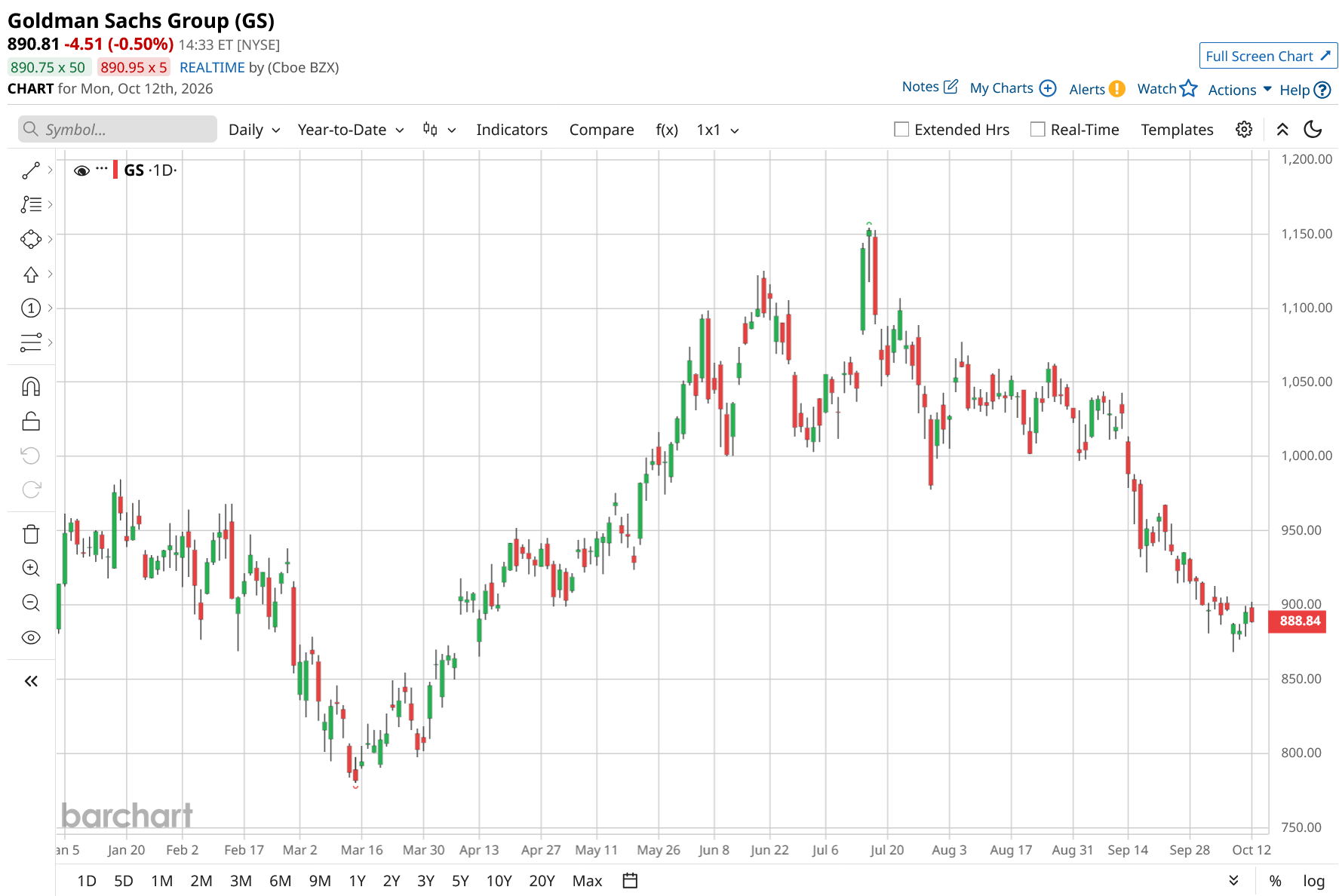
Goldman Sachs' stock has gained around 17% over the past year, while the stock has delivered only 1.4% returns year-to-date (YTD), with shares giving back much of their earlier advances amid a sharp recent pullback. The stock has slumped 13% over the past month.
The recent weakness reflects growing concerns about the sustainability of Goldman Sachs’ strong trading performance. CEO David Solomon indicated that fixed-income trading activity was softer in the third quarter, while non-compensation expenses were expected to increase by approximately $500 million compared with the second quarter, partly due to technology investments. These comments weighed on investor sentiment as markets reassessed the bank’s near-term earnings outlook. Rising bond yields have added to the pressure on financial stocks.
With Goldman Sachs scheduled to report its third-quarter results on Oct. 13, investors will be watching closely for updates on trading revenue, investment banking activity, and expense growth. The upcoming report could help determine whether the recent selloff represents a temporary correction or a more prolonged reassessment.
Coming to its valuation, the stock currently trades at 13.08 times forward earnings and 2.05 times sales, a premium to industry peers.
Better-Than-Expected Q2 Earnings
The company released its results on Jul. 14, for the quarter ended Jun. 30, reporting net revenue of $20.3 billion, up 39% year-over-year (YoY). Net earnings climbed 78% to $6.6 billion, while EPS surged about 92% to $20.98 from $10.91, topping estimates. The bank’s annualized return on average common shareholders’ equity (ROE) improved to 23.5%, compared with 12.8% in the prior-year quarter, reflecting stronger profitability. Revenue also increased 18% sequentially, while EPS rose 20%.
The bank’s Global Banking & Markets division was the primary growth driver, generating $15.5 billion in revenue, up 53% YoY, while investment banking fees increased 55% to $3.4 billion as equity and debt underwriting activity strengthened and completed mergers and acquisitions increased.
Plus, Goldman’s Asset & Wealth Management division generated $4.6 billion in revenue, up 20% YoY. Higher management fees, supported by increased average assets under supervision, and stronger gains from private-equity investments contributed to the growth. However, Platform Solutions revenue fell 64% to $221 million, primarily due to markdowns related to the Apple Card loan portfolio, which had been transferred to held-for-sale status in late 2025.
On the expense front, operating expenses increased 26% to $11.7 billion, reflecting higher compensation and benefits costs and transaction-based expenses. Despite the increase, the first-half efficiency ratio improved to 58.8% from 62.0% a year earlier. Additionally, the provision for credit losses declined 73% to $102 million from $384 million in Q2 2025, providing additional support to earnings.
Meanwhile, analysts expect EPS of $67.48 for fiscal 2026, representing about 31.5% YoY growth, while fiscal 2027 earnings are expected to grow 7% to $72.17. For the third quarter, the consensus estimate calls for EPS of $12.90, up about 5.3% from the prior-year period.
What Do Analysts Expect for GS Stock?
Most recently, TD Cowen initiated coverage of Goldman Sachs on Oct. 8, assigning the stock a “Buy” rating and a $1,050 price target. The firm sees Goldman’s Markets business as more resilient than in the past and believes its investment-banking franchise has significant growth potential.
On the other hand, BMO Capital Markets maintained its “Market Perform” rating on GS stock on Oct. 6, while slightly lowering its price target to $970 from $972.
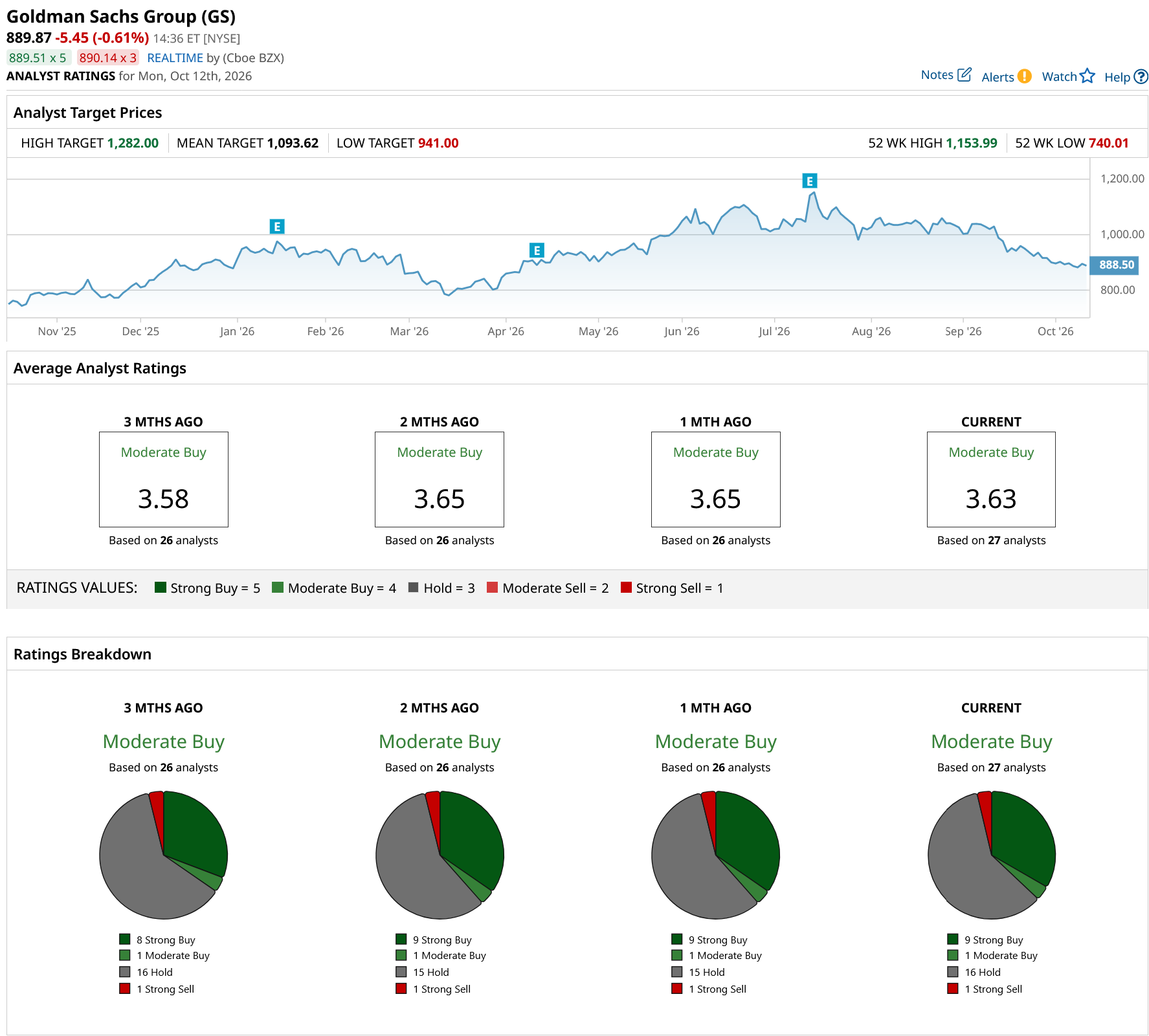
Overall, GS stock has a consensus “Moderate Buy” rating. Out of 27 analysts covering the stock, nine recommend a “Strong Buy,” one suggests a “Moderate Buy,” 16 analysts stay cautious with a “Hold” rating, and one offers a “Strong Sell.”
GS’ average analyst price target of $1,093.62 reflects an upside of 23%, while the Street-high target price of $1,282.00 suggests a 44% upside ahead.
On the date of publication, Subhasree Kar did not have (either directly or indirectly) positions in any of the securities mentioned in this article. All information and data in this article is solely for informational purposes. For more information please view the Barchart Disclosure Policy here.