


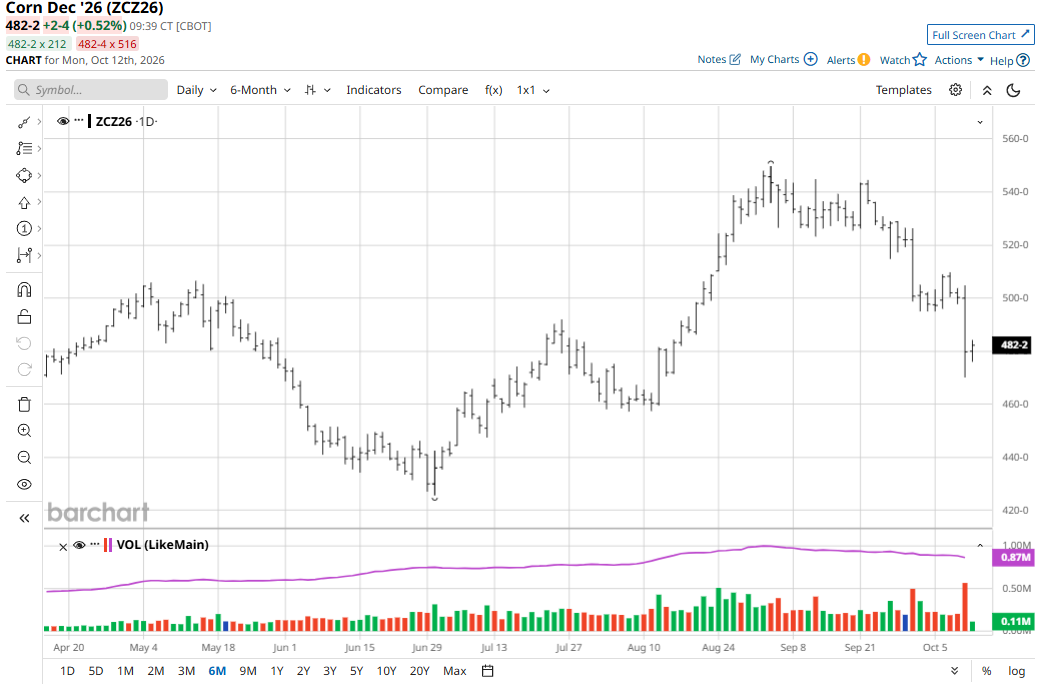
The corn futures market at midday Friday got gut-punched by another surprisingly bearish USDA report. December corn futures (ZCZ26) on Friday closed down 20 1/2 cents to $4.79 3/4, hit a two-month low, and for the week were down 18 cents. The Agriculture Department raised its U.S. corn crop estimate 234 million bushels from last month. The average U.S. corn yield increased 2.7 bushels to 181.2 bushels per acre — way above market expectations. New-crop corn carryover at 1.849 billion bushels was up 282 million bushels from last month and is 179 million bushels above the average pre-report trade estimate. The USDA put the national average on-farm cash corn price for 2025-26 at $4.70, down a dime from last month.
Friday’s technically bearish weekly low close suggests more chart-based selling in corn futures early this week. Traders will continue to monitor the weekly USDA crop progress reports, with this week’s report out on Tuesday afternoon due to the Columbus Day holiday today.
U.S. Corn Harvest Kicks into High Gear
Corn and soybean harvesting in the U.S. Midwest will occur rapidly in most areas during the next two weeks according to weather forecasts. Some scattered showers will occur, but not enough rain to slow field work for very long. Corn and soybean harvesting got a late start in the western U.S. Corn Belt, and the related commercial hedge pressure has ramped up, which will also add to selling pressure in corn and bean futures.
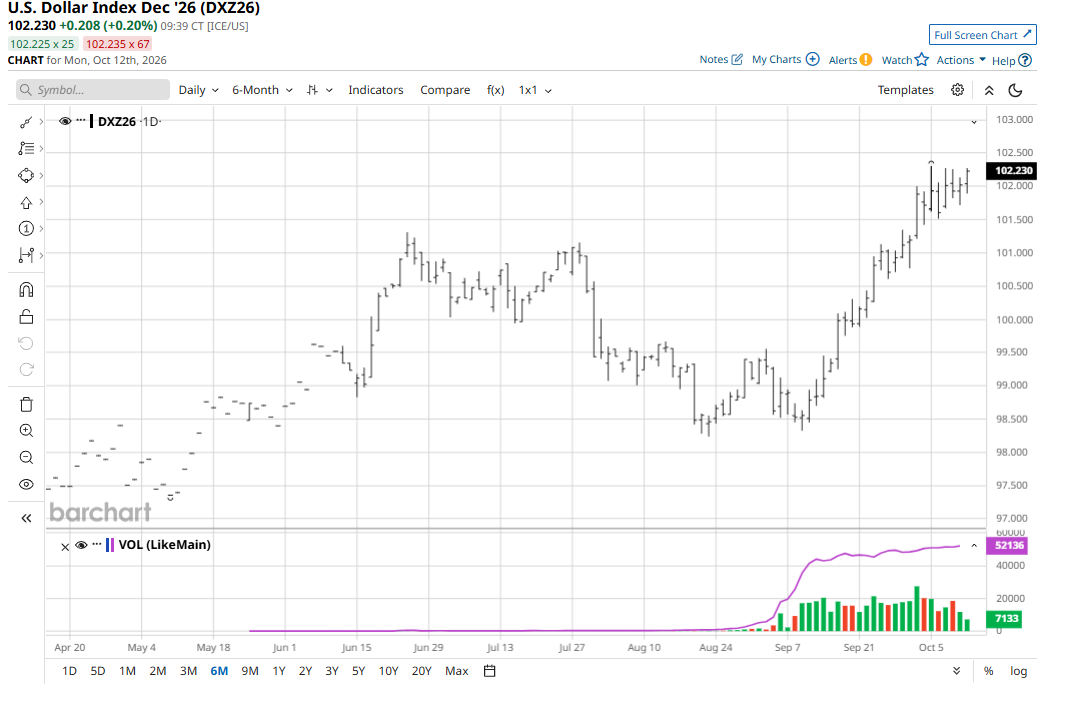
The strong U.S. dollar ($DXY) on the foreign exchange market will also be a headwind for the grain futures markets in the coming weeks. The U.S. dollar index is trading near its recent 1.5-year high.
Mexico making recent daily purchases of U.S. corn recently is a positive sign that U.S. corn may be seeing better export demand in the coming months. Attention in the coming months will turn from abundant U.S. supplies to potentially better export demand for U.S. corn.
Soybeans Get a Mostly Neutral USDA Report Friday
November soybean futures (ZSX26) on Friday rose 4 1/2 cents to $12.92 and hit a six-week low early on. For the week, November beans were up 13 3/4 cents. December soybean meal futures (ZMZ26) rose $8.00 to $356.60 and for the week were up $18.10. The soybean and meal futures markets on Friday saw late-session rallies that took prices from below unchanged to near their daily highs. Sharply lower corn and wheat futures prices on Friday did limit the upside in soybeans.
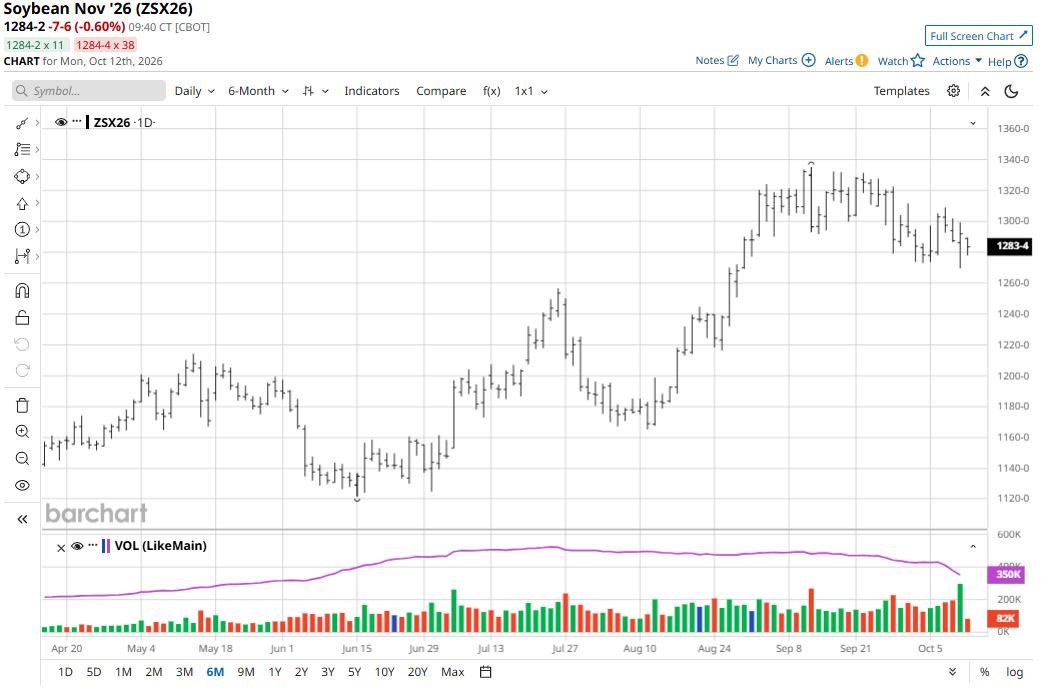
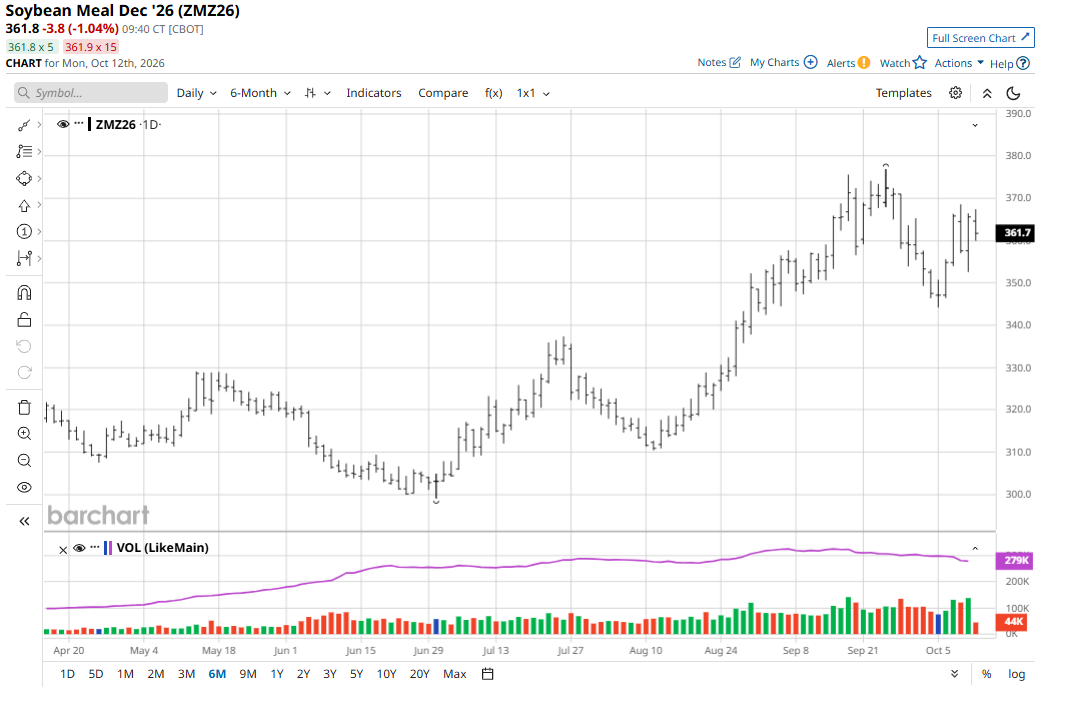
The USDA on Friday raised its U.S. soybean crop estimate by 27 million bushels from last month, at a record high, and slightly above market expectations. The average U.S. soybean yield rose 0.3 bushels to 53.1 bushels per acre, also slightly above expectations. USDA pegged new-crop U.S. soybean carryover at 315 million bushels, up 5 million from last month and 10 million bushels above the average pre-report trade estimate. Total new-crop supplies were increased 17 million bushels from last month, with a bigger crop estimate more than offsetting the decrease to beginning stocks. USDA puts the national average on-farm cash soybean price for 2026-27 at $12.00, unchanged from last month.
Quality concerns for the harvested U.S. soybean crop have arisen from the unseasonably wet weather that most of the Midwest has seen the past month.
Winter Wheat Futures Prices Remain Trapped in Downtrends
December soft red winter (SRW) wheat futures (ZWZ26) on Friday fell 12 1/4 cents to $6.71, hit a two-month low, and for the week were down 12 cents. December hard red winter (HRW) wheat futures (KEZ26) lost 17 cents to $7.19 1/4, hit a two-month low, and for the week were down 16 cents. Big losses in corn futures markets also spilled over into the wheat markets.
The winter wheat futures markets on Friday saw a mostly neutral USDA monthly supply and demand (WASDE) report. The agency forecast U.S. wheat carryover for 2026-27 at 740 million bu., up 23 million bu. from last month and 19 million bu. above the average pre-report trade estimate. USDA raised total supply by 8 million bu. due to a 3-million bu. increase in production and a 5-million-bu. increase in estimated imports. USDA put the national average on-farm cash wheat price for 2026-27 at $6.30, down a dime from last month.
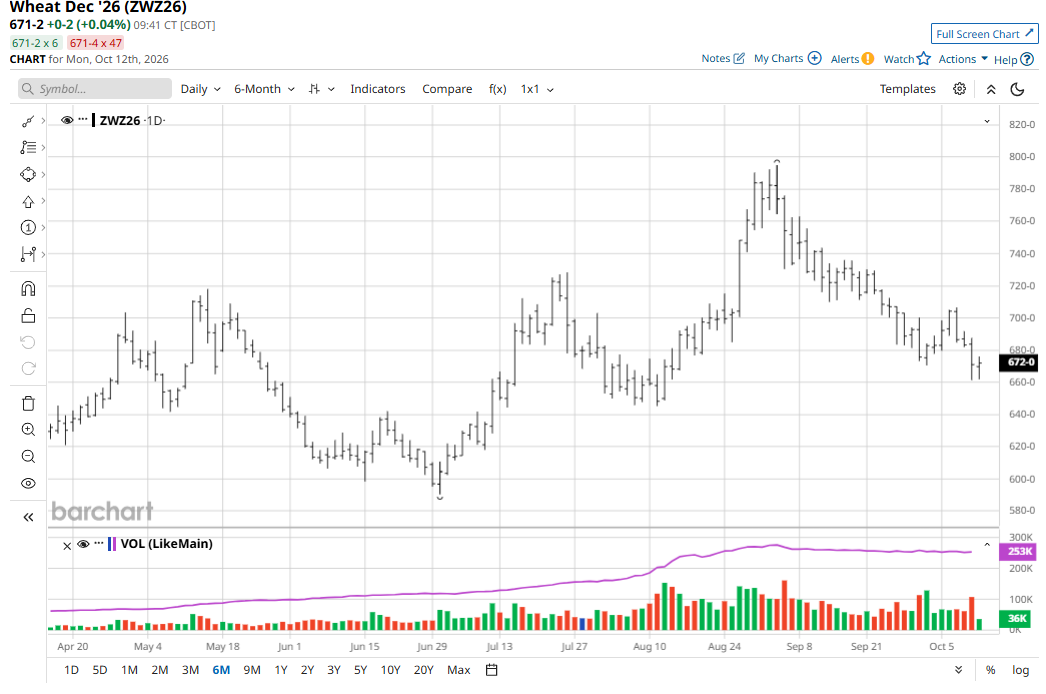
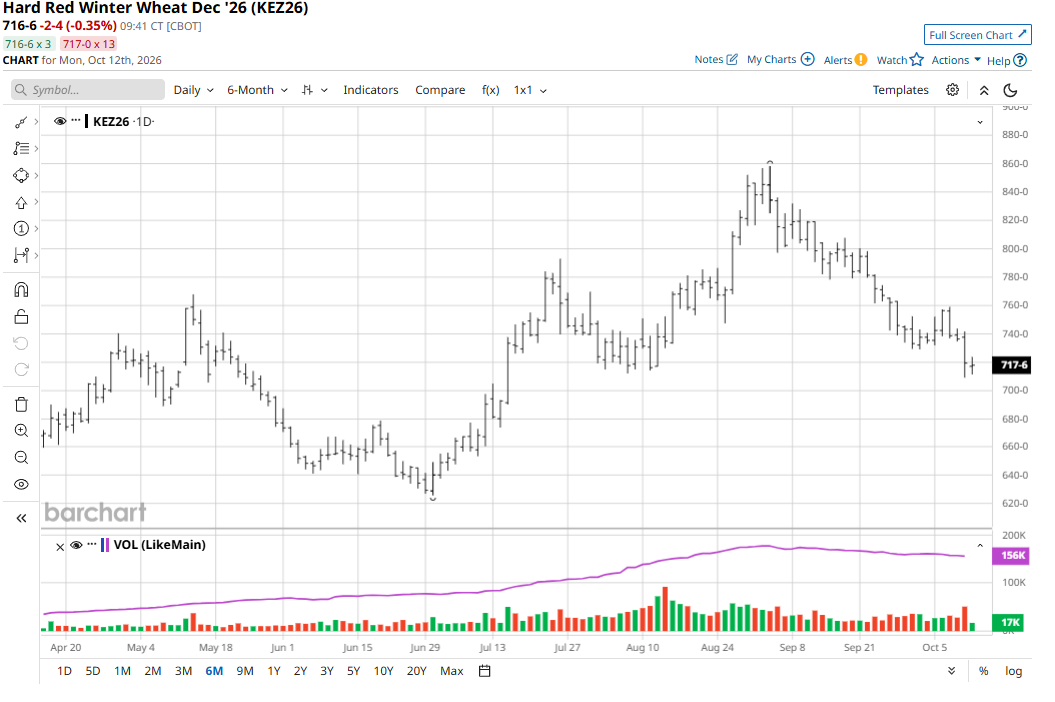
The latest USDA weekly wheat export sales numbers were up significantly, totaling 451,600 MT across all classes. That was up 56% from the week prior and the second highest this marketing year. For the winter wheat markets to be able to sustain price uptrends, continued better U.S. weekly export sales figures need to occur.
The firming U.S. dollar makes U.S. wheat less attractive, but given the major problem of getting grain crops from the Black Sea region to the world market, foreign buyers face limited options.
Let me know what you think. I enjoy hearing from my valued Barchart readers all around the globe. Email me at jim@jimwyckoff.com.
On the date of publication, Jim Wyckoff did not have (either directly or indirectly) positions in any of the securities mentioned in this article. All information and data in this article is solely for informational purposes. For more information please view the Barchart Disclosure Policy here.