


- W. R. Berkley is heading into its September 2026 quarter with analysts expecting higher revenue and a year over year earnings increase, supported by an Earnings ESP of 1.31% ahead of the 19 October results release.
- The focus on earnings quality matters because it ties directly into W. R. Berkley’s underwriting discipline and pricing decisions across specialty insurance lines and reinsurance exposure.
- This review considers how W. R. Berkley’s investment narrative is affected by expectations of an earnings beat on higher premium driven revenue.
Compare W. R. Berkley’s potential earnings surprise with a curated 31 resilient stocks with low risk scores that could help you spot other insurers and financials with relatively resilient profiles before their next reports reach the market.
W. R. Berkley Investment Narrative Recap
To own W. R. Berkley, you need to believe its specialty focus, underwriting discipline and reallocation away from weaker reinsurance pockets can keep combined ratios and returns acceptable even if premium growth slows. The near term catalyst is simple: the September 2026 earnings print either reinforces that underwriting story or raises questions around pricing and loss trends.
The biggest risk right now is that softer commercial pricing and heavier competition in property and reinsurance erode that underwriting buffer faster than management adjusts exposure. Expectations for a year over year earnings uptick do not materially change that risk reward equation; they simply put more attention on how sustainable current margins really are.
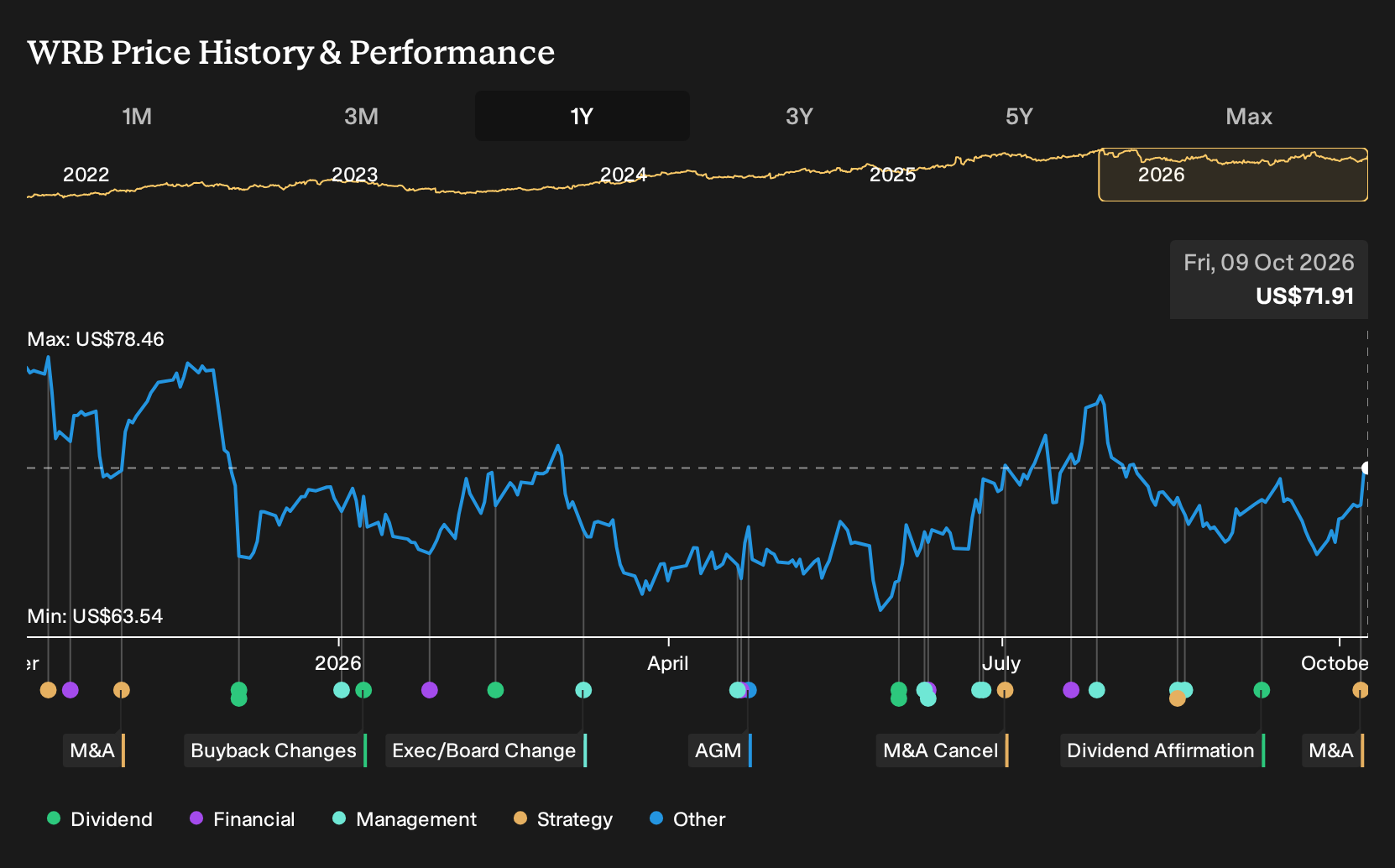
With no fresh corporate announcements around W. R. Berkley tied directly to this upcoming report, the most relevant reference point is still its recent pullback in treaty reinsurance with unattractive ceding commissions. That decision shows management is willing to sacrifice premium volume when terms look weaker. This is exactly what the current earnings debate revolves around.
For you as an investor, that retrenchment cuts both ways. It may support underwriting quality and loss experience, yet it also introduces the possibility that overall written premiums and future revenue settle below earlier expectations if Insurance segment opportunities do not fully offset the reinsurance step back. The October 19 numbers help you judge how that trade off is playing out.
W. R. Berkley's narrative projects US$13.9b revenue and US$1.9b earnings by 2029. This aligns with analysts assuming revenue will decrease 2.2% per year and earnings will remain around US$1.9b, with no material value change from current earnings.
Uncover why W. R. Berkley's fair value indicates a 3% potential downside to its current price, which leaves little room for error.
Exploring Other Perspectives
One alternate view on W. R. Berkley leans heavily on a more cautious revenue path. The lowest analysts were working off projections of about US$13.6b revenue and US$1.9b earnings by 2029. That is tied to a lower implied P/E of 12.9x. You can treat this as a more pessimistic pre-earnings script that may shift after the October 19 release.
Explore another W. R. Berkley fair value estimate, including one that suggests it could be worth just $69.41.
Reach Your Own Conclusion
Don't just follow the ticker; dig into the data and build a conviction that's truly your own.
- A great starting point for your W. R. Berkley research is our analysis highlighting 2 key rewards and 2 important warning signs that could impact your investment decision.
- See our latest analysis for W. R. Berkley. The report includes a comprehensive fundamental analysis summarized in a single visual, the Snowflake, making it easy to evaluate W. R. Berkley's overall financial health at a glance.
Looking For More Investment Ideas Beyond W. R. Berkley?
Once you have formed a view on W. R. Berkley, it often helps to compare that thesis with other companies that share similar qualities or offer a different mix of risk and income through the Simply Wall St Screener.
- If capital preservation is near the top of your list, consider reviewing a 31 resilient stocks with low risk scores that focuses on resilience when conditions turn tougher.
- For investors who prioritize income, check out a curated 8 dividend fortresses that targets companies aiming to combine higher yields with balance sheet support.
- If the goal is to find potential future leaders before they become widely followed, scan through a 20 high quality undiscovered gems that filters for quality fundamentals hiding in plain sight.
This article by Simply Wall St is general in nature. We provide commentary based on historical data and analyst forecasts only using an unbiased methodology and our articles are not intended to be financial advice. It does not constitute a recommendation to buy or sell any stock, and does not take account of your objectives, or your financial situation. We aim to bring you long-term focused analysis driven by fundamental data. Note that our analysis may not factor in the latest price-sensitive company announcements or qualitative material. Simply Wall St has no position in any stocks mentioned.
Have feedback on this article? Concerned about the content? Get in touch with us directly. Alternatively, email editorial-team@simplywallst.com